

If you’re missing one or more teeth, a dentist can close the space using a dental bridge. A dental bridge consists of a replacement tooth (pontic) that’s supported by the natural teeth adjacent to the gap.
While pontics can be fabricated from several materials such as gold, they are most commonly crafted from porcelain to match the appearance of your natural teeth. Continue reading to find out more.

Types of dental bridges
There are four primary categories of dental bridges:
- traditional
- cantilever
- Maryland
- implant-supported
Traditional dental bridge
A traditional bridge features one or more false teeth held in place by dental crowns cemented onto the abutment teeth on either side of the gap. This is the most commonly used bridge and works when you have natural teeth flanking the space left by the missing tooth.
Cantilever dental bridge
Resembling a traditional bridge, a cantilever bridge secures the pontic with a crown attached to only one abutment tooth. This option is suitable when there is a single natural tooth beside the missing-tooth space.
Maryland dental bridge
Like a traditional bridge, a Maryland bridge relies on two natural abutment teeth, one on each side of the gap. Instead of crowns, a Maryland bridge uses a metal or porcelain framework that is bonded to the back surfaces of the abutment teeth.
As with traditional bridges, a Maryland bridge requires a natural tooth on each side of the empty space caused by the missing tooth or teeth.
Implant-supported dental bridge
As the name suggests, implant-supported bridges are anchored to dental implants rather than crowns or frameworks. Typically, an implant is placed for each missing tooth and these implants support the bridge. If placing an implant for every missing tooth isn’t feasible, the bridge may suspend a pontic between two implant-supported crowns.
Regarded as the most robust and stable option, an implant-supported bridge usually involves two surgeries:
- one procedure to place the implants into the jawbone
- a second procedure to attach the bridge
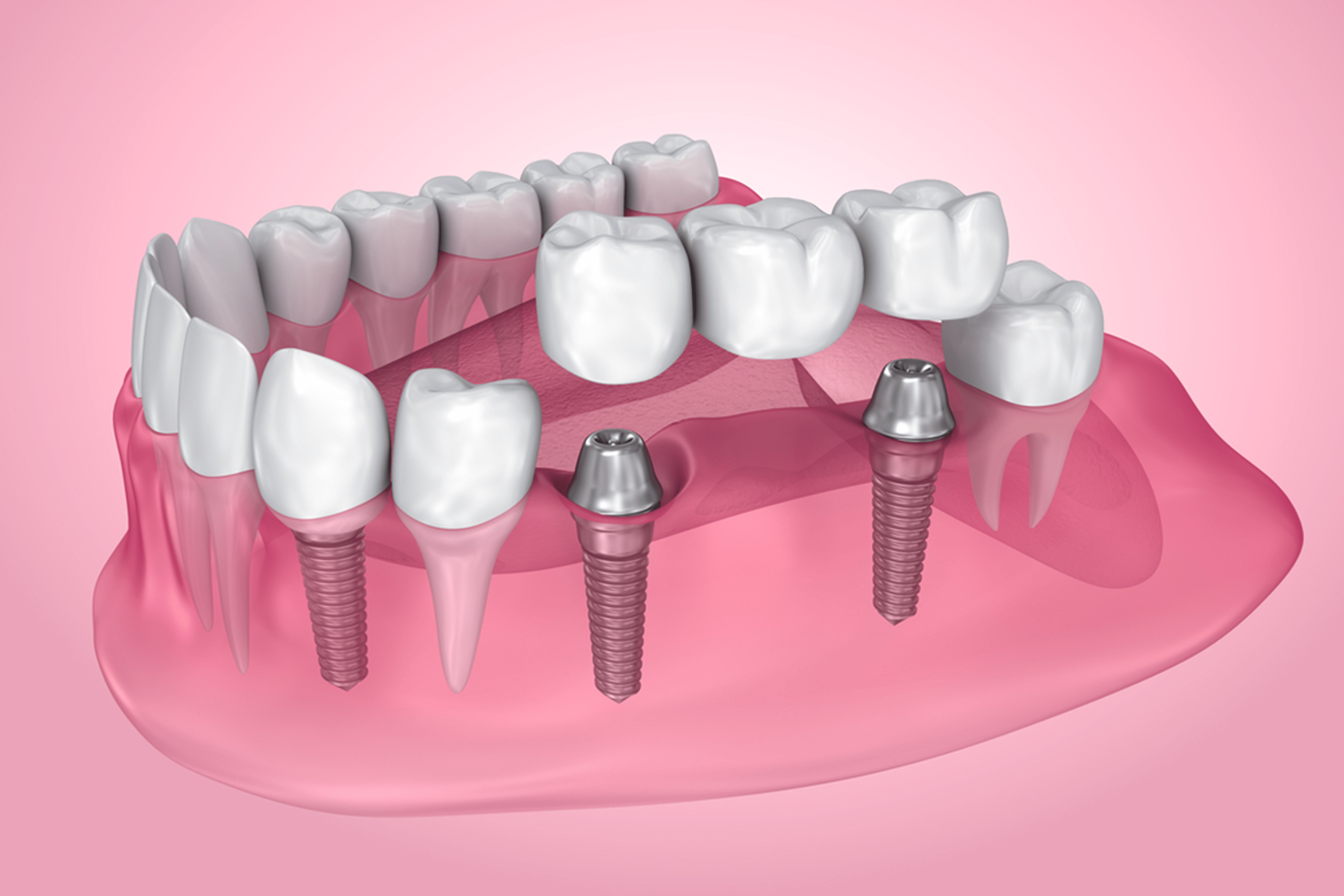
The entire process can take several months to complete.
How much does a dental bridge cost?
Numerous factors influence the price, including:
- how many teeth need replacing
- materials selected, such as composite resin, zirconia, or metal alloy with resin coating
- the complexity or difficulty of the placement
- additional treatments for other dental conditions, like gum disease
- your geographic area
Costs also vary by the type of bridge you choose:
- Traditional or cantilever bridges generally run $2,000 – $5,000 for one pontic plus crowns on each abutment tooth.
- Maryland bridges usually cost $1,500 – $2,500 for one pontic with the supporting framework (or wings) bonded to the abutment teeth.
- An implant-supported bridge may range from $5,000 – $15,000 for a bridge supported by two dental implants spanning three or four teeth.
Dental bridge vs. dental implant
Many dental insurance plans cover bridges, and an increasing number now include implants as well. Bridges often need replacement every 5 to 15 years depending on care, while implants are typically viewed as a permanent solution. Factors like oral hygiene can shorten the lifespan of any bridge or implant.
Why might you need a dental bridge?
Missing teeth can have several impacts, and a dental bridge can help address these issues, including:
- restoring your smile
- bringing back the ability to chew properly
- improving speech and pronunciation
- preserving the shape of your face
- rebalancing your bite to distribute chewing forces correctly
- preventing remaining teeth from shifting out of alignment
Outlook
If you’ve lost one or multiple teeth, discuss replacement choices with your dentist. Dental bridges offer many advantages, but you should weigh factors — including cost — before deciding which solution is best for you.






















Leave a Reply
You must be logged in to post a comment.