

In recent years, laser gum surgery has become increasingly common for managing moderate to advanced gum disease. The term laser stands for light amplification by stimulated emission of radiation.
Your dentist might suggest laser surgery as a follow-up to conventional scaling and root planing.
They may also propose laser gum surgery instead of traditional non-laser techniques, like flap surgery. Lasers are used for other dental treatments too, including gum reshaping to correct a gummy smile for cosmetic reasons. You can read more about related treatments like laser dentistry for additional context.
The Food and Drug Administration (FDA) has cleared lasers for use in the following dental areas:
- periodontal procedures
- endodontic procedures
- oral surgery
- tooth whitening
A limited amount of research suggests laser gum surgery is both safe and effective for a range of dental issues, including periodontal disease.
The American Dental Association has not formally endorsed lasers for gum disease treatment yet, though there is some evidence indicating they can be useful for various dental conditions.
The American Academy of Periodontology reviewed available studies and concluded that appropriate laser therapy may offer a modest advantage over standard treatments, while also noting that current data are limited and further studies are needed.
For these reasons, it’s crucial to choose a periodontist experienced in laser procedures if you decide to proceed.
How much does laser gum surgery cost?
The price of laser gum surgery for treating gum disease varies depending on several elements, such as the extent of treatment required and where you live.
If you have dental insurance, your plan will often cover part of the expense.
Some practices offer a complimentary consultation before scheduling the procedure. Initial visits typically include X-rays, which can range from about $50 to several hundred dollars.
If scaling and root planing are performed prior to laser treatment, costs may range from roughly $200 for a single quadrant to $1,500 or more for the whole mouth.
Laser gum surgery is sometimes carried out with a Nd:YAG laser following the LANAP (laser-assisted new attachment procedure) protocol. Staff at Advanced Dental Arts in New York report that LANAP prices typically fall between $1,000 and $2,650 per quadrant.
If the laser is used to correct a gummy smile, most insurers will not cover the cost because it’s considered cosmetic.
Costs for gummy smile laser surgery vary, but generally you might expect to pay in the ballpark of $675 to $875 per tooth.
How does laser gum surgery work?
Lasers are devices that emit concentrated beams of light energy to perform several functions during gum procedures. They can:
- excise and remove infected tissue
- seal blood vessels to encourage clotting
- eradicate bacteria
- sterilize the surgical site
Lasers operate by inducing an energy shift in atoms: the light moves atoms from a resting state into an excited state, prompting spontaneous emission of energy.
When atoms revert to their baseline state, they release photons — particles of light. This emitted energy enables actions such as cutting tissue without needing a blade.
Procedure for laser gum surgery
The LANAP technique is commonly used to address periodontal disease.
Typical steps for laser gum surgery include:
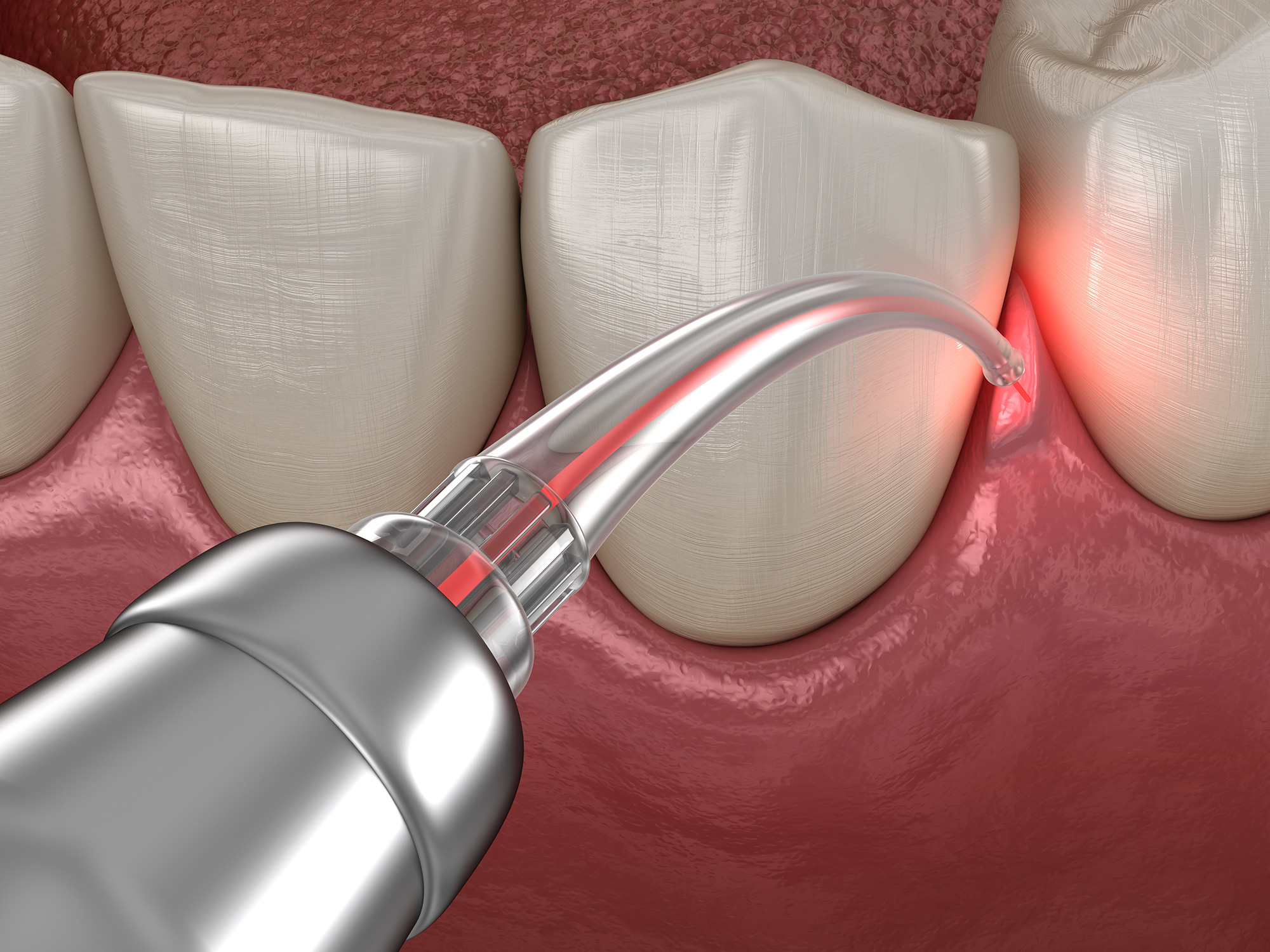
- Your periodontist will position the laser’s fiber-optic tip at the opening of the periodontal pocket. The tip is about the thickness of three human hairs.
- The laser uses a focused light beam to remove infected and inflamed gum tissue from the pocket. It is designed to eliminate diseased tissue while sparing healthy gums, and it also eradicates bacteria within the pocket.
- After cleaning out the damaged tissue and microbes, the laser is temporarily set aside.
- The clinician then employs an ultrasonic instrument to break up and extract tartar and calcified deposits using sound waves.
- The laser is brought back into the pocket to perform a deeper cleaning and remove remaining debris.
- The laser further sterilizes the tissue and bone and stimulates a blood clot, which promotes healing and helps the gum reattach to the tooth, often removing the need for sutures.
If the whole mouth is treated, you may require two appointments lasting 1 to 2 hours each.
A single quadrant typically requires 1 to 2 hours to complete.
Procedure for laser gummy smile surgery
A typical gummy smile correction with lasers may proceed as follows:
- If excess gum tissue is caused by inflammation or infection, the periodontist will first perform scaling and root planing.
- Next, a laser is used to sculpt and reshape the gum line. This can be performed by a periodontist or an orthodontist.
- During the operation, a soft-tissue laser removes surplus gum tissue.
- The laser simultaneously cauterizes the area, which reduces bleeding and postoperative discomfort.
- Your dental specialist may also use the laser to remodel the underlying jawbone if needed.
Targeted areas for treatment
Laser gum surgery can be applied to gum tissue in any quadrant of the mouth. The types of lasers used for these procedures are tailored for soft tissue treatments.
Laser techniques are also used on teeth and inside teeth, but those applications employ different lasers designed for hard tissue.
Are there any risks or side effects?
There are multiple laser types, and none are universally appropriate.
Lasers differ in wavelength and power. Using an unsuitable laser may harm gum tissue, so it’s essential to consult a clinician trained in laser therapy.
Other potential complications include:
- infection
- scarring
- permanent changes in tissue color
Because lasers sterilize the area, infections are uncommon. Still, contact your dental professional right away if you see any signs of infection, such as:
- swelling
- discharge
- worsening pain
- fever
What to expect after laser gum surgery
Many patients can return to normal activities the day after surgery, while others may need a few days to feel fully recovered.
Mild soreness that lasts several days is normal. Other transient side effects may include:
- minor bleeding
- some swelling
- temporary discoloration of the gums
Aftercare instructions often include:
Healing typically takes about a week. During this period your periodontist may advise you to:
- avoid brushing or flossing the treated area
- rinse gently and let water or mouthwash fall out rather than forceful spitting
- consume soft foods
- refrain from nicotine products like cigarettes
For the first one to two days, your periodontist may suggest rinsing every few hours with warm salt water to soothe the mouth. Dissolve 1/2 teaspoon of salt in 8 ounces of water. Ensure the solution is neither too hot nor too cold.
Laser therapy can reduce periodontal disease, but to maintain oral health and prevent infection you must keep up excellent hygiene habits, including:
- brushing and flossing daily
- visiting a dentist twice a year for preventive care and cleaning
Before and after pictures
Laser gum procedures help eliminate gum disease and remove tartar and bacteria, improving both the health and appearance of teeth.
Preparing for laser gum surgery
General anesthesia is not typically used for laser gum procedures; local anesthesia is sufficient, so fasting beforehand is unnecessary.
Wear comfortable, warm clothing, as treatment areas are often kept cool to help reduce bacterial growth.
Remove nose rings and tongue piercings.
If you have long hair, avoid a ponytail or bun since you will rest your head against the chair for an extended period and those styles may be uncomfortable.
The bottom line
Laser gum surgery is an option for dental treatments like managing gum disease and reshaping gums to correct a gummy smile.
Because lasers remove tissue without a scalpel, they often eliminate the need for stitches and reduce postoperative bleeding. When used to treat gum disease, insurance coverage is often available.


















Leave a Reply
You must be logged in to post a comment.