

If you want robust abs, you must train all parts of your core.
Although many people know the rectus abdominis — the familiar “six-pack” — the deeper abdominal layer called the transversus abdominis is often overlooked or unknown to many.
Working this muscle is essential for solid core strength, reducing back discomfort, and making everyday tasks easier.
Despite its importance, many abdominal routines emphasize the other abdominal muscles and don’t adequately activate the transversus abdominis. Therefore, learning movements that specifically target and strengthen this muscle helps develop balanced core strength.
This piece explores the anatomy and role of the transversus abdominis, outlines its advantages, and presents 5 effective exercises to engage it.
What is the transversus abdominis?
The transversus abdominis, often called the transverse abdominis, is the deepest abdominal layer. It lies beneath the internal and external obliques and the rectus abdominis, extending from the lower ribs (costal cartilages of ribs 7–12) down to the pelvis (1, 2, 3, 4).
As the name implies, its fibers run transversely (horizontally) around the belly, functioning much like a corset. In fact, the transversus abdominis is often referred to as the body’s natural “corset” (1, 2, 3, 4).
It’s unique among the abdominal muscles because its fibers run side to side rather than vertically or diagonally.
The transversus abdominis plays an important part in everyday motions by protecting and stabilizing the spine. From walking across a room to hitting a volleyball, this muscle is engaged (1, 2, 3).
It also helps preserve normal tension of the abdominal wall and raise intra-abdominal pressure, supporting internal organs and assisting expulsive actions such as forced exhalation, late-stage childbirth, urination, and defecation (1, 2, 3).
Given its involvement in so many movements, a well-developed transversus abdominis can help shield your spine and adjacent muscles from injury.
Summary: The transversus abdominis, known as the “corset” muscle, is a deep abdominal muscle that encircles your midsection and is key to spinal protection and stability.
Benefits of strengthening the transversus abdominis
Building strength in your transversus abdominis offers several advantages.
Marcy Crouch, PT, DPT, WCS, a physical therapist focused on pelvic floor issues and founder of the DT method, highlights multiple benefits of reinforcing the transversus abdominis.
“It’s a primary stabilizer of the core, so when the transversus abdominis is strong and functioning well, it helps maintain spinal support. It’s also been shown to reduce back pain, improve pelvic floor performance, and assist posture.”
May reduce lower back pain
A solid core makes daily tasks and workouts safer and less strenuous. It also supplies dynamic stabilization — stabilization that occurs during movement — for the lumbar spine.
Muscles involved in lower spine stabilization include the transversus abdominis, multifidus, pelvic floor muscles, rectus abdominis, and the internal and external obliques (3).
Specifically, learning to properly activate the transversus abdominis produces a co-contraction with the multifidus in the back during movement, which can help alleviate back pain by better supporting the spine (3, 5, 6, 7).
This effect has been demonstrated in several trials involving exercise programs that target the transversus abdominis alongside other core muscles (8, 9, 10, 11).
However, some scientists caution that while core strengthening can help certain people with low back pain, it shouldn’t be viewed as a one-size-fits-all remedy, and more high-quality research is required (12, 13).
Also, core training may not suit everyone, such as pregnant individuals or those with chronic back conditions or hernias. Always consult your healthcare professional before beginning a new exercise program.
Lower risk of injury
A strong core, including a well-developed transversus abdominis, can help protect your back during heavy compound lifts like deadlifts and squats (14).
Additionally, learning to brace your core when lifting (for example, picking up a heavy box) stabilizes the spine and prevents potentially injurious movements (14).
May make your waist look smaller
Because it acts like a corset, strengthening the transversus abdominis may help your waist appear narrower.
This muscle encircles the abdomen and can create a “cinching” effect.
Although research is limited on this topic, many anecdotal reports — particularly from bodybuilding and physique communities — report benefits from training the transversus abdominis.
That said, the transversus abdominis lies beneath the rectus abdominis and isn’t responsible for the visible “six-pack.” Visible abs are mainly a result of low body fat, which may not be healthy or realistic for everyone.
Summary: Reinforcing the transversus abdominis is key to core strength. It may ease back pain, reduce injury risk, and in some cases help the waist look slimmer.
How to engage the transversus abdominis
Learning to activate the transversus abdominis requires practice but will greatly improve your core training.
“There are a few schools of thought on this,” says Crouch. “My cue is to exhale, draw in the lower belly, engage the pelvic floor, and sense the lower abs becoming firm and contracted.”
“You can feel the transversus abdominis contract under your fingers if you place them just inside the top of your hip bones.”
Crouch warns against overusing the “navel to spine” cue. “That cue can be helpful, but the transversus abdominis also needs to coordinate with the breath, the pelvic floor, and other core muscles.”
She adds, “It’s not a ‘sucking in’ motion — many people try to do it that way, but that’s not the correct action.”
Because it’s a deep muscle, the transversus abdominis is harder to feel and contract than superficial abdominal muscles, so practice is necessary to engage it correctly.
To get acquainted with the transversus abdominis, practice the abdominal drawing-in maneuver (ADIM), sometimes called “stomach vacuuming” or “stomach hollowing” (2, 3, 5):
- Lie on the floor with knees bent and feet flat.
- Place two fingers on the top of your hip bones, then move them about 1 inch (2.54 cm) inward and 1 inch (2.54 cm) down.
- Inhale deeply and slowly exhale through your mouth. As you breathe out, draw in your lower belly and engage the pelvic floor. You should feel the transversus abdominis contract beneath your fingers.
- Breathe normally while holding your belly in. Aim to hold for at least 10 seconds.
As you improve, gradually extend the hold time. This drill helps you learn to engage your core while performing other movements.
Summary: To activate the transversus abdominis, focus on drawing in the lower abdomen while coordinating breath and pelvic floor engagement.
Exercises to strengthen your transversus abdominis
Although isolating the transversus abdominis is difficult, many movements encourage its activation along with other abdominal muscles to build a resilient core (3, 15).
“It’s an important muscle and should be included in comprehensive core work,” says Crouch.
“The transversus abdominis acts like a corset: when it contracts it pulls inward rather than flexing the trunk forward like a crunch.”
Movements that recruit the transversus abdominis are primarily stabilization-focused, requiring you to hold positions for time and sometimes move the limbs slowly and with control (11, 16).
Once you’ve mastered the abdominal draw-in, try these exercises to strengthen the transversus abdominis.
1. Hollow body hold
The hollow body hold is an excellent test of core control and targets the transversus abdominis.
- Lie on the floor with your arms extended overhead and legs together on the mat.
- With your core engaged and legs together, point your toes and lift your legs about 12–18 inches (30–46 cm) off the floor.
- Slowly lift your shoulders off the floor so only your lower back and hips remain in contact with the ground. Keep your neck neutral and chin slightly tucked to avoid strain.
- Hold for 15–30 seconds, or as long as you can keep correct form and core engagement.
Tip: Your body should resemble a banana shape when performed correctly.
2. Dead bug
The dead bug is an effective core-stability move, particularly helpful if you struggle with balance.
- Lie on your back with arms reaching toward the ceiling and knees bent in a tabletop position (knees at 90 degrees, shins parallel to the floor).
- With your core braced, extend your left leg (toes pointed) and lower your right arm behind your head, keeping them about 6 inches (15 cm) from the floor without touching it.
- Return to the starting position and alternate sides.
- Repeat for 30–60 seconds, or as long as you can maintain good form.
3. Toe taps
Toe taps, a classic Pilates move, targets the deep core.
- Lie on your back with arms by your sides and knees bent in tabletop position (knees at 90 degrees, shins parallel to the floor).
- Keeping the knee bent, exhale and lower your left toes to tap the ground. Keep your core engaged and spine stable; avoid arching your back as the foot lowers.
- Inhale and return the left leg to the start.
- Repeat on the right.
- Alternate sides for 30–60 seconds.
4. Bird-dog
The transversus abdominis engages when you move limbs while maintaining balance. The bird-dog requires lifting opposite arm and leg while preserving stability, engaging the deep core.
- Begin on all fours with knees under hips and shoulders over hands. Keep your spine flat and neck neutral.
- Extend your left arm forward and your right leg back while keeping the other arm and leg planted for support.
- Hold for 2–3 seconds, keeping your core engaged, then switch sides.
- Repeat 8–12 times.
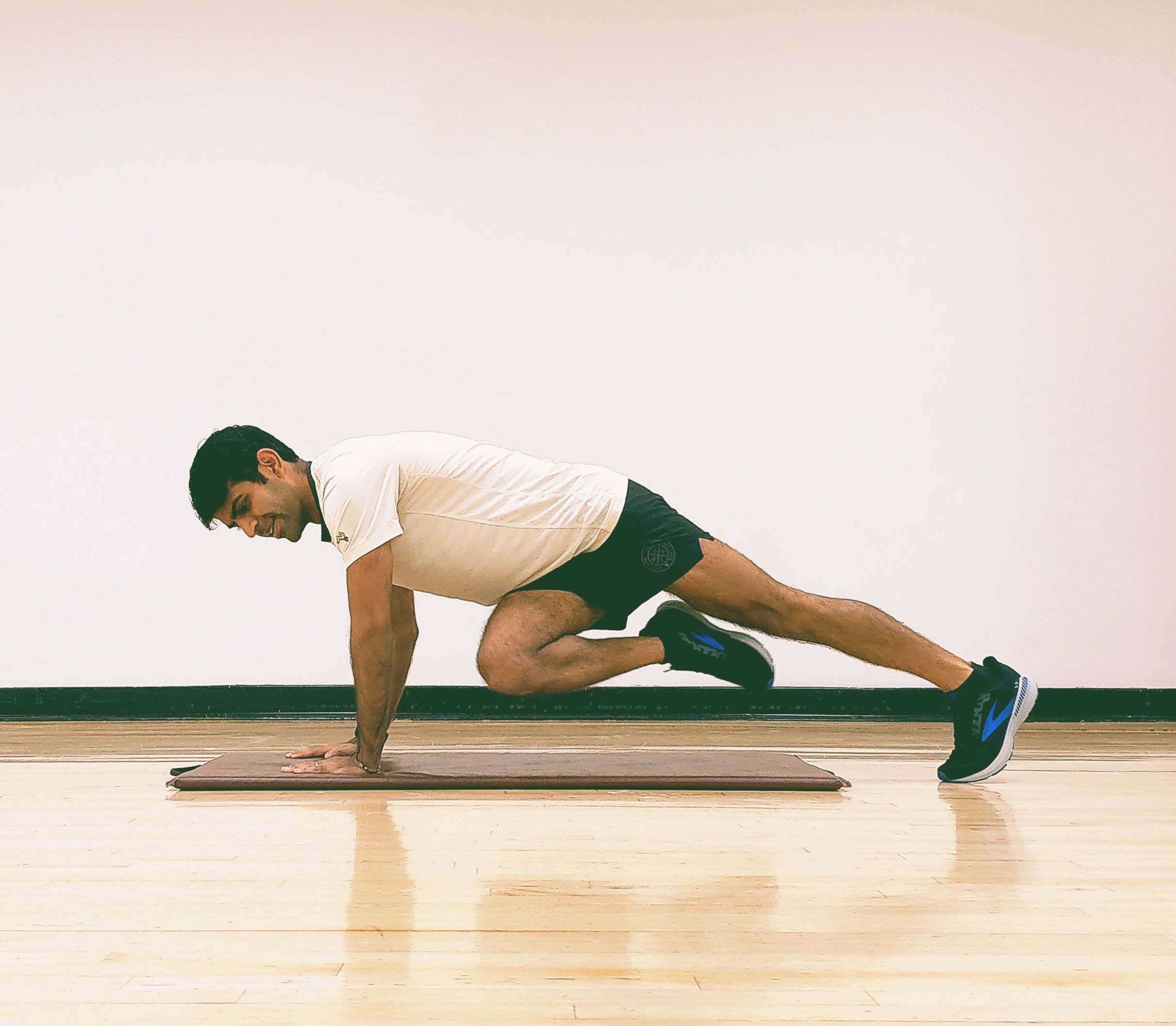
5. Plank
The plank is a staple for full-spectrum core strength. During this move, concentrate on pulling your abdominals inward.
- Start in a push-up position with elbows and forearms under your shoulders and palms down.
- Press your hands into the ground and lift your torso. Your body should resemble the top of a push-up position. Ensure shoulders align over hands, legs are straight, feet hip-width apart, and core engaged.
- Hold as long as you can while preserving proper form and core tension.
Summary: Movements that target the transversus abdominis are primarily stabilization exercises rather than repetitive crunching.
The bottom line
Operating like a corset, the transversus abdominis wraps around the midsection and is vital for spinal protection and stability.
Strengthening this muscle can help lessen lower back pain, reduce injury risk, and may even contribute to a slimmer waistline.
When practicing exercises aimed at the transversus abdominis, focus on drawing in the lower belly and coordinating your breath. With practice, engaging this muscle will become more natural.
So next time you’re told to brace your core, remember to include the transversus abdominis in your engagement.






















Leave a Reply
You must be logged in to post a comment.