

Having a nasal-sounding voice can alter how you speak. It may stem from obstructions or structural issues in the nose, throat, or mouth. In some cases, a nasal tone is simply a natural and distinctive aspect of your voice.
Everyone’s voice has its own subtle characteristics. A person with a nasal voice may sound as though they’re speaking through a congested or runny nose, both of which can be underlying causes.
Your speaking voice forms when air exits your lungs and travels upward across your vocal cords and through your throat into your mouth. The resulting timbre is known as resonance.
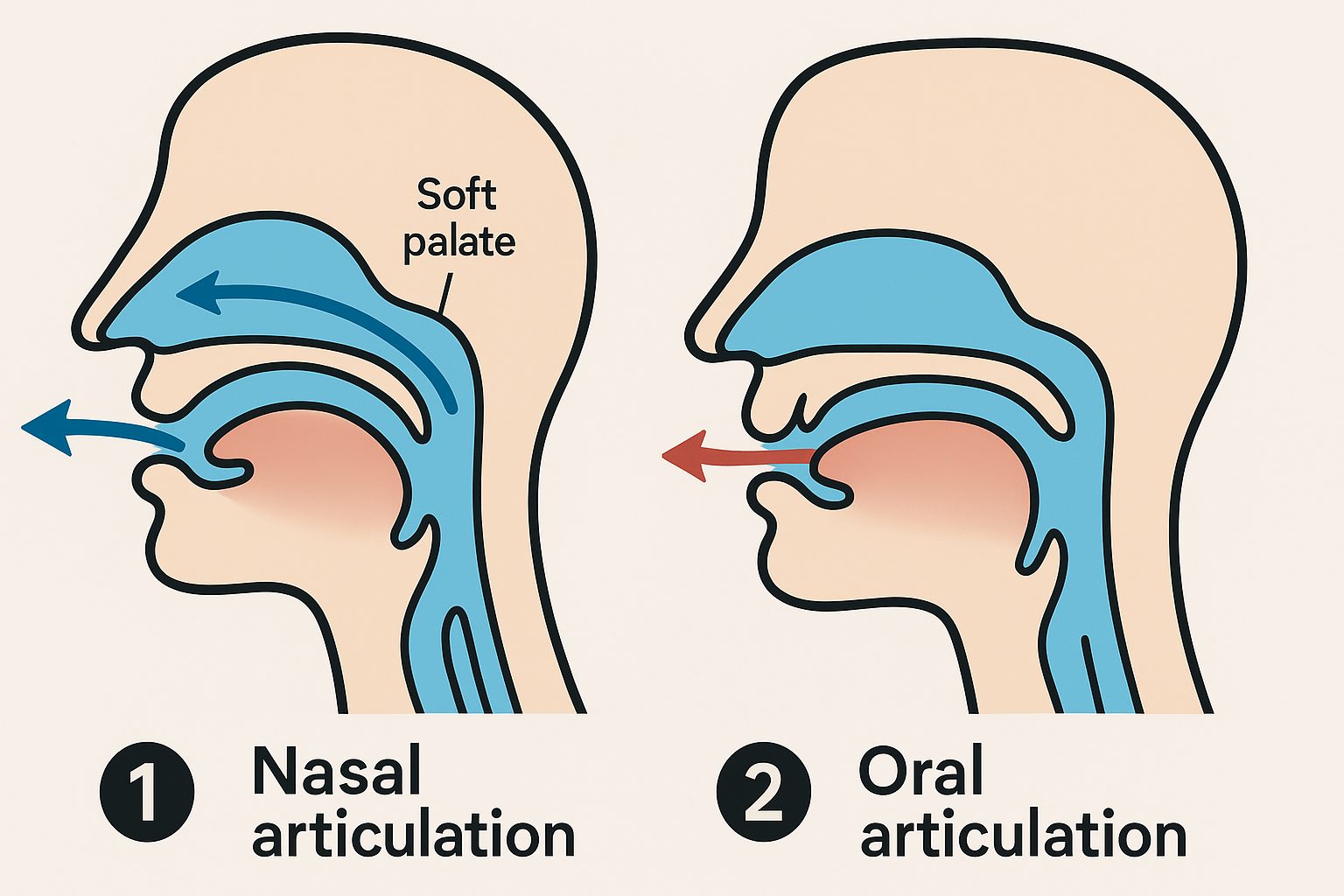
While speaking, the soft palate at the roof of your mouth elevates until it contacts the back of the throat. This creates a seal that regulates how much air passes through the nose depending on the sounds you make.
The soft palate together with the side and rear walls of the throat form a passage called the velopharyngeal valve. If this valve doesn’t operate correctly, speech can be altered.
There are two main types of nasal-sounding voices:
- Hyponasal. This occurs when too little air flows through the nose during speech. The result is a voice that lacks sufficient resonance.
- Hypernasal. This occurs when excess air escapes through the nose while speaking. The sound then has too much nasal resonance.
If you suspect your voice has a nasal quality that needs evaluation, especially if it’s a new change, see an ear, nose, and throat (ENT) specialist. Many causes of a nasal voice are highly treatable.
What does a nasal voice sound like?
A hyponasal voice can sound muffled, as if your nose is blocked. It resembles the sound you get when you pinch your nose while talking.
You might also notice these signs with a hyponasal voice:
- stuffy or runny nose
- difficulty breathing through the nose
- nasal discharge
- sore throat
- cough
- loss of smell and taste
- facial pain around the eyes, cheeks, or forehead
- headache
- snoring
- foul breath
A hypernasal voice sounds like speaking through the nose, with an audible leakage of air.
You might notice these symptoms along with a hypernasal voice:
- difficulty producing consonants that need high air pressure, such as p, t, and k
- air escaping through the nose when saying clusters like s, ch, and sh
What causes a nasal voice?
Several factors shape your voice quality, including the dimensions and contours of your mouth, nose, and throat, and how air moves through these areas.
Hyponasal speech usually results from a blockage in the nasal passages. That blockage can be temporary — for instance from a cold, sinus infection, or allergies.
Or it can be due to a more lasting structural issue, such as:
- enlarged tonsils or adenoids
- a deviated septum
- nasal polyps
The primary cause of a hypernasal voice is dysfunction of the velopharyngeal valve, known as velopharyngeal dysfunction (VPD).
There are three forms of VPD:
- Velopharyngeal insufficiency stems from a structural issue like an unusually short soft palate.
- Velopharyngeal incompetence occurs when the valve fails to close properly due to a movement disorder.
- Velopharyngeal mislearning happens when a child doesn’t learn to control airflow through the throat and mouth correctly.
These conditions are also referred to as resonance disorders.
Factors that can lead to VPD include:
- Adenoid surgery. Removing the glands behind the nose can create a larger space at the back of the throat, allowing air to escape into the nose. This is usually temporary and tends to improve within weeks after surgery.
- Cleft palate. This congenital defect occurs when the mouth doesn’t form properly during pregnancy. Repair surgery is commonly performed by around 1 year of age. Still, about 20 percent of children with a cleft palate continue to experience VPD after surgery.
- A short palate. This leaves excessive distance between the palate and the throat, permitting air to escape.
- DiGeorge syndrome. This chromosomal disorder affects development of several body systems, notably the head and neck, and can cause cleft palate and related anomalies.
- Brain injury or neurological disease. Traumatic brain injury or conditions such as cerebral palsy can impair movement of the soft palate.
- Mislearning. Some children never acquire correct ways to produce speech sounds.
How is a nasal voice treated?
Treatment depends on what’s causing the nasal quality in your voice.
Medications
Decongestants, antihistamines, and steroid nasal sprays can reduce swelling and ease nasal congestion from allergies, sinusitis, polyps, or a deviated septum. Antibiotics may be used for a bacterial sinus infection that hasn’t improved.
Surgery
Many structural issues behind a nasal voice can be corrected surgically:
- removal of tonsils or adenoids
- septoplasty to correct a deviated septum
- endoscopic procedures to excise nasal polyps
- Furlow palatoplasty and sphincter pharyngoplasty to lengthen a short soft palate
- reconstructive surgery for cleft palate in infants at about 12 months of age
Speech therapy
Speech therapy can be used before or after surgery, or as a standalone approach. A speech-language pathologist will assess your speech to determine the most suitable treatment plan.
Therapy teaches adjustments to lip, tongue, and jaw movements to produce sounds accurately. You’ll also learn strategies to better control the velopharyngeal valve.
Speech exercises to try at home
Your speech therapist will recommend exercises to practice at home. Consistent repetition is important. Contrary to some popular suggestions, blowing and sucking exercises do not help keep the velopharyngeal valve closed.
A more effective strategy is to practice speaking as directed by your therapist. Talk, sing, and vocalize regularly to help alter your voice quality if that’s your goal.
The takeaway
If a medical issue is creating a nasal voice, there are numerous treatment options.
Structural problems such as polyps or a deviated septum can often be corrected surgically. Speech-language therapy can help you manage airflow through your mouth and nose so you speak more clearly and confidently.
That said, every voice is individual. If your voice has a nasal character but you don’t have any of the medical causes mentioned, consider accepting it as part of who you are. We tend to be more critical of our own voices than others are; people may not notice it or may even find it a distinctive and positive trait.























Leave a Reply
You must be logged in to post a comment.