

Found in everything from cosmetics to ice cream, xanthan gum — produced by fermenting corn sugar with a bacterium — is a widely used additive that functions as a thickener, binder, and emulsifier (1).
Whereas a thickener simply increases viscosity, a binder keeps ingredients together and an emulsifier mixes components that would otherwise separate, such as oil and vinegar. This is why xanthan gum is commonly used in salad dressings (2).
It’s also a staple in baking — particularly for gluten-free recipes, which lack gluten’s natural binding properties.
Still, many bakers might not have it available.
Whether you’re caught short or prefer to omit it, here are 9 replacements for xanthan gum.
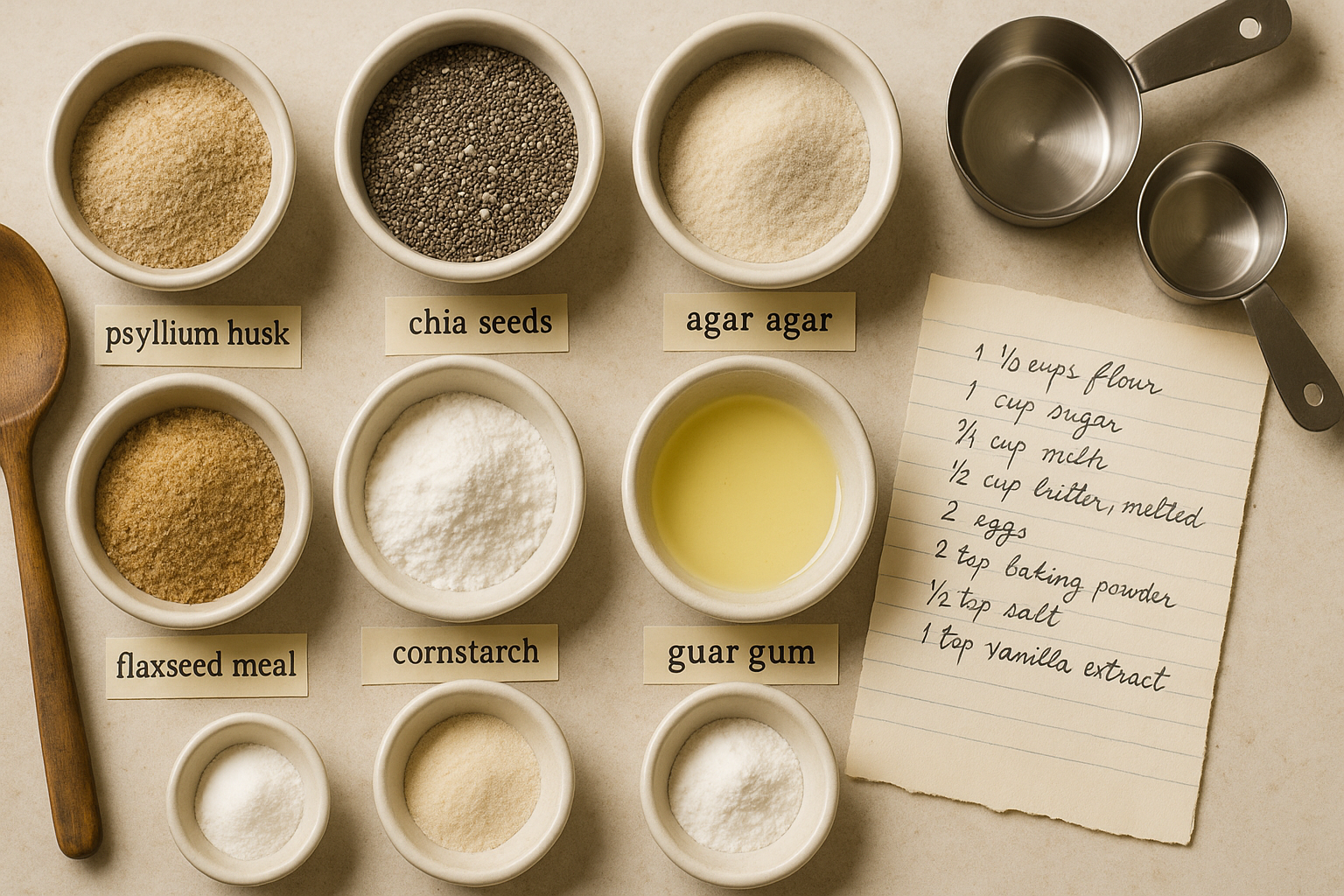
1. Psyllium husk
Psyllium husk comes from the outer coating of Plantago ovata seeds and is sold ground for baking. It may help lower blood glucose, acting similarly to xanthan gum in the digestive tract — making it an excellent alternative.
While very large intakes of xanthan gum have been associated with digestive and respiratory concerns, several small trials suggest that substantial amounts may reduce blood sugar (3, 4, 5, 6, 7, 8).
Although further studies are required, this effect may arise because both xanthan gum and psyllium husk are soluble fibers that your body cannot digest. They form a gel-like matrix that slows nutrient absorption (8, 9, 10).
For baking, use 2 parts psyllium husk for every 1 part xanthan gum.
Summary: Like xanthan gum, psyllium husk is a soluble fiber that forms a gel in the gut. In recipes that call for xanthan gum, use twice the amount of psyllium husk.
2. Chia seeds and water
Soaked chia seeds create a gel similar to xanthan gum. Additionally, they’re high in fiber and several beneficial nutrients.
You can use whole chia seeds, but they impart a slight crunch and mild nutty flavor — so grind them if you want a smoother result.
Chia seeds can be substituted for xanthan gum in a 1:1 ratio.
Combine 1 part chia seeds with 2 parts hot water, stirring until the mixture thickens.
You may need to extend baking time by 10–15 minutes when using chia gel.
Summary: Chia seeds gel when mixed with liquid and can thicken and bind baked items. Use the same amount as xanthan gum and mix with water.
3. Ground flax seeds and water
Like chia, flax seeds form a viscous paste when combined with water. They’re affordable and widely available.
Whole flax seeds don’t bind well, so grind them yourself or buy flax meal. Mixing ground flax with water activates its binding qualities.
Keep in mind ground flax can give a nuttier, slightly coarse texture.
Substitute ground flax for xanthan gum 1:1, mixing 1 part flax with 2 parts hot water.
Summary: Ground flax seeds replace xanthan gum at a 1:1 ratio but must be mixed with hot water first.
4. Cornstarch
Cornstarch has a mouthfeel similar to xanthan gum and is highly absorbent, making it a preferred thickener for sauces, stews, and gravies.
Although naturally gluten-free, some cornstarch products can be contaminated with gluten, so check labels if you need a certified gluten-free product.
Unlike other options, cornstarch doesn’t require pre-mixing with water.
Use cornstarch in the same amount as xanthan gum.
Summary: Cornstarch is an effective thickener widely used in savory dishes. Swap it for xanthan gum at a 1:1 ratio.
5. Unflavored gelatin
Gelatin firms up recipes because it’s derived from animal collagen, a protein that forms a jelly-like network in connective tissues (11).
Use 2 parts gelatin for every 1 part xanthan gum.
It works well in baked items like breads and muffins.
However, gelatin is not suitable for vegans or vegetarians. As most gelatin originates from pig skin, it also isn’t appropriate for kosher or halal diets.
Summary: Gelatin thickens many dishes but isn’t suitable for vegans, vegetarians, or those following kosher or halal dietary rules.
6. Egg whites
Egg whites provide both leavening and binding, helping baked goods rise and set, which makes them a practical xanthan gum substitute.
They’re particularly good for quick breads, batter breads, and cakes. Because they yield a light, airy crumb, they’re less suitable for yeasted, kneaded breads.
Egg whites are an animal product and thus not vegan-friendly.
Replace each tablespoon (4.5 grams) of xanthan gum with one egg white.
Summary: Egg whites create a fluffy texture and act as both a binder and leavening agent. Use one egg white per tablespoon (4.5 g) of xanthan gum.
7. Agar agar
Agar agar, derived from red algae, behaves similarly to unflavored gelatin, thickening and producing a jelly-like consistency (12).
Because it’s plant-based, agar agar is a good vegan alternative to gelatin. It’s available as flakes, sheets, or powder.
Swap xanthan gum with agar agar at a 1:1 ratio.
Dissolve it in room-temperature water first: use 4 tablespoons (60 mL) of water per tablespoon (5 g) of flakes or per teaspoon (2 g) of powder.
Heat gently for 3–5 minutes until it dissolves, then cool slightly before using. If the mixture becomes too firm, an immersion blender will help smooth it out.
Note that agar agar can yield a somewhat firmer, denser texture.
Summary: Agar agar is an algae-based thickener that works like a vegan gelatin. It requires a bit of prep but can replace xanthan gum 1:1.
8. Guar gum
Guar gum (guaran) is extracted from guar beans. Like xanthan gum, it’s a white powder used as a binder and thickener (13).
Use 3 parts guar gum for every 2 parts xanthan gum called for in a recipe.
A helpful approach is to blend guar gum with fats in the recipe first, then add this blend into the liquid components.
Summary: Guar gum functions as a binding and thickening agent and replaces xanthan gum in a 3:2 ratio.
9. Konjac powder
Konjac powder (glucomannan) is made from the konjac root and is commonly used in Asian cuisine (14).
Its high fiber content thickens preparations similarly to xanthan gum.
Replace xanthan gum with konjac powder at a 1:1 ratio. For chewier items like tortillas or flatbreads, you may want to use about 1.5 times the typical amount.
Summary: For most baked goods, substitute konjac powder in equal measure to xanthan gum. For chewier products, increase the amount to about 1.5 times.
The bottom line
Xanthan gum is widely used in products from cosmetics to foods because it’s an effective thickener and emulsifier.
If it’s unavailable or you’d rather avoid it, many alternatives exist.
Consider dietary preferences and the texture you want in your baked goods when choosing a replacement.


















Leave a Reply
You must be logged in to post a comment.