
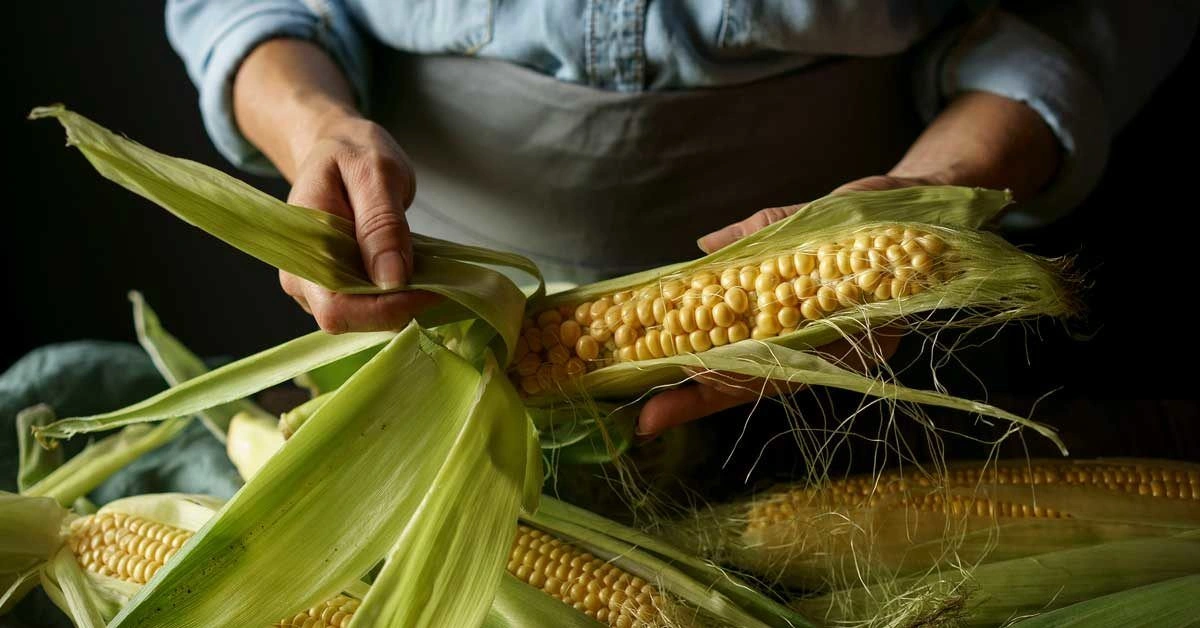
Corn flour and cornstarch both originate from corn, but that doesn’t mean they’re interchangeable in cooking and baking.
While both are derived from corn, cornstarch and corn flour differ in nutrient content, taste, and culinary uses.
In the United States, corn flour denotes a finely milled powder made from whole corn kernels. Cornstarch, however, is also a fine powder but is produced only from the starchy portion of the kernel.
Because they are processed differently and contain different nutrients, their applications in the kitchen vary. Additionally, terminology can differ by region.
This article explains the distinctions between cornstarch and corn flour and how each is best used.

Processing
Both cornstarch and corn flour come from corn.
Corn flour is produced by grinding whole corn kernels into a fine powder. As a result, it retains protein, fiber, starch, and the vitamins and minerals present in whole corn. It’s generally yellow (1).
Cornstarch is more refined: the protein and fiber are removed from the kernel, leaving only the starchy center called the endosperm, which is processed into a white powder (1).
Below is a comparison of the nutrient values for 1/4 cup (29 grams) of cornstarch and corn flour (2, 3):
| Cornstarch | Corn flour | |
| Calories | 120 | 110 |
| Protein | 0 grams | 3 grams |
| Fat | 0 grams | 1.5 grams |
| Carbs | 28 grams | 22 grams |
| Fiber | 0 grams | 2 grams |
Besides offering more fiber and protein, corn flour contains B vitamins, iron, potassium, magnesium, and other micronutrients (1).
Cornstarch, by contrast, lacks B vitamins and has much lower levels of other nutrients compared with corn flour.
Summary: Corn flour is produced by finely milling whole corn kernels, whereas cornstarch comes from only the starchy portion. Consequently, corn flour provides protein, fiber, vitamins, and minerals, while cornstarch is largely carbohydrate.
Flavor differences
Like whole corn, corn flour has an earthy, sweet flavor.
It can be used in addition to or as a substitute for wheat flour in breads, pancakes, waffles, and pastries to impart a corn-like flavor.
Corn flour is sometimes mistaken for cornmeal, which in the U.S. refers to a more coarsely ground product also made from corn kernels. Cornmeal tends to have a stronger corn flavor than corn flour.
Cornstarch, on the other hand, is essentially neutral in taste and contributes texture rather than flavor. It’s a bland powder mainly used to thicken foods.
Summary: Corn flour carries an earthy, sweet taste similar to whole corn, whereas cornstarch is virtually flavorless.
Confusing naming practices
In the United Kingdom, Israel, Ireland, and several other countries, cornstarch is commonly called corn flour (4).
Meanwhile, what Americans call corn flour may be labeled as cornmeal in those regions.
As a result, recipes from outside the U.S. may request corn flour when they mean cornstarch, or cornmeal when they intend corn flour.
If you’re uncertain which ingredient a recipe requires, try to determine the recipe’s geographic origin.
Alternatively, look at how the corn product is used: if it’s applied like wheat flour, corn flour is likely intended.
If the ingredient’s role is to thicken a sauce or soup, cornstarch is the probable choice.
Summary: Outside the U.S., including in the U.K., Israel, and Ireland, cornstarch is often labeled corn flour and corn flour may be called cornmeal. When in doubt, infer the intended ingredient from the recipe’s use or origin.
Not interchangeable in recipes
Because their nutritional makeups and properties differ, cornstarch and corn flour aren’t interchangeable in recipes.
Corn flour can be used to prepare breads, pancakes, biscuits, waffles, and pastries, either alongside or as an alternative to wheat flour. It imparts a distinct corn flavor and a yellow hue.
However, corn flour lacks gluten — the main protein in wheat that provides elasticity and structure to breads — so baked goods may turn out denser and more crumbly.
Cornstarch’s primary use is to thicken soups, stews, sauces, and gravies. To prevent lumps, it should be dissolved in a cold liquid before being added to hot mixtures.
Because cornstarch is mostly starch and contains no protein or fat, it can’t replace corn flour in baking applications.
Cornstarch is also used in batters and breading to help create a crisp exterior and is often mixed into confectioners’ sugar to keep it free-flowing.
Summary: Corn flour is suitable for making breads and pastries, while cornstarch is used chiefly as a thickener.
The bottom line
Corn flour is a yellow powder made from finely milled whole dried corn, whereas cornstarch is a fine white powder derived from the starchy portion of the kernel.
Names for these products vary by location.
Corn flour functions similarly to other flours in baking, while cornstarch is primarily employed to thicken liquids.



















Leave a Reply
You must be logged in to post a comment.