

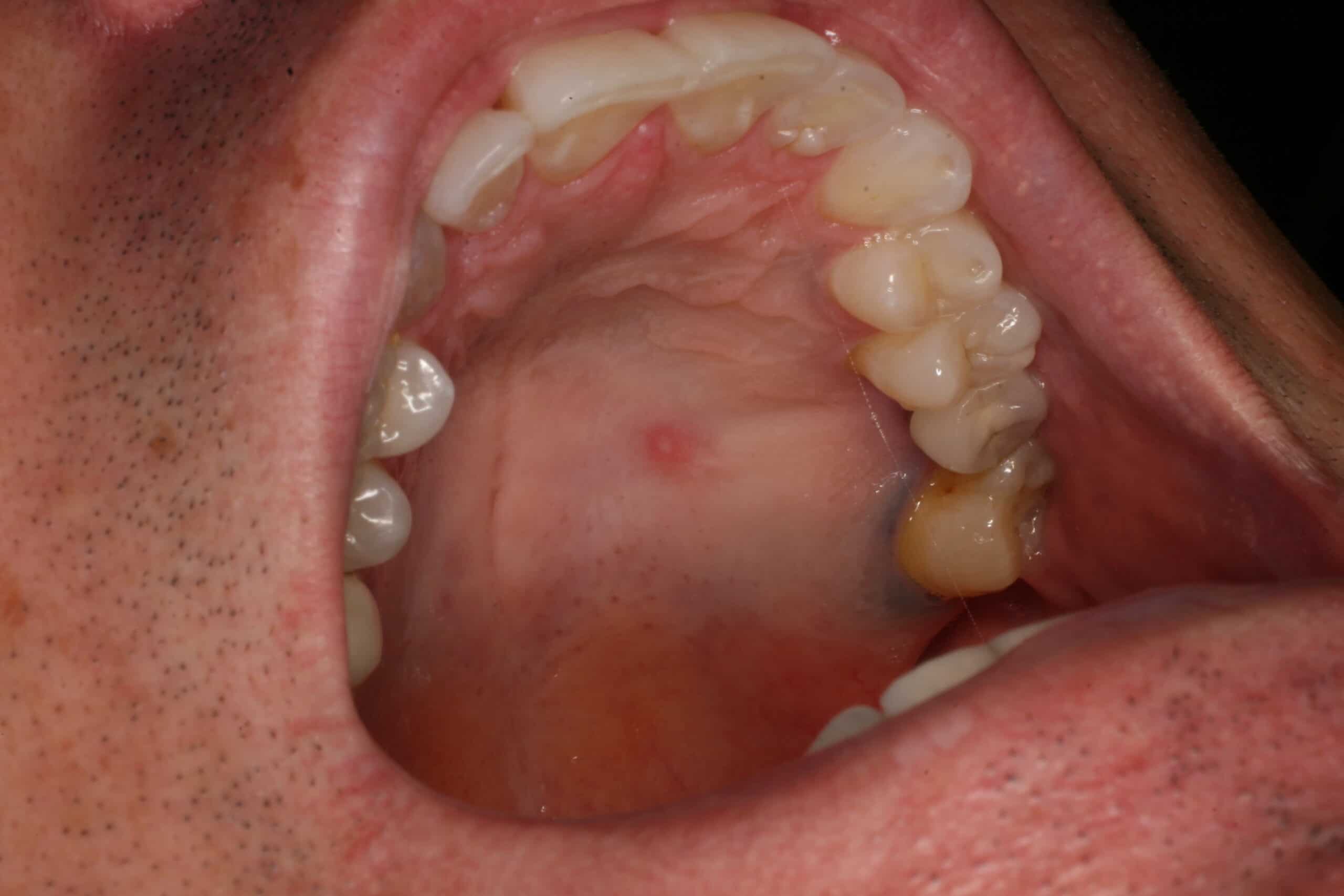
A lump, bump, or other lesion on the hard palate might be a cold sore, a canker sore, or a form of cyst. A sore that bleeds or fails to resolve could signal a more serious issue, such as oral cancer.
Bumps and lumps in the mouth are fairly common. You may have felt them before on your tongue, lips, or the back of your throat. Many things can produce a lesion on the roof of your mouth, including cysts or canker sores. Most causes are benign.
Below we outline 12 potential reasons for bumps on the roof of the mouth and what to do if you notice one.
1. Torus palatinus
Torus palatinus is a bony protrusion in the midline of the hard palate, also called the roof of the mouth. Sizes vary from barely perceptible to quite large. Even when prominent, torus palatinus doesn’t indicate underlying disease. Some people are born with it, though it may not become noticeable until later in life.
Signs include:
- a hard lump in the center of the roof of the mouth
- a bump that may be smooth or nodular
- a bump that slowly enlarges over years
Most torus palatinus cases require no treatment. If it becomes large enough to interfere with dentures or causes irritation, surgical removal is an option.
Torus palatinus occurs in about 27 per 1,000 people.
2. Nasopalatine duct cyst
A nasopalatine duct cyst can form in the area just behind your two front teeth, called the incisive papilla. It’s also referred to as a cyst of the palatine papilla.
These cysts are typically painless and often go unnoticed. If they become infected or symptomatic, surgical excision can resolve the issue.
3. Canker sores
Canker sores are small red, white, or yellow ulcers that may appear on the roof of the mouth, tongue, or inside the lips and cheeks.
Canker sores are not contagious. They can occur at any time, often after mouth trauma, during stress, or due to an allergic reaction or sensitivity.
Other symptoms may include:
- pain
- difficulty swallowing
- sore throat
Canker sores usually resolve without treatment within a week, but larger ulcers can persist for up to 4 weeks. For painful sores, over-the-counter topical numbing agents containing benzocaine (such as Orabase) may help.
Here are 16 home remedies for canker sores.
4. Cold sores
Cold sores are fluid-filled blisters that most often appear on the lips but can occasionally develop on the roof of the mouth. They’re caused by the herpes simplex virus, which can be asymptomatic in some people.
Additional signs of cold sores include:
- painful blisters often clustered together
- tingling, stinging, or pain before the blister appears
- fluid-filled blisters that break and crust over
- blisters that ooze or form open sores
Cold sores typically heal on their own within 2–3 weeks and are highly contagious during that period. Prescription antivirals like valacyclovir (Valtrex) can shorten recovery time.
What are some cold sore remedies?
5. Epstein pearls
Epstein pearls are tiny whitish-yellow cysts that newborns develop on their gums and the roof of their mouths. They usually measure 1–3 millimeters across and may occur singly or in small clusters.
They resemble milia, the small white bumps that can show up on a newborn’s face.
Parents often confuse them with emerging teeth. Epstein pearls are harmless and generally disappear within about 3 months after birth.
6. Mucoceles
Oral mucoceles are mucus-filled cysts that can arise anywhere in the mouth, including the hard palate. They usually result when minor trauma irritates a salivary gland, leading to mucus accumulation.
Mucoceles usually present as lumps that are:
- round and dome-shaped
- filled with mucus
- transparent, bluish, or red if there’s bleeding
- solitary or multiple
- white, rough, and scaly at times
- painless
Mucoceles can persist from several days to 3 years. They often don’t need treatment and may rupture spontaneously, frequently while eating, leaving a painful ulcer that heals over a few days.
7. Squamous papilloma
Oral squamous papillomas are benign growths caused by the human papillomavirus (HPV). They can appear on the roof of the mouth or elsewhere within the oral cavity.
Symptoms include a lump that:
- is painless
- grows slowly
- has a cauliflower-like appearance
- is white or pink
- may make eating or biting uncomfortable if it enlarges
Most don’t require treatment, but surgical removal is possible if they become problematic.
How can HPV affect the mouth?
8. Injuries
The tissue on the roof of the mouth is delicate and susceptible to damage such as burns, cuts, and chronic irritation. A severe burn may form a fluid-filled blister during healing.
A cut or puncture may swell and feel like a lump.
Persistent irritation, often from dentures or other appliances, can produce a lump of scar tissue called an oral fibroma.
Symptoms of a mouth injury may include:
- pain
- bleeding or open cuts
- burning sensation
- burns that blister or crust
- bruising
- a firm, smooth lump of scar tissue, which may be flattened by dentures
Minor oral injuries usually heal within several days. Rinsing with warm salt water or diluted hydrogen peroxide can help speed healing and lower infection risk.
9. Hyperdontia
Hyperdontia is a condition characterized by having extra teeth. Most supernumerary teeth develop in the roof of the mouth, behind the two front teeth. If the lump is toward the front of the palate, it might be an extra tooth erupting.
Other symptoms of hyperdontia include:
- facial pain
- headache
- jaw discomfort
Hyperdontia can be identified on routine dental X-rays. If extra teeth are present, dentists can generally remove them without major complications.
What are impacted teeth?
10. Ectopic teeth
It’s also possible for a supernumerary tooth to erupt in an unusual location, termed an ectopic tooth. These may occasionally emerge on the roof of the mouth. Less commonly, they can be found in the nasal cavity or sinuses.
11. Strep throat
An infection with group A Streptococcus, known as strep throat, can produce red spots or petechiae on the roof of the mouth.
Other signs of strep throat include:
- sore throat
- redness and swelling in the throat
- a swollen uvula
- sudden fever
- lack of cough
A healthcare provider can prescribe antibiotics to treat strep throat.
12. Oral cancer
Oral cancer describes malignancies that develop anywhere inside the mouth or on the lips. While uncommon, cancer can arise in the salivary glands on the roof of the mouth.
Signs of oral cancer include:
- a lump, growth, or thickened area inside the mouth
- a sore that won’t heal
- a bleeding sore
- jaw pain or stiffness
- sore throat
- red or white patches
- difficulty or pain with chewing or swallowing
Treatment depends on the cancer’s location and stage. Using tobacco raises the risk of oral cancer. If you smoke and notice a lump in your mouth, have a doctor evaluate it.
What are the early warning signs of oral cancer?
When to see a doctor
Often, a bump on the roof of the mouth is not serious. Still, contact your healthcare provider if you notice any of the following:
- Persistent pain that isn’t improving
- A sore that won’t heal
- A severe burn
- Too much pain to chew or swallow
- Your lump changes in size or appearance
- A foul odor in your mouth
- Dentures or dental devices no longer fit properly
- A new lump doesn’t resolve after a few weeks
- Difficulty breathing
Frequently asked questions
What does a bump at the roof of your mouth mean?
A new bump on the roof of the mouth may indicate various conditions, including injury, cysts, canker sores, extra teeth, or, in rare cases, cancer.
What are the bumps on the roof of my mouth and sore throat?
Red bumps or spots on the palate accompanied by a sore throat could be a sign of strep throat.
What is this weird bump in my mouth?
You might have been born with a bump on the roof of your mouth called torus palatinus, which is not a disease.
When should I worry about a lump in my mouth?
See a healthcare professional if the lump doesn’t improve with home care, you notice infection signs, the lump changes in size, color, or appearance, or you have a persistent foul taste. These could signal a condition needing medical attention.
Summary
There are many reasons for bumps on the roof of the mouth, from canker sores to teeth erupting in unusual places.
Some, like canker sores, are painful but typically respond to over-the-counter remedies.
Many bumps are harmless or resolve on their own, but occasionally a lump in the roof of the mouth can be cancerous. If you’re concerned about any bumps or lesions on the palate, it’s best to consult a doctor.





















Leave a Reply
You must be logged in to post a comment.