
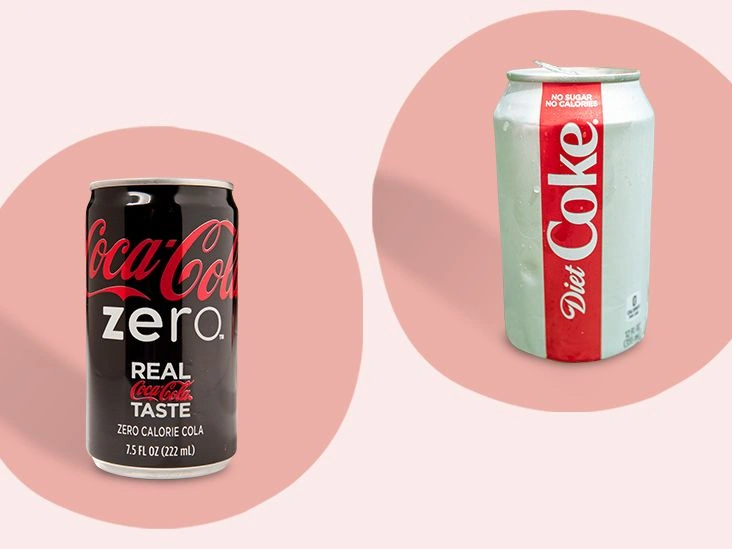
There’s not a huge gap between Coke Zero and Diet Coke. Both are options if you want to cut down on sugar, since they rely on non-nutritive sweeteners instead of sugar.
You’ve probably heard that reducing added sugar in your diet is important for overall health.
People who drink regular sodas often switch to beverages sweetened with artificial or zero-calorie sweeteners to lower their added-sugar intake.
These substitutes give a sweet flavor without causing the blood sugar spikes that table sugar can trigger.
Diet beverages are a common way to avoid added sugars in drinks, and more recently “zero” labeled sodas have become common as well. Coca-Cola is a well-known brand that offers both “diet” and “zero” versions.
If you’re curious about how Coke Zero and Diet Coke differ — and which might be a better pick for you — keep reading.

Nutrition facts and ingredients of Coke Zero and Diet Coke
Below are the ingredient lists and nutrition facts for Coke Zero and Diet Coke. This section highlights the main similarities and distinctions you may want to consider.
Coke Zero nutrition facts
Ingredients in Coke Zero include:
- carbonated water
- caramel color
- phosphoric acid
- aspartame
- potassium benzoate (to protect flavor)
- natural flavors
- potassium citrate
- acesulfame potassium
- caffeine
It also contains the amino acid phenylalanine, so people with phenylketonuria (PKU) should avoid it.
A 12-ounce (355-mL) serving of Coke Zero supplies:
- Calories: 0
- Total fat: 0 grams (g)
- Sodium: 40 milligrams (mg)
- Total carbohydrates: 0 g
- Total sugars: 0 g
- Protein: 0 g
- Potassium: 60 mg
- Caffeine: 34 mg
Coke Zero contains no added sugars because it uses artificial sweeteners. It’s available in several flavors, including cherry, cherry vanilla, orange vanilla, and vanilla. Coke Zero typically has less caffeine than Diet Coke, and a caffeine-free version is also sold.
Diet Coke nutrition facts
Ingredients in Diet Coke include:
- carbonated water
- caramel color
- aspartame
- phosphoric acid
- potassium benzoate (to protect flavor)
- natural flavors
- citric acid
- caffeine
As with Coke Zero, Diet Coke contains phenylalanine and is not suitable for people with PKU.
A 12-ounce (355-mL) serving of Diet Coke contains:
- Calories: 0
- Total fat: 0 g
- Sodium: 40 mg
- Total carbohydrates: 0 g
- Total sugars: 0 g
- Protein: 0 g
- Caffeine: 46 mg
Diet Coke has no added sugars, as it relies on artificial sweeteners. The standard Diet Coke uses aspartame, but you can also find Diet Coke made with sucralose (marketed as Splenda).
Flavor options for Diet Coke include ginger lime and feisty cherry, and a caffeine-free version is available as well.
Key differences between Coke Zero and Diet Coke
These drinks are largely alike, especially in their main selling point: they don’t contain sugar.
The main distinctions are the sweetener formulations and caffeine amounts, though these differences are unlikely to be meaningful for most consumers.
Diet Coke is sweetened primarily with aspartame, while Coke Zero uses a blend of aspartame and acesulfame potassium (also called Ace K or acesulfame K).
Acesulfame potassium is another zero-calorie sweetener that passes through the body without raising blood glucose.
Because ingredients on labels are listed in order by weight, Diet Coke’s ingredient list suggests aspartame is the dominant sweetener and that it likely contains less acesulfame potassium than Coke Zero. Overall, the ingredient profiles are very similar.
The other notable difference is caffeine: Coke Zero contains less caffeine than Diet Coke. Still, both are well below the FDA’s recommended 400 mg per day limit for most adults.
One subjective difference is flavor. Some people can’t tell them apart, while others strongly prefer one over the other as tasting closer to “real” Coca-Cola.
Taste comparison
Recently, Coca-Cola has noted in its marketing that it adjusted the recipe for Coke Zero. The company doesn’t provide full details of the change but claims the formula delivers more authentic Coca-Cola flavor without any sugar.
Coke Zero may have a slightly different aftertaste compared with Diet Coke, likely due to the inclusion of acesulfame potassium. Many people report Diet Coke tastes more similar to classic Coke; others disagree.
Neither perfectly matches original Coca-Cola. Factors such as fountain dispense versus can or bottle can also affect the flavor you perceive.

Potential side effects
For most people, drinking carbonated soft drinks in moderation is not associated with many harmful effects.
However, caffeine and artificial sweeteners can cause adverse effects in certain individuals, even at moderate consumption levels.
The United States Department of Agriculture (USDA) suggests adults limit caffeine to about 400 mg per day.
That’s roughly equivalent to 4 cups of coffee, or about nine 12-ounce (355-mL) cans of Diet Coke or eleven 12-ounce cans of Coke Zero. So you’re unlikely to exceed this limit if you drink these sodas moderately.
If you are sensitive to caffeine, keep an eye on your intake of these beverages; otherwise, they supply relatively low caffeine amounts.
Aspartame has been reported to trigger headaches in some people, according to the American Migraine Foundation. This effect varies by individual, so it’s helpful to notice patterns if you develop headaches after consuming these drinks.
Some studies have raised concerns about a possible link between aspartame and cancer, but higher-quality, long-term human research is needed to clarify any connection.
Regulatory reviews have generally concluded that aspartame is safe at currently used levels for the general population, though it may carry specific risks for certain groups, including:
- people with seizure disorders
- individuals with some neurological conditions
- people with phenylketonuria (PKU)
- pregnant people
Those who prefer to avoid certain additives may opt to steer clear of aspartame. The FDA currently deems aspartame safe.
Acesulfame potassium has also been examined for potential carcinogenicity, but the evidence is inconclusive and further long-term human studies are necessary.
Acesulfame potassium is approved by the FDA.
Which is a better choice?
There are only minor differences between Diet Coke and Coke Zero, so there’s no clear-cut reason to declare one superior nutritionally.
Their nutrient profiles are essentially the same, and ingredient and caffeine content are comparable, meaning neither is demonstrably healthier than the other.
Keep in mind that diet soda isn’t a health food. It’s an occasional treat that can be enjoyed in moderation — and swapping regular soda for a diet version is a reasonable first step if you want to cut added sugars.
Your choice will mostly come down to which flavor you prefer. Coke Zero is often described as tasting more like original Coke, but many people prefer Diet Coke or find it closer to what they enjoy.
Tips for reducing diet soda intake
Given the mixed evidence on artificial sweeteners, you might want fizzy drinks with fewer or no artificial sweeteners. Here are some alternatives to try:
- Flavored waters: Calorie-free flavored waters are refreshing and hydrating. Keep a few varieties in your fridge or cooler.
- Kombucha: This fermented tea is naturally fizzy and contains probiotics. Most kombuchas have less sugar than regular soda, but check labels for added sugars.
- Probiotic sodas: Some brands produce probiotic “soda” that tastes similar to soda but has much less sugar and offers probiotic benefits like kombucha.
- Stevia-sweetened sodas: Some fizzy beverages use plant-based sweeteners such as stevia or monk fruit instead of artificial sweeteners. They mimic soda flavors without sugar or artificial sweeteners.
- Sparkling water: If carbonation is what you crave, sparkling water can satisfy without any sugar or sweeteners. They’re not sweet, but they provide the fizz.
The bottom line
If you want to reduce added sugars, sodas sweetened with non-nutritive sweeteners — like Diet Coke and Coke Zero — can be a reasonable option.
Although some artificial sweeteners in these drinks have been questioned for potential health effects, enjoying either in moderation is unlikely to be problematic, particularly compared with the harms of sugar-sweetened sodas.
Nutritionally, Coke Zero and Diet Coke are nearly identical and mainly differ in taste.
If you’re aiming to limit both added sugars and artificial sweeteners, kombucha or a probiotic soda could be suitable alternatives.





















Leave a Reply
You must be logged in to post a comment.