
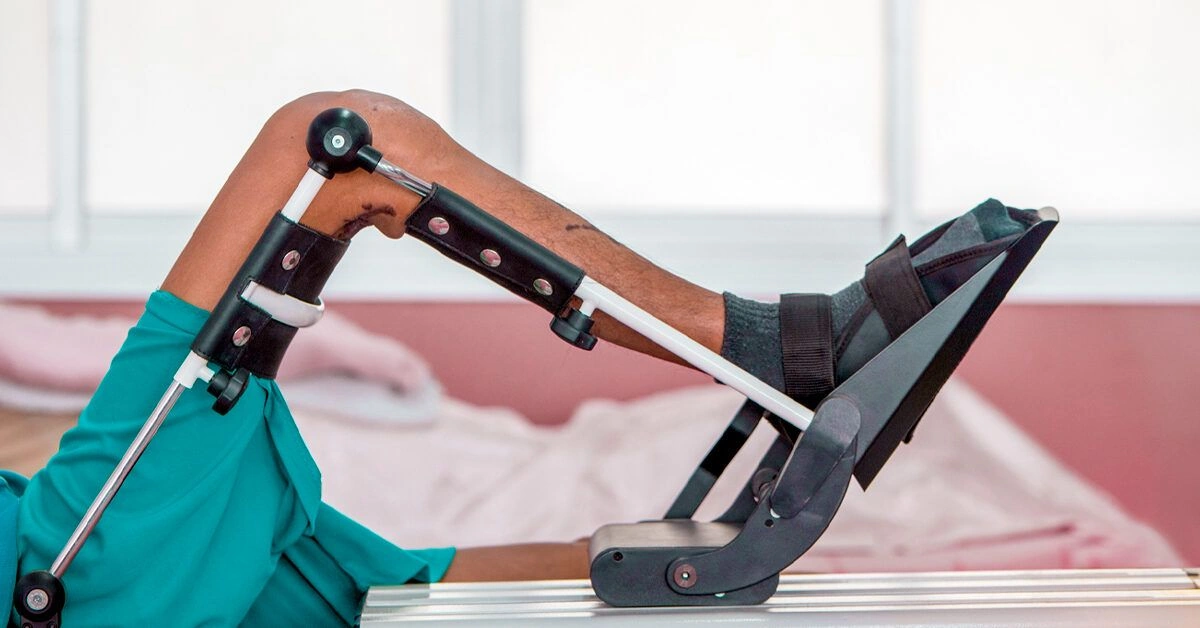
A continuous passive motion (CPM) machine is a motor-driven device that gently moves a joint through a predetermined range without active muscle effort. These units are often employed after operations to help limit stiffness and enhance joint mobility. While commonly associated with knee replacement recovery, CPMs may also be used following procedures on the elbow, hip, or shoulder.

Traditionally, CPMs have been found in hospitals and offered as take-home equipment. Over the past decade, though, mounting research has raised questions about how effective they truly are.
Continue reading to learn what current studies indicate and how CPM might fit into your post-surgical rehabilitation.
Do CPM machines have benefits?
Joint stiffness can be an issue after certain surgeries. If left unchecked, it can contribute to scar tissue formation and lasting limitations in range of motion.
CPM machines move the joint without requiring active contraction of your muscles. The idea is they may offset the harmful effects of prolonged immobilization. Still, their benefit remains debated. Multiple studies have reported no measurable improvement in range of motion among patients who used CPM postoperatively.
The American Physical Therapy Association advises against routine CPM use following total knee replacement. That guidance followed several studies indicating CPMs did not improve recovery outcomes.
Some research does find potential benefits in specific scenarios, but positive findings are inconsistent and often come from small trials.
As a result, many clinicians no longer endorse CPMs as standard care. Check with your surgeon or therapist about whether other rehabilitation options might be preferable.
CPM machine uses
CPM devices are most frequently used after knee operations. They’re also applied to the hip, shoulder, and elbow, and have been tested as a treatment for chronic non-specific lower back pain.
CPM machine after knee surgery, including total knee replacement
Although CPMs are sometimes used following knee reconstruction, a number of reviews suggest they offer little to no advantage.
A 2014 study reported that CPM use after repair of intra-articular knee fractures provided no clear benefit.
Other trials have shown more favorable outcomes, so the role of CPM remains disputed.
For example, a 2019 study of 163 patients under 20 who underwent ACL reconstruction found that those treated with CPM were less likely to require a secondary procedure to remove scar tissue within six months.
A 2018 review noted that initiating CPM early and rapidly progressing range-of-motion parameters correlated with better recovery than prolonged, slower CPM use.
CPM machine for the hip
CPM devices may be prescribed following hip surgery. A 2017 study observed that CPM after arthroscopic correction of hip impingement was linked with improved postoperative hip flexion.
CPM machine for the shoulder
In selected cases, your care team might recommend CPM after shoulder procedures.
A 2016 trial compared CPM and physiotherapy for people with diabetes undergoing surgery for adhesive capsulitis (frozen shoulder). Both approaches produced improved outcomes at 12 weeks, but those using CPM showed more marked reductions in pain and better functional gains.
CPM machine for the elbow and arm
After elbow surgery, both CPM and physical therapy are common rehabilitation choices. Yet, current evidence indicates CPM may be unnecessary and often offers little benefit.
A small 2020 study found that adding CPM to standard rehab for wrist fractures did not provide extra improvement.
CPM machine for the lower back
CPMs have been explored as a therapy for chronic non-specific back pain, where the pain isn’t linked to a distinct diagnosable condition.
A small 2015 study investigated three weeks of self-used CPM in 36 people with mild to moderate chronic non-specific back pain. Participants who used the device for 10 minutes one to three times daily reported reduced pain after the three-week period.
How to use a CPM machine
Confirm with your surgeon or therapist whether a CPM is appropriate and discuss alternative approaches. Recent literature does not support universal effectiveness.
Your clinician and the device manufacturer’s instructions will give the best guidance on operating your CPM.
Generally, the machine is used while you lie in bed or on a comfortable surface. Most models include a remote to set the flexion and extension angles and control speed. You can start and stop the motion using the remote.
The unit typically has several knobs and straps to adapt the device to the length of your limb. Your healthcare provider can demonstrate the proper adjustments.
How long should you use a CPM machine?
Duration depends on the surgery type and severity. Commonly, CPMs are used about 4 hours per day for 4 weeks after hip surgery. Following knee replacement, typical use is around 3 weeks but may be shorter or longer based on clinical judgment.
Precautions when using a CPM machine
Some clinicians still recommend CPMs, although many recent studies challenge their value. The American Physical Therapy Association advises against routine CPM after knee surgery unless formal physical therapy cannot be provided.
APTA notes that any limited gains must be weighed against extra costs and hazards associated with prolonged bed rest.
A 2017 study reported that individuals with obesity experienced less favorable outcomes with CPM compared with those without obesity.
If you experience pain, increased tenderness, or other concerning symptoms, discontinue use and contact your healthcare provider.
CPM machine price and other costs
Buying a CPM typically costs more than $2,000, while renting is often the more economical choice. One CPM rental provider lists starter rental rates at $425 for three weeks, with an additional $100 for each added week. Specialty CPM units start at around $775 to rent.
Many insurers, including Medicare, cover CPM equipment. Medicare Part B covers home-use CPM devices for 21 days following knee replacement surgery.
Takeaway
CPM devices were historically applied after surgeries on the knee, hip, shoulder, and elbow to reduce stiffness and help restore motion. In recent years, however, the evidence base has increasingly questioned their routine benefit, and many physicians no longer recommend them universally.
If you’re unsure whether CPM might help in your recovery, discuss the option with your healthcare team.

















Leave a Reply
You must be logged in to post a comment.