
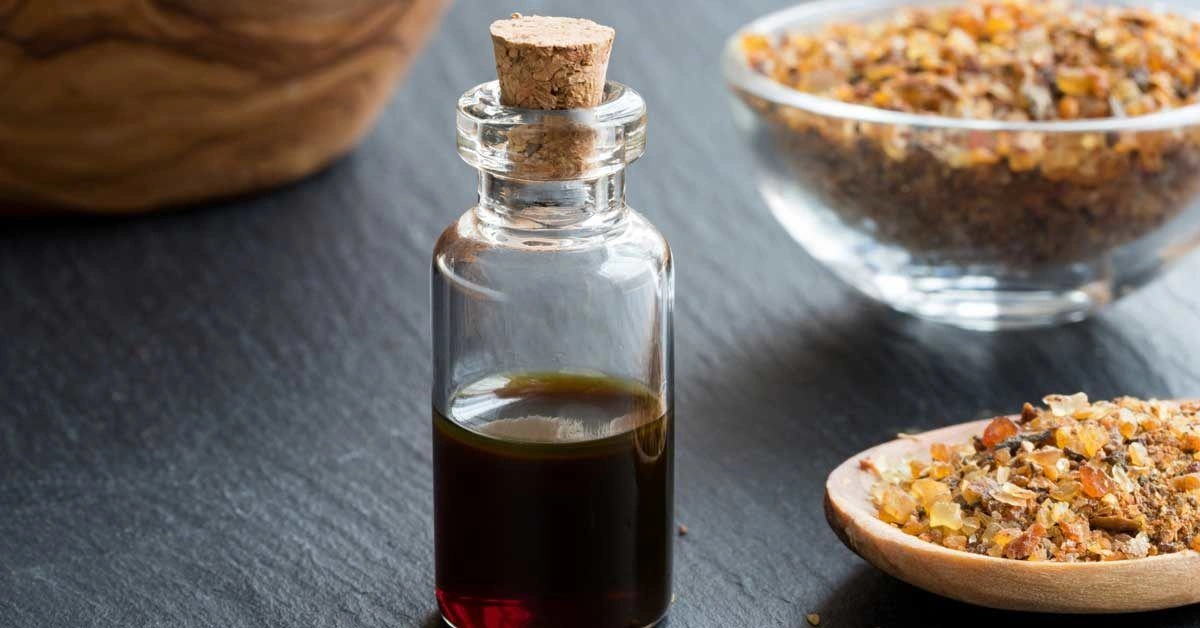
Myrrh essential oil may offer advantages such as killing certain bacteria and supporting oral health, though additional research is necessary. To experiment with it, blend the oil with a carrier oil before applying to the skin or inhale its scent. You can also purchase commercial products like mouthwash or salves that include myrrh.
You might recognize myrrh from Biblical accounts even if you’re unsure what it actually is.

Myrrh is a reddish-brown hardened resin obtained from a thorny tree — Commiphora myrrha, also called C. molmol — native to northeastern Africa and parts of southwest Asia (1, 2).
Myrrh essential oil is produced by steam distillation. It ranges in color from amber to brown and has an earthy fragrance (3).
Historically, myrrh has been used in traditional Chinese and Ayurvedic systems of medicine. Modern researchers are exploring its possible roles in easing pain, fighting infections, and treating skin lesions (4).
Below are 11 science-based uses and potential health benefits of myrrh essential oil.
1. Destroys Harmful Bacteria
Ancient Egyptians utilized myrrh and other oils in embalming practices; these substances not only scented the remains but also slowed decomposition. Researchers now understand this is due to their antimicrobial activity (5).
In historical religious contexts, myrrh incense — often burned alongside frankincense — was used to cleanse the air and reduce the spread of contagious illnesses, including bacterial infections.
One recent experiment showed that burning myrrh and frankincense incense lowered airborne bacterial levels by about 68% (6).
Preliminary animal experiments indicate myrrh can directly kill bacteria and may also boost immune responses by increasing white blood cell counts (7).
In vitro studies reveal that myrrh oil has potent activity against various infectious bacteria, including some antibiotic-resistant strains (3, 8, 9, 10).
One lab study found that a low 0.1% dilution of myrrh oil eradicated dormant Lyme disease bacteria, which can linger after antibiotic therapy and cause ongoing symptoms (11).
Nevertheless, further research is required to determine if myrrh oil can effectively treat persistent Lyme infections in humans.
Summary: Myrrh oil has been used historically to eliminate bacteria long before microbial science explained infections. It may act against some drug-resistant strains and dormant Lyme bacteria.
2. Could Aid Oral Health
Because of its antimicrobial traits, myrrh has a history of use for oral infections and inflammation (12).
Some natural mouthwashes and toothpastes feature myrrh oil; the FDA recognizes it as a flavoring agent (13, 14).
In a study of people with Behcet’s disease — an inflammatory condition — using a myrrh-containing mouthwash four times daily for a week, half experienced full pain relief and 19% had complete healing of mouth ulcers (15).
Laboratory studies suggest that mouthwash with myrrh oil might also be useful against gingivitis, inflammation of the gums caused by plaque buildup (12).
More clinical trials are needed to validate these findings.
Remember never to swallow oral-care products containing myrrh, as high amounts can be harmful (15).
If you’ve recently had oral surgery, avoid myrrh mouthwash during healing. A lab study found that certain sutures, especially silk ones, may weaken when exposed to myrrh, though sutures typically used in mouthwash doses remained intact (16).
Summary: Myrrh appears in some natural dental products and may ease mouth sores and gum inflammation. Do not ingest these products.
3. May Promote Skin Health and Wound Healing
Traditionally, myrrh has been applied to skin wounds and infections, and researchers are now evaluating these uses (17).
One in vitro study on human skin cells showed that an essential oil blend containing myrrh aided wound repair (18).
Another investigation reported that baths with myrrh and other essential oils helped postpartum mothers recover from perineal wounds after vaginal delivery (19).
Because multiple oils were used in these studies, isolating myrrh’s specific contribution is difficult.
Studies focused on myrrh alone are more informative.
A lab screen of 247 essential oil combinations found myrrh mixed with sandalwood oil was particularly potent against microbes that infect skin wounds (20).
In another in vitro study, myrrh oil by itself inhibited 43–61% growth of five fungi responsible for skin conditions like ringworm and athlete’s foot (17).
Human trials are necessary to confirm these effects. If you want to try myrrh for skin care, many natural salves and soaps include it, or you can apply a diluted preparation directly.
Summary: Diluted myrrh oil may aid wound repair and combat microbes that cause skin infections. It also appears to inhibit certain skin fungi.
4. Fights Pain and Inflammation
Pain, including headaches, joint discomfort, and backache, is common.
Myrrh contains active constituents that interact with opioid receptors to reduce pain perception. It also suppresses production of inflammatory compounds that cause swelling and discomfort (1, 2, 21, 22).
In a study of people prone to headaches, a multi-ingredient supplement containing myrrh-related pain-relieving compounds reduced headache intensity by about two-thirds over six months (23).
More research is needed to verify these benefits. The specific supplement studied isn’t available in the US, and ingesting myrrh oil is not advised.
Topical homeopathic rubs and blends containing myrrh are marketed for sore muscles and joints, but these preparations lack robust study.
Summary: Compounds in myrrh may temporarily reduce pain by affecting pain pathways and by lowering inflammatory chemicals that cause swelling.
5. May Act as a Potent Antioxidant
Myrrh appears to be a strong antioxidant, meaning it can counteract oxidative damage from free radicals.
Oxidative stress contributes to aging and various diseases.
One lab study found myrrh oil outperformed vitamin E, a known antioxidant, in neutralizing free radicals (24, 25).
In an animal model, myrrh oil reduced lead-induced oxidative damage in the liver in a dose-dependent manner when given before lead exposure (26).
It is unknown whether inhaling or topical application of myrrh oil — the typical safe uses for people — provides antioxidant protection in humans.
Summary: Test-tube and animal data indicate myrrh oil is a powerful antioxidant, possibly exceeding vitamin E, but human evidence is lacking.
6. Kills Certain Parasites
Parasites can be acquired via pets, sexual contact, or contaminated food and water (27).
Two common parasitic infections in the US are trichomoniasis (a sexually transmitted infection) and giardiasis (an intestinal infection) (28, 29, 30).
In a preliminary human study, women who did not respond to standard therapy for trichomoniasis were treated with Mirazid, an oral preparation made from myrrh resin and its oil; about 85% were cured (31).
Animal research also found the same myrrh formulation effective against giardiasis (32).
Some human trials indicate Mirazid might work against Fasciola gigantica, a parasite affecting the liver and bile ducts, but results are inconsistent across studies (33, 34, 35, 36).
Mirazid is not widely used in current medical practice.
Although preliminary evidence is promising, more studies are necessary to confirm myrrh’s antiparasitic efficacy and safety. Oral ingestion of myrrh oil is not recommended without proper medical oversight (37).
Summary: Early studies suggest a myrrh-based medication may treat certain parasites, but more evidence on effectiveness and safety is needed.
7–10. Additional Investigational Benefits
Researchers are exploring other possible uses for myrrh and its active constituents. These areas under investigation include:
- Sunscreen: One lab study found an SPF 15 sunscreen containing added myrrh oil provided better UV protection than the sunscreen alone. By itself, myrrh oil was less effective than the sunscreen (38).
- Cancer: In vitro studies suggest myrrh oil may slow or kill cancer cells from the liver, prostate, breast, and skin, but these effects have not been tested in humans (39, 40, 41).
- Digestive health: Animal studies suggest myrrh compounds may relieve intestinal spasms related to irritable bowel syndrome and may help heal stomach ulcers (42, 43).
- Mold control: Laboratory data indicate myrrh oil can inhibit mold species such as Aspergillus niger, which appears as wall mildew, and A. flavus, which contaminates food (3, 44).
Summary: Ongoing research is assessing myrrh oil’s potential in sunscreens, cancer care, digestive disorders, and mold suppression.
11. Easy to Use
Myrrh oil can be inhaled, used topically, or employed in oral-care products; it should never be swallowed.
General recommendations:
Topical Application
To minimize skin irritation, dilute myrrh oil in a carrier oil such as jojoba, almond, grapeseed, or coconut oil. Dilution also slows the oil’s evaporation (45).
Typical dilutions: 3–6 drops of essential oil per teaspoon (5 ml) of carrier oil for adults (about 2–4%). For children, use 1 drop per teaspoon of carrier oil (≈1%).
You can mix a drop or two into unscented lotion before applying, or add it to massage blends.
Avoid sensitive areas like eyes and inner ears, and wash hands thoroughly after handling essential oils to prevent accidental contact with delicate tissues.
Inhalation
Add 3–4 drops of myrrh oil to a diffuser to disperse it as a fine vapor.
If you don’t own a diffuser, place a few drops on a tissue or cloth and inhale intermittently, or add several drops to hot water and inhale the steam.
An easy household trick is to put a few drops on the cardboard core of a toilet paper roll so a faint scent is released when the roll is used.
Blends
Myrrh’s earthy scent pairs well with spicy, citrus, and floral oils, such as frankincense, lemon, and lavender.
The myrrh-frankincense pairing is especially favored for its complementary aromas and synergistic effects.
In vitro work shows that combining myrrh and frankincense enhances antimicrobial activity against infectious bacteria and other microbes, with synergy accounting for roughly 11% of the improved effect (46).
Summary: Diluted myrrh oil can be applied to the skin, diffused, or used in oral-care products (never ingested). It works well alone or combined with oils like frankincense and lemon.
Potential Risks
As with other essential oils, myrrh is very concentrated, so use only small amounts. Avoid diffusing it near infants and very young children, since safe inhalation levels for them are uncertain.
Do not ingest myrrh oil — it can be toxic (15).
Certain people should be particularly cautious or avoid myrrh oil. Consider avoiding it if any of the following apply to you (45, 47):
- Pregnancy and breastfeeding: Avoid myrrh oil during pregnancy because it may cause uterine contractions and could increase miscarriage risk. Its safety during breastfeeding is also unknown.
- Blood thinners: If you use anticoagulants like warfarin, avoid myrrh as it may reduce their effectiveness.
- Heart conditions: Large amounts of myrrh can influence heart rate; use caution if you have a cardiac disorder.
- Diabetes: Myrrh might lower blood sugar, which could interact with diabetes medications and cause hypoglycemia.
- Surgery: Myrrh could affect blood sugar control around the time of surgery. Stop using myrrh products at least two weeks before surgery or follow your surgeon’s guidance.
Summary: Avoid or limit myrrh oil if you’re pregnant, have heart disease, plan surgery, or take blood thinners or diabetes medicines.
The Bottom Line
Besides its warm, earthy aroma, myrrh oil may offer several health-related effects.
Research indicates it could kill harmful bacteria, some parasites, and other microbes. It may also support oral health, assist in healing skin lesions, and reduce pain and swelling.
However, most evidence comes from lab studies, animal experiments, or small human trials, so definitive conclusions about benefits in people are premature.
If you choose to try myrrh oil, dilute it in a carrier oil for topical use or diffuse it to inhale. You can also purchase products such as mouthwashes and salves that include the oil.






















Leave a Reply
You must be logged in to post a comment.