
Key takeaways
- The Norwood Scale is a commonly used reference for identifying and discussing male pattern hair loss. It provides a straightforward visual guide to determine the stage of balding and review treatment choices.
- Starting treatment early with medicines such as minoxidil and finasteride can slow down hair loss. For advanced stages, surgical approaches like hair transplantation or scalp micropigmentation may be necessary.
- Genetic, hormonal, and environmental influences affect male pattern hair loss. Increased sensitivity to DHT can shorten hair growth cycles, causing follicles to miniaturize.
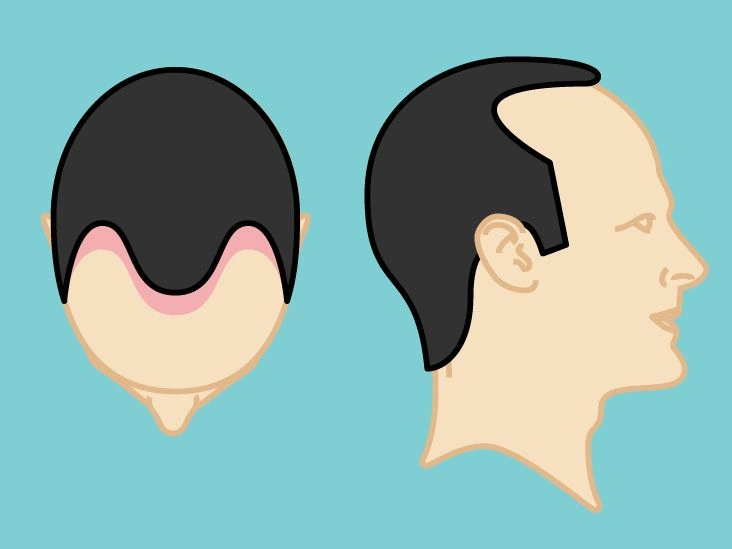
The Norwood scale (also known as the Hamilton-Norwood scale) is the primary classification system used to assess the degree of male pattern baldness. Men tend to lose hair following several typical patterns over many years. The Norwood scale supplies easy-to-use illustrations that represent various balding stages.

There are other classification systems used by physicians, scientists, and hair transplant specialists. Some of these scales include both men and women or are designed specifically for female pattern hair loss.
Nonetheless, the Norwood scale remains the measurement most frequently used by clinicians when addressing male pattern baldness. It serves as a benchmark to determine the severity of hair loss, evaluate treatment options, and monitor treatment outcomes.
What are the 7 stages of hair loss?
The Norwood scale outlines seven stages. Each stage describes the pattern and extent of hair loss.
- Stage 1. No noticeable hair loss or recession of the hairline.
- Stage 2. Mild recession of the hairline at the temples. This is often called an adult or mature hairline.
- Stage 3. The earliest signs of clinically significant balding appear. The hairline recedes deeply at both temples, forming an M, U, or V shape. The recessed areas are either bare or sparsely covered.
- Stage 3 vertex. The hairline remains at stage 2, but there is marked thinning or hair loss on the crown (vertex) of the scalp.
- Stage 4. Hairline recession is more pronounced than in stage 2, and there is little or no hair on the crown. The two balding regions are separated by a band of hair that connects with the hair on the sides.
- Stage 5. The two balding sections are more extensive than in stage 4. They are still distinct, but the hair bridge between them is narrower and thinner.
- Stage 6. The bald areas at the temples join with the bald region at the crown. The transverse band of hair across the top of the head is absent or very thin.
- Stage 7. The most advanced stage of hair loss, leaving only a horseshoe-shaped band of hair around the sides of the head. This remaining hair is typically sparse and may be fine in texture.
- Norwood class A. The class A variant is a less common progression where the hairline uniformly recedes straight back, without an isolated patch of hair in the center and without a bald crown. The recession advances evenly from front to back.
What does hair loss look like for each stage?
How is male pattern baldness diagnosed?
Hair loss is usually diagnosed through a physical examination and a review of your medical history. While most cases are classified as male pattern baldness, doctors may investigate other causes if you are young, female, or experiencing atypical hair loss.
A dermatologist or hair loss specialist can inspect your scalp to determine the pattern and level of hair loss. Your clinician may also gently pull a few hairs and inspect the follicles under magnification.
How is hair loss treated?
Treatments for hair loss are most effective when begun early. It’s generally easier to slow further loss than to encourage new growth. Follicles that stop producing hair tend to become dormant after about two years and are unlikely to be reactivated. Once substantial hair loss has occurred, surgical options may be the most viable solution.
Over-the-counter (OTC) treatments
Non-prescription options include:
- Minoxidil. Applied topically to the scalp, this drug (marketed as Rogaine) can prevent hairs from thinning and may promote regrowth on the crown. It can be used alongside other therapies.
- Laser devices. Various combs, brushes, and devices that emit laser light are sold as treatments for hair loss. They may encourage hair growth for some users, but they haven’t been clinically proven to be effective.
Prescription treatments
Depending on how advanced your hair loss is and how you respond to OTC therapies, your doctor might prescribe finasteride (Proscar, Propecia). Finasteride is an oral medication approved by the U.S. Food and Drug Administration for treating male hair loss.
Per the American Academy of Dermatology, it slows hair loss in about 88% of men and promotes regrowth in roughly 66%.
Procedures
There are also procedural interventions available, including:
- Hair transplantation. Healthy hair-bearing sections of the scalp are harvested and grafted into bald or thinning areas.
- Scalp reduction. A portion of the bald scalp is excised, and adjacent hair-bearing areas are drawn together. This can be combined with grafting.
- Scalp expansion. Expanders are placed under the scalp for several weeks to stretch the skin. This can precede a scalp reduction or be used on its own.
- Scalp micropigmentation. Small tattooed dots are placed on the scalp to mimic the look of a shaved head.
What causes male pattern hair loss?
Male pattern hair loss arises from a mix of genetic, hormonal, and environmental factors. Your inherited genes determine how sensitive your hair follicles are to androgens, especially dihydrotestosterone (DHT).
Each hair grows from a follicle and typically goes through a growth phase lasting two to six years before entering a resting phase and shedding. The cycle then repeats as a new hair begins to grow.
Elevated androgen activity in follicles can shorten the growth phase to weeks or months. DHT drives follicle miniaturization, producing progressively finer and shorter hairs. Over time, follicles can shrink to the point they no longer produce visible hair.
Optum Now is operated by RVO Health. By clicking on this link, we may receive a commission. Learn more.
Is there a way to prevent male pattern hair loss?
Prevention and treatment overlap. People begin losing hair at different ages and progress at varied rates, so deciding when to act is a personal choice.
Treatments such as minoxidil and finasteride can help most men halt further hair loss.
The takeaway
The Norwood scale is a practical tool that helps you and your healthcare providers gauge the stage of male pattern baldness. Early stages may respond to medications, while later stages offer several surgical approaches.





















Leave a Reply
You must be logged in to post a comment.