How Rear Lateral Raises Can Benefit Your Workout Routine


The rear lateral raise, often referred to as the bent-over lateral raise, is an exercise designed to increase strength and muscle growth (hypertrophy) in the posterior deltoids — the small muscles located on the back of your shoulders.
Rear lateral raises also engage other upper- and lower-body muscles, such as the trapezius and rhomboids.
Among its many advantages, the rear lateral raise supports improved posture and makes daily and athletic movements easier.
Continue reading to learn how to perform rear lateral raises, the advantages they offer, and safety tips to keep in mind.
What is a rear lateral raise?
A rear lateral raise is a dumbbell exercise in which you hinge at the hips so your torso is nearly parallel to the floor, then lift your arms out to the sides.
Rear lateral raises mainly target the posterior deltoids. The exercise also benefits the following muscles:
| Synergist muscles | Stabilizer muscles |
| infraspinatus | erector spinae |
| lateral deltoids | triceps brachii |
| teres minor | wrist extensors |
| middle and lower trapezius | gluteus maximus |
| rhomboids | adductor magnus |
| quadriceps | |
| hamstrings |
How to do rear lateral raises
To build muscle size, incorporate rear lateral raises into your regular resistance-training program. They’re also useful as part of a warm-up routine.
Allow your muscles time to recover by spacing sessions with one or two rest days in between. On those alternate days, work other muscle groups. Aim for at least one full rest day each week.
Perform 3 to 5 sets of 12–20 reps.
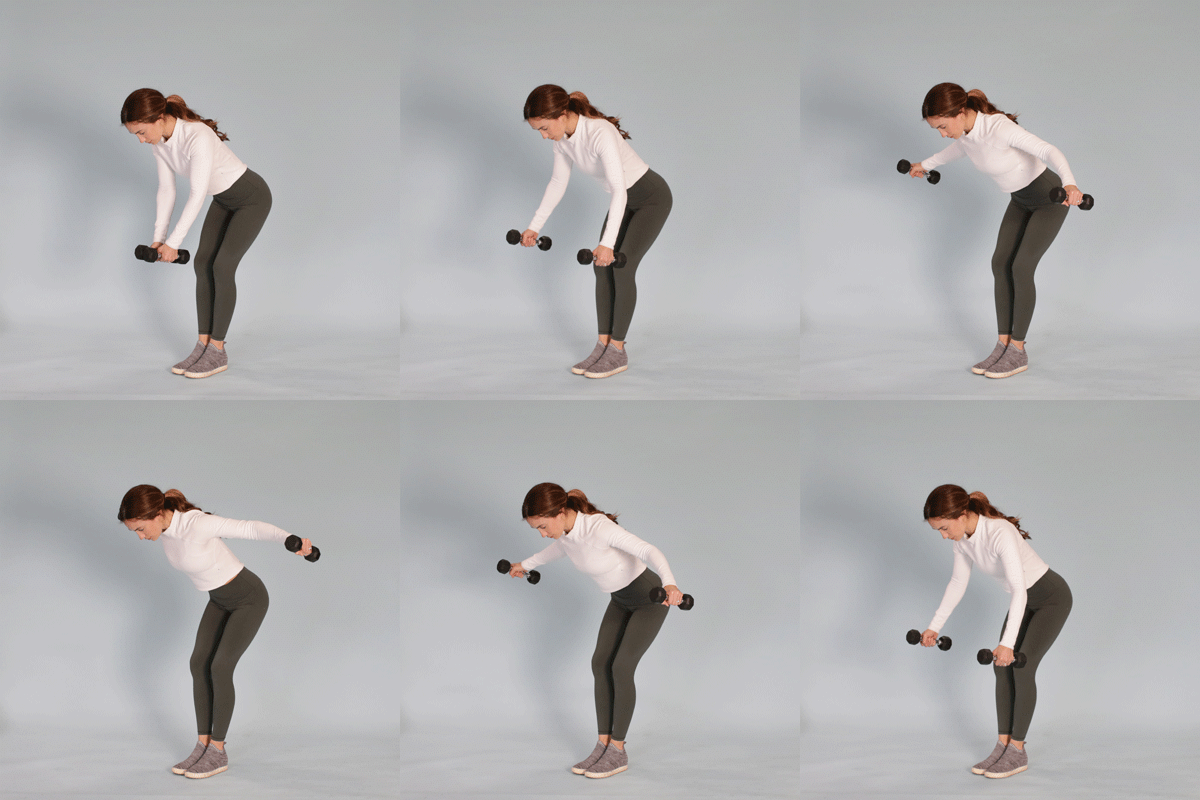
Standing rear lateral raise
To perform a standing rear lateral raise:
- Keep a slight bend in your elbows throughout the movement.
- Stand with your feet about hip-width apart and your knees marginally bent.
- Hold a dumbbell in each hand with your arms resting at your sides.
- Lengthen your spine and brace your core as you hinge forward from the hips.
- Bring your torso to a position that’s nearly parallel to the ground.
- Let your arms hang down beneath your shoulders with your palms facing one another.
- Retract your shoulder blades as you lift the weights out to the sides.
- Pause when your elbows reach shoulder height; your pinky should be slightly higher than your thumb.
- Slowly lower the dumbbells back to the starting position with control.
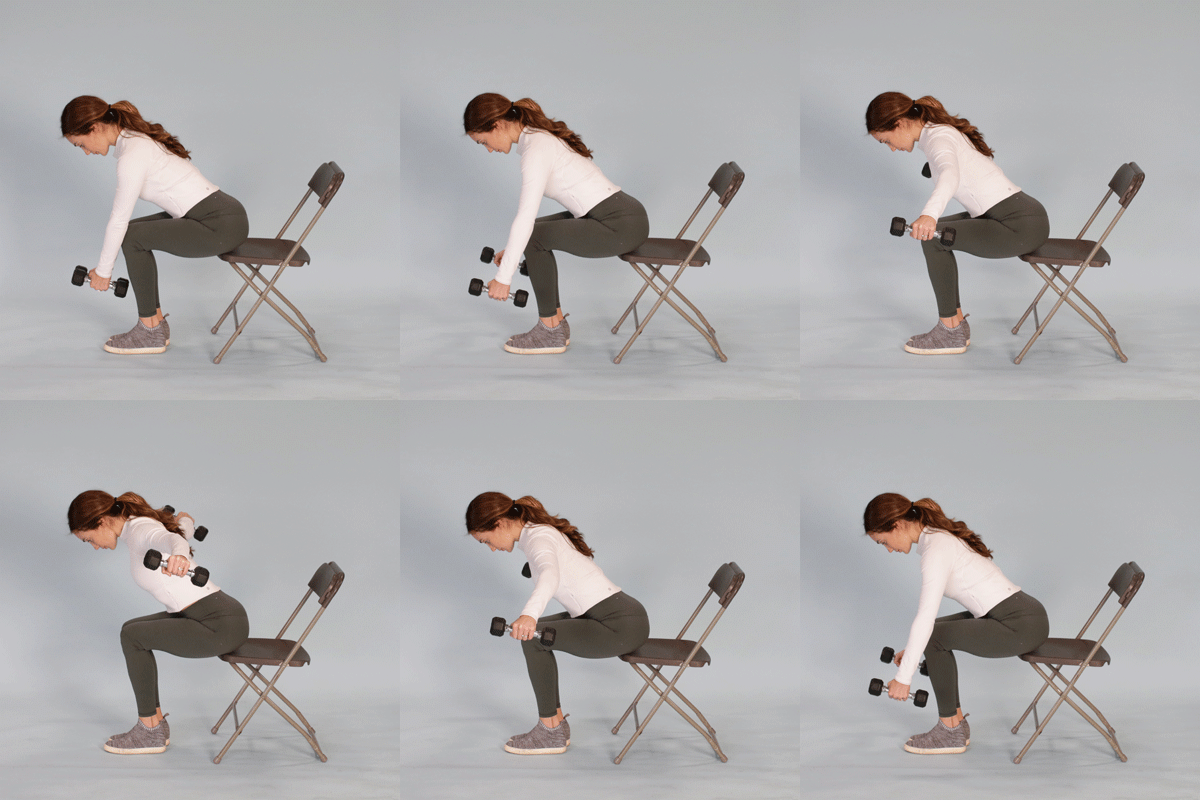
Seated rear lateral raise
For this variation, sit on the front edge of a flat bench or chair and follow the same steps as the standing rear lateral raise.
Prone rear lateral raise on an incline bench
This adaptation helps keep your alignment and form strict, preventing torso movement or momentum from completing the lift.
Lie face down on an incline bench and follow the same cues as for the standing variation. Press your chest firmly against the pad throughout the movement.
If you lack an incline bench, you can rest your forehead on a raised table or plyo box, ensuring you don’t let your head lift off the surface to avoid upper-body motion.

Pro tips
- Avoid weights that are too heavy, which can compromise your technique and cause swinging or bouncing. Aim to keep your body stable and not rely on momentum.
- It’s preferable to perform more repetitions with a lighter weight than to lift too heavy. Lighter loads allow for controlled movement and better targeting of the rear delts.
- To steady your torso, pull your shoulder blades back and down, squeezing them together at the top of the lift.
- Keep your upper arms moving along a path perpendicular to your torso to prevent excessive use of the back muscles and latissimus dorsi.
- A slight bend in the knees helps avoid hyperextension and makes it easier to maintain a neutral spine.
- If your lower back rounds, increase knee bend or raise your torso slightly to restore a neutral spine.
What are the benefits of rear lateral raises?
Working the shoulder and upper-back muscles strengthens your posterior delts and upper body. Visually, well-developed deltoids make your upper body appear stronger, fuller, and more defined.
Developing these muscles reduces injury risk, encourages better posture, and improves shoulder stability. It can also help create a more balanced and aligned physique.
Isolating the posterior deltoids during this movement is important because adjacent muscles — like the rhomboids, trapezius, and latissimus dorsi — often take over during compound movements.
Increasing strength, alignment, and mobility enhances performance in athletic and daily tasks, including pushing, pulling, and overhead actions.
Robust rear deltoids contribute power and stability to lifts such as the bench press, snatch, and deadlift, and assist in bodyweight movements like push-ups, handstands, and dips.
Strength training can also:
- support stronger bones
- help maintain a healthy body weight
- enhance overall well-being
- boost cognitive performance
- increase energy levels
- improve mobility, flexibility, and stability
Who shouldn’t be doing rear lateral raises?
Rear lateral raises are generally safe for most individuals who are reasonably fit and have an established exercise routine.
If you’re new to training, have existing injuries, or have health concerns, consult a physician, physical therapist, or certified trainer before attempting this exercise. Breathe normally during the movement and stop if you feel pain or significant discomfort.
Key takeaways
The rear lateral raise isolates the posterior deltoid, helping to strengthen, tone, and stabilize the shoulders and upper body.
Stronger deltoids assist with pressing, pulling, and overhead tasks, making everyday and athletic activities easier and reducing injury risk.
Introduce rear lateral raises thoughtfully into your routine, and consider guidance from a fitness professional when you start.
Frequently Asked Questions
Rear lateral raises primarily target the posterior deltoids and also engage the trapezius, rhomboids, infraspinatus, and stabilizers like the erector spinae and glutes.
A common recommendation is 3–5 sets of 12–20 reps, using a lighter weight to maintain strict form and emphasize muscle activation over heavy loads.
Yes—beginners can do rear lateral raises with light weights or no weight to learn the hinge and scapular retraction. Consult a trainer if you have shoulder issues.
Avoid using momentum, swinging the arms, lifting too heavy, and letting the lower back round. Keep a neutral spine, slight knee bend, and controlled motion.
Yes. Variations include standing, seated, and prone on an incline bench. Lighter weights, resistance bands, or cable variations can adjust difficulty and stability demands.



Related Posts
8 Alternatives to Leg Curls
Sep 14, 2026 • 24 min read
Ballistic Stretching: Is It Safe?
Oct 3, 2026 • 34 min read
The No BS Guide to Building Lean Muscle
Sep 19, 2026 • 7 min read
Which Is Better — Using Free Weights or Machines?
Sep 15, 2026 • 4 min read
12 Bench Press Alternatives to Build Size and Strength
Sep 14, 2026 • 27 min read