

Rumination involves repetitive, intrusive thinking and is frequently seen across various forms of obsessive-compulsive disorder (OCD). If pervasive rumination is increasing your stress, psychotherapy can teach strategies to interrupt the pattern.
Have you ever noticed a single negative thought balloon into a torrent of gloomy ideas you can’t seem to stop? Psychologists label this pattern rumination, and most people experience it at times.

Rumination refers to cyclical thinking focused on negative emotions and thoughts about the past, present, and future. It appears in many mental health diagnoses, including OCD. Within OCD, rumination often functions as a compulsion.
Below, we’ll look closer at rumination in OCD: what it’s like, what contributes to it, and how it’s treated.
What does OCD rumination feel like?
When people ruminate, they get caught in a loop of upsetting thoughts about past events, current circumstances, and future possibilities. Once this loop begins, it can crowd out nearly everything else.
For someone with OCD, rumination can become a central feature that sustains the disorder — and here’s why.
OCD typically involves two main elements: obsessions and compulsions. Obsessions are unwanted, intrusive thoughts, urges, or sensations that provoke high anxiety. Compulsions are actions people perform to try to reduce those obsessions and the distress they cause.
People with OCD often ruminate about their obsessions, which vary by OCD theme. For instance, an individual with existential OCD may obsessively mull over unsettling philosophical or existential questions.
In some cases, people develop a form sometimes called rumination OCD, where the intrusive thoughts themselves focus on the act of ruminating.
Rumination can arise in any OCD subtype. When it appears as part of OCD, it’s considered a compulsion. Individuals may spend long periods ruminating in efforts to neutralize obsessions or ease their discomfort and anxiety.
Is OCD rumination the same as overthinking?
It’s normal to overthink at times, particularly when stressed, anxious, or worried. You might second-guess your outfit before a first date or fret over the font you picked for an important presentation.
But rumination in OCD differs from everyday overthinking because it’s a compulsive pattern that’s hard to halt. OCD-related rumination can become so intense that it interferes with daily functioning.
Examples of OCD rumination
OCD obsessions often follow particular themes, which shape the intrusive thoughts someone might obsessively mull over. Common OCD themes include:
- contamination
- checking
- harm
- perfectionism
- relationship
- sexual
- existential
- somatic
Rumination as a compulsion can occur across any of these themes, and people with OCD frequently try to ruminate their way out of obsessions and the distress they cause.
For example, someone with contamination OCD may obsessively replay everything they touched that day or plan ways to avoid future contamination. A person with harm OCD might spend hours replaying whether they unintentionally hurt someone in the past.
Other forms of rumination in OCD include mental rituals such as:
- creating and mentally checking lists
- revisiting past events and behaviors in the mind
- replaying thoughts and emotions
- repetitively thinking about the same subjects
- trying to mentally solve or resolve the obsessions or anxiety
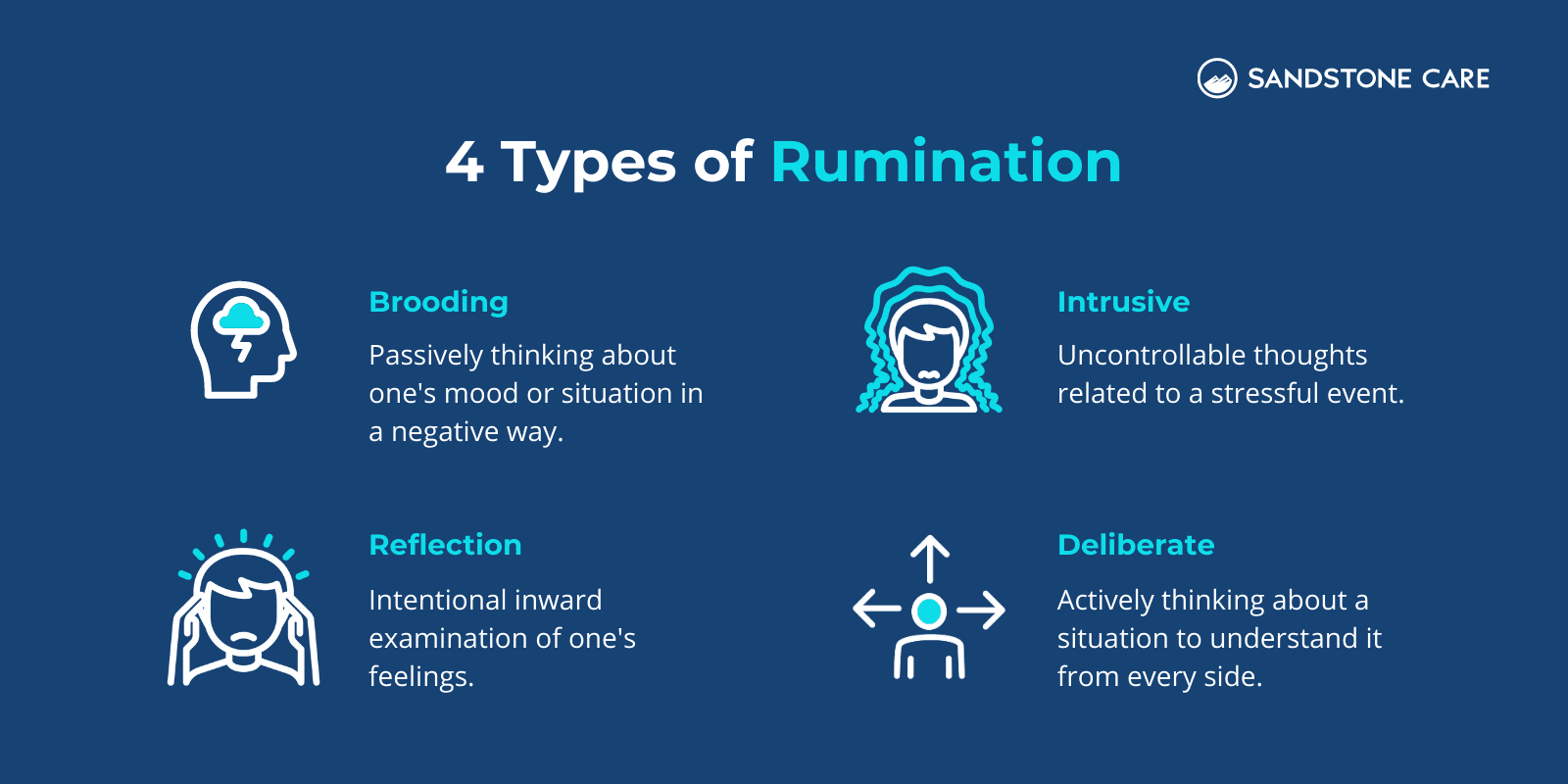
Is rumination an ADHD or OCD symptom?
Rumination isn’t limited to OCD — it’s also tied to worsening symptoms in conditions like depression, anxiety disorders, and attention-deficit/hyperactivity disorder (ADHD).
In a 2020 study, researchers investigated connections between ADHD and mental activities such as mind-wandering and rumination. Their findings suggested links between ADHD symptoms and various forms of rumination.
What causes or triggers rumination in OCD?
An OCD trigger is anything that increases OCD symptoms. For rumination in OCD, triggers that heighten obsessions often also raise the urge to ruminate.
OCD operates in a loop: obsessions provoke compulsions, which deliver short-lived relief until another trigger revives the obsessions. So even though rumination may temporarily reduce anxiety, the relief doesn’t last and the pattern restarts.
Coping strategies and treatments for rumination OCD
A crucial early step in addressing OCD rumination is recognizing it as a compulsion and understanding that mulling over obsessions doesn’t eliminate them. Instead, rumination perpetuates the obsession-compulsion cycle.
After grasping how rumination worsens symptoms, the next step is learning to notice when you’re doing it. Awareness makes it possible to interrupt or shift the behavior.
It’s also important to pursue evidence-based treatments for OCD, such as therapy and, when appropriate, medication:
- Therapy: Exposure and response prevention (ERP) is the most effective therapeutic approach for OCD-related behaviors like rumination. ERP helps you confront triggers and obsessions without resorting to compulsions like rumination to reduce anxiety.
- Medications: Medications can also help, particularly when paired with therapy. Selective serotonin reuptake inhibitors (SSRIs) and certain tricyclic antidepressants are commonly prescribed to lessen OCD symptoms.
If rumination is keeping you trapped in the OCD loop, help is available. Consider consulting your doctor or therapist to explore suitable treatment options.
Takeaway
Rumination appears across many mental health conditions and is one of the more common compulsive behaviors in OCD.
Although ruminating can produce brief relief, it becomes increasingly difficult to stop and ultimately fuels more anxiety and distress. With appropriate treatment, however, people can reduce rumination and better manage OCD in daily life.





















Leave a Reply
You must be logged in to post a comment.