Try These Squats for Glutes for a Well-Rounded Workout


- Which muscles do conventional squats target?
- How to increase glute engagement
- Squat stance
- Squat depth
- Movement strategy
- Consciously squeezing the glutes
- 4 squat variations to hit the glutes
- 1. Sit-to-stand (box) squat
- 2. Resistance-band squat
- 3. Sumo squat
- 4. Goblet squat
- General tips for squatting to target glutes
- Final thoughts
For lots of people, squats are the default movement for building a firmer, stronger backside.
Squats are a valuable functional exercise — they can make everyday tasks like bending and lifting simpler. They’re also an effective method for developing muscle and strength in the lower body.
That said, many lifters notice squats emphasize the quadriceps (front of the thighs) more than the glutes. To shift more workload onto the glutes, it’s helpful to understand correct technique, range of motion, and variations that bias the movement toward the glute muscles.
This piece explains what you need to know about using squats to strengthen your glutes and outlines four squat variations to try.
Which muscles do conventional squats target?
Squats are a comprehensive lower-body exercise because they recruit several muscle groups. The primary muscles involved are the quadriceps, gluteus muscles (primarily the gluteus maximus), hamstrings, calves, abdominal musculature, and spinal erectors (1 ).
Whether your quads or glutes do more work depends on your stance, body structure, movement strategy, and how deep you go (1 , 2 ).
For instance, letting the knees travel forward makes the exercise quad-dominant, whereas hinging the hips back into a deeper squat shifts emphasis to the glutes (1 ).
Summary: Squats are an effective lower-body movement that works your quadriceps, glutes, hamstrings, calves, and core.
How to increase glute engagement
As noted above, how much your glutes fire during a squat is influenced by stance, movement pattern, squat depth, and individual anatomy. While a basic squat does engage the glutes, small tweaks can shift more load onto them.
Squat stance
Everyone’s optimal stance varies with their anatomy and comfort.
Using a conventional stance (feet just outside shoulder width with toes slightly turned out) encourages external hip rotation and often allows a deeper squat, increasing glute involvement (1 , 2 , 3 ).
A wider stance (the “sumo” style) may also help by keeping the hips externally rotated and letting you handle heavier loads (1 , 2 , 3 ).
Foot angle differs between people, but it should generally sit between pointing straight ahead and about a 45-degree outward turn. Make sure both feet mirror each other (4 ).
Squat depth
Your squat depth is largely dictated by your mobility (flexibility, past injuries) and body proportions (leg-to-torso ratio) (5 ).
To best engage the glutes, aim to squat until your thighs are at least parallel with the floor. If you can safely go deeper without breaking form or feeling pain, you may activate the glutes even more (6 , 7 , 8 ).
Movement strategy
When lowering into the squat, aim to hinge at the hips rather than thrust the knees forward, which tends to overwork the quads.
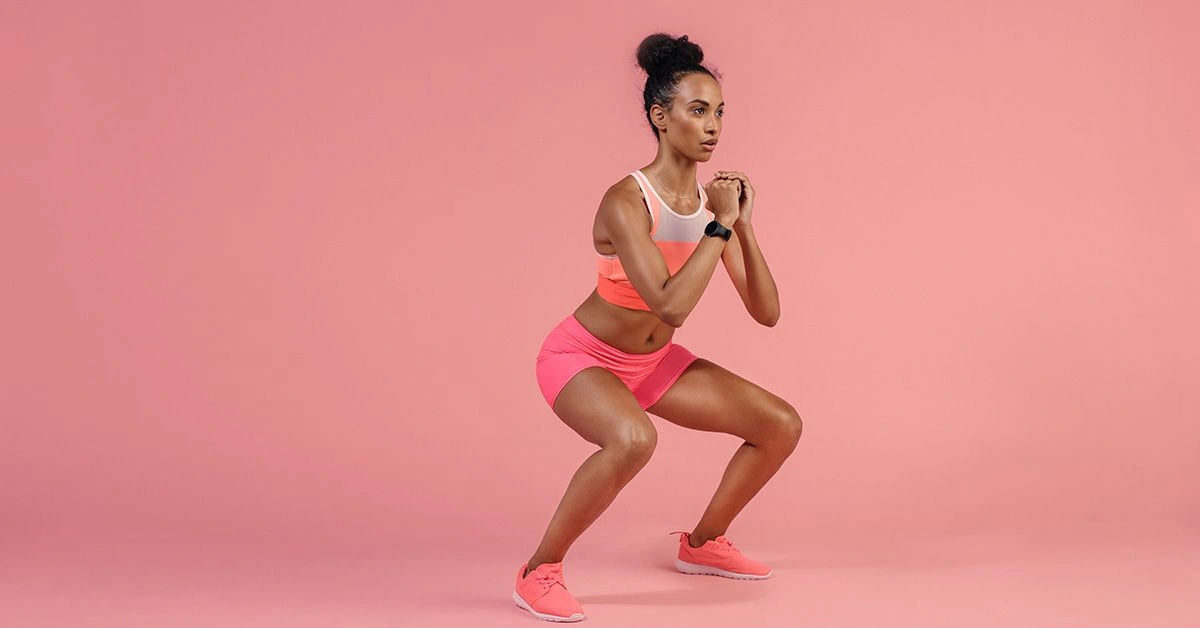
Think about pushing your hips back as you descend — like sitting down on a chair — and ensure your hip crease sits below your knees at the bottom of the movement. This increases range of motion and glute activation (1 ).
Also watch your knee alignment. Avoid having your knees collapse inward (knee valgus). Instead, cue your knees to track slightly outward — this encourages glute recruitment and lowers the risk of knee discomfort (1 , 3 , 9 ).
Consciously squeezing the glutes
If you still struggle to feel your glutes, intentionally contract them as you stand up from the squat — this cue can boost glute activation (2 , 10 ).
Be careful, though, not to thrust your pelvis forward or hyperextend your lower back at the top of the movement, as that breaks sound technique.
Summary: Small adjustments to stance, foot angle, and squat depth can enhance glute engagement.
4 squat variations to hit the glutes
If you want more variety in your squat work, try these four effective squat variations.
1. Sit-to-stand (box) squat
To build confidence and reinforce solid mechanics, begin with the sit-to-stand or box squat.
Equipment: a box or chair at or just below knee height
- Stand with feet slightly wider than shoulder width, with your back facing the box or chair. Turn your toes out slightly (45 degrees or less).
- Slowly hinge at the hips, push your butt back, and bend your knees until your glutes touch the box (avoid fully sitting).
- Press through your heels and squeeze your glutes to stand up. That counts as 1 rep.
- Do 2–3 sets of 12–15 reps.
Move deliberately to engrain proper technique. When this feels easy, progress to harder squat variations.
Tip: If you lack a box but have a low bench, straddle it and perform the same pattern.

2. Resistance-band squat
Adding a loop band helps promote hip external rotation and prevents the knees from collapsing inward, increasing glute involvement. If it feels too challenging, remove the band until you master a bodyweight squat.
Equipment: loop resistance band
- Place the band just above your knees. Stand with feet slightly wider than shoulder width, toes turned out a little, and hands on hips or in front.
- Hinge at the hips, push your butt back, and bend your knees to descend into a squat.
- Lower until your thighs are parallel to the floor or deeper. Pause 1–2 seconds.
- Slowly stand by pressing through your heels and squeezing the glutes. That’s 1 rep.
- Perform 2–3 sets of 8–12 reps.
3. Sumo squat
The sumo squat is particularly effective at engaging the glutes. The wider stance keeps the hips externally rotated, promoting greater glute work.
- Stand with feet wider than shoulder width, toes angled outward slightly, and hands extended in front of you.
- Push the hips back, hinge, and bend the knees as you lower. Your knees should move outward under control.
- Descend as far as you comfortably can without pain.
- Return to standing by driving through the heels and squeezing the glutes while keeping the knees pushing outward. That’s 1 rep.
- Do 2–3 sets of 12–15 reps.
Tip: After nailing the form, add load with a mini-band, dumbbell, or barbell for extra stimulus.
4. Goblet squat
The goblet squat is a practical option that helps stop the knees from collapsing and encourages an upright torso.
Equipment: a single dumbbell
- Stand with feet slightly wider than shoulder width. Hold a dumbbell by the head at chest level, elbows tucked.
- Lower by hinging at the hips, pushing the butt back, and letting the knees track outward. Keep the dumbbell close to your chest and your elbows between your knees as you descend to discourage knee collapse.
- Stand back up by driving the knees outward, pressing through your heels, and squeezing the glutes. That counts as 1 rep.
- Complete 2–3 sets of 8–12 reps.
Tip: Keep the weight close to your chest and maintain tucked elbows throughout the movement.

Summary: Adding different squat styles into your program helps target the glutes more effectively and can improve results.
General tips for squatting to target glutes
Use these cues to refine your squat, boost glute activation, and reduce injury risk (1 , 2 , 11 ):
- Press through the heels. This improves balance and places more tension on the glutes.
- Focus on the glutes. A strong mind-muscle link helps you intentionally recruit your glutes during the movement.
- Keep a neutral torso. Avoid excessive forward lean, rounding, or arching. Brace your core to maintain a neutral spine.
- Maintain a neutral pelvis. Don’t tuck the pelvis during the descent, which can stress the lower back.
- Align knees with toes. Let your knees track in line with your toes rather than collapsing inward.
- Look ahead. Avoid looking down, which can strain the neck.
- Prioritize technique over load. Only increase weight or volume once you can perform flawless reps. Reduce weight if form breaks down.
- Warm up first. Light glute activation drills before squatting can help “wake up” the muscles.
Take your time to dial in technique before progressing to more demanding squat variations for the best outcomes.
Summary: Mastering squat form requires patience but delivers the best muscle-building and injury-prevention benefits.
Final thoughts
Squats are a foundational lower-body exercise that help develop stronger glutes and legs.
To get the most glute activation from squats, use a stance at or wider than shoulder width, point your toes slightly outward, and squat as deep as your mobility and comfort allow.
Consistent practice of correct technique ensures you’re loading the glutes effectively while minimizing injury risk. Once you’re comfortable with the movement, increase resistance or explore different variations.
If squats aren’t yet part of your training, consider adding them now — and if you need mobility work to feel them more, learn how to stretch glutes to support your progress.
Frequently Asked Questions
A stance at or slightly wider than shoulder width with toes turned out slightly often encourages hip external rotation and deeper squats, which helps engage the glutes more than a narrow stance.
Aim for at least parallel (thighs parallel to the floor). If you can safely go deeper without pain or form breakdown, deeper squats typically increase glute activation.
Yes. Loop bands placed above the knees promote hip external rotation and prevent knee valgus, helping the glutes fire more during the squat.
Box (sit-to-stand) squats are great for beginners because they reinforce hip-hinge mechanics and controlled depth, building a solid foundation for glute-focused squatting.
Look for feeling tension in the buttocks during the ascent, ensure knees track outward, press through the heels, and try a conscious glute squeeze at the top—if you feel these cues, your glutes are likely activating.

Related Posts
Tire Workouts: What You Need to Know Before Starting
Sep 14, 2026 • 7 min read
7 Easy Ways to Stretch Tight Glutes
Sep 18, 2026 • 7 min read
Pregnancy Yoga Stretches for Back, Hips, and Legs
Sep 15, 2026 • 11 min read
8 Alternatives to Leg Curls
Sep 14, 2026 • 36 min read
10 Ways to Stretch and Strengthen Your Lats
Sep 15, 2026 • 9 min read