

Asperger’s and narcissistic personality disorder (NPD) share some overlapping features, yet they are distinct diagnoses. It’s possible for someone to live with both autism and a personality disorder at the same time.
Narcissism is a personality characteristic that many people may display to varying degrees. People labeled as “narcissists” are often described as having an inflated sense of self, limited empathy, or a strong sense of entitlement.
Occasional narcissistic behavior differs from narcissistic personality disorder — a mental health condition that persistently affects a person’s thoughts, emotions, and actions and causes marked distress or impairment.
Asperger’s is a neurodevelopmental condition. The term “Asperger’s” is now included under the autism spectrum disorder (ASD) classification in diagnostic manuals, and some experts advise caution in using the historical label “Asperger’s.” Many people still identify with the term, but new clinical diagnoses are made as ASD.
Although Asperger’s and NPD are separate, certain signs can look similar. Clinicians often need to consider and rule out personality disorders when assessing autism in adults.
Narcissism versus NPD
In this piece, we may use “narcissism” when referring to NPD in some contexts. Keep in mind that many people can show narcissistic traits, while up to only 5% of people are estimated to meet criteria for NPD.
Can Asperger’s be mistaken for narcissism?
Narcissistic traits or NPD can sometimes be confused with Asperger’s because certain behaviors can appear alike.
Primarily, the overlap is in social interaction and communication styles seen in autistic individuals and people with NPD.
Individuals with either condition may struggle with:
- initiating and maintaining relationships
- expressing or experiencing empathy
- attentive listening or responsiveness to others
- daily functioning at work, school, or in social contexts because of relational difficulties
However, the root causes for these problems distinguish the two.
A person with Asperger’s may seem aloof or self-focused because they are compensating for challenges in social communication. In contrast, someone with NPD may present as arrogant or self-centered because they genuinely feel superior to others.
A 2014 study reported that some autistic individuals can display “narcissistic-like” behaviors, including:
- being reluctant to acknowledge mistakes
- being highly sensitive to critique while being overly critical of others
- appearing preoccupied with themselves
Those descriptions can also match behaviors seen in NPD.
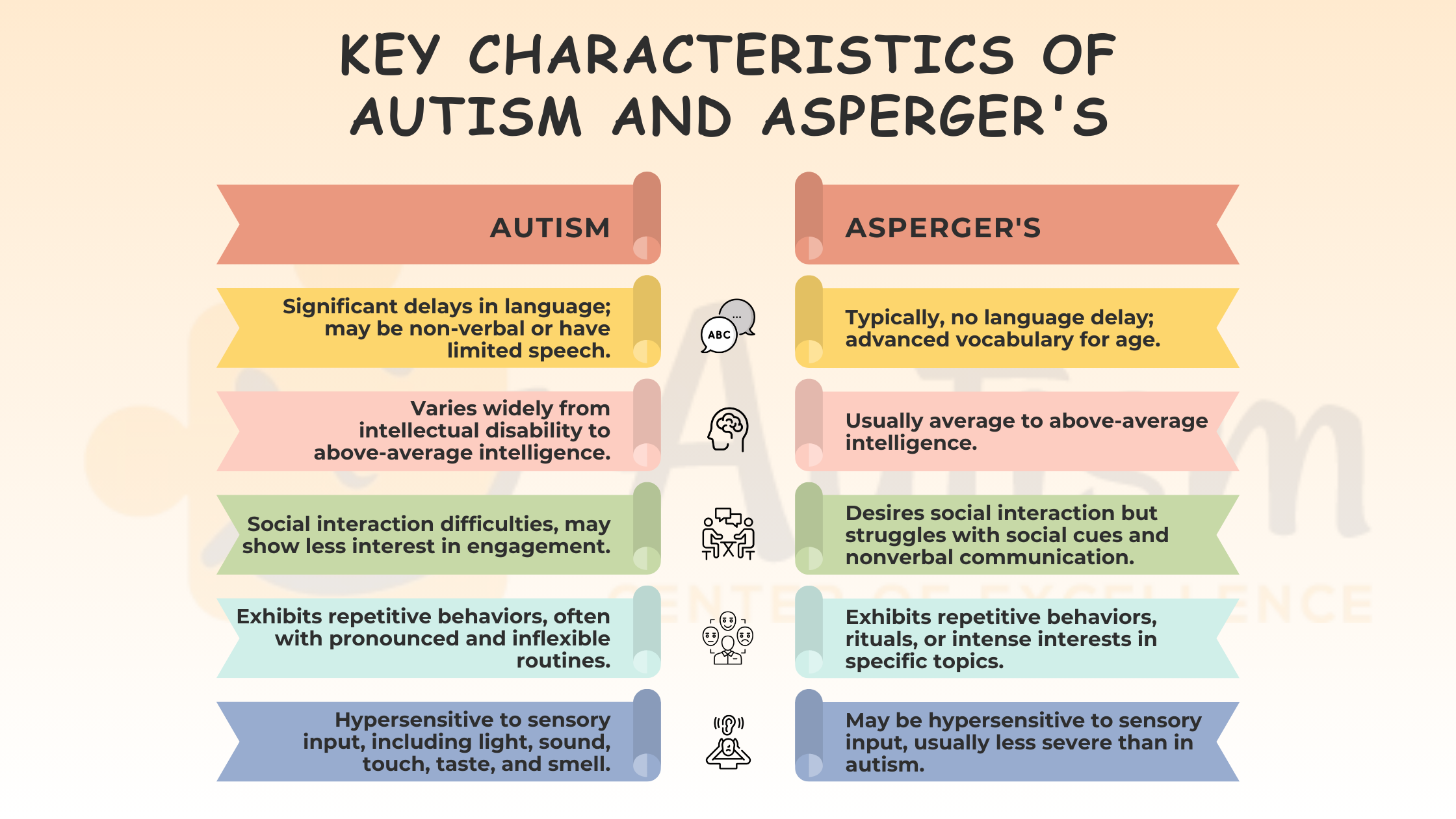
How to distinguish Asperger’s from narcissism
There are many symptoms that differentiate the two conditions.
Asperger’s is a neurodevelopmental disorder, whereas personality disorders are enduring patterns that shape thoughts, emotional reactions, interpersonal relations, and behavior regulation.
Key differences between autism and narcissism include:
- Restricted and repetitive behaviors: An ASD diagnosis requires evidence of restricted or repetitive behaviors. These are typically absent in people with NPD.
- Reason for seeming unempathetic: Both groups may be described as lacking empathy. Autistic people often seem unempathetic because of difficulties with social cues and nonverbal communication, whereas those with NPD may be self-focused and unwilling or unable to consider others’ feelings.
- Focus of preoccupation: Individuals with NPD are frequently preoccupied with fantasies about themselves, while autistic individuals are more likely to be absorbed by objects, parts of objects, or specific interests.
- Why narcissistic traits appear: An autistic person may come across as egotistical as a strategy to cope with social interaction challenges. A person with NPD may behave arrogantly because they truly believe in their superiority, lack empathy, or exploit others to meet their needs.
Signs of narcissism
Common NPD signs include:
- a pronounced sense of self-importance and grandiosity, often exaggerating personal achievements
- difficulty recognizing or caring about others’ feelings
- preoccupation with fantasies about success, attractiveness, love, or power
- a strong need for admiration
- a belief in special treatment or entitlement
- deliberately using others for personal gain
- a haughty, arrogant, or self-centered demeanor
- frequent jealousy or the conviction that others envy them
Symptoms can vary based on severity and co-occurring issues like depression, substance misuse, or other personality disorders.
An NPD diagnosis is made only after a clinician documents a long-standing pattern of these traits. Most professionals avoid diagnosing personality disorders until a person reaches adulthood.
Signs of Asperger’s
As described in a 2006 review, DSM-IV criteria for Asperger’s included:
- difficulties with nonverbal behaviors such as eye contact and gestures
- limited interest in sharing experiences with others
- a lack of social and emotional reciprocity
- intense focus on specific interests
- rigid routines and rituals
- repetitive motor movements like hand flapping or whole-body motions
- preoccupation with parts of objects
Under DSM-IV, an Asperger’s diagnosis required that these traits significantly impair daily functioning and that there be no substantial delay in language or cognitive development. In DSM-5-TR, these presentations are diagnosed as ASD instead.
Is there a link between narcissistic abuse and autism?
Narcissistic abuse usually refers to emotional or psychological mistreatment. Anyone in a relationship with someone with NPD — whether a parent, partner, family member, or friend — can experience this form of abuse.
There isn’t a straightforward, direct link between narcissistic abuse and autism. Still, 2019 research indicates autistic children face a higher likelihood of maltreatment.
A 2015 study also found that children with elevated autistic traits are at increased risk of being subjected to sexual, emotional, and physical abuse.
Consequently, people on the autism spectrum may be more vulnerable to narcissistic abuse.
For related reading, see resources about aspergers in adult relationships and comparisons like histrionic vs narcissistic.
Can narcissism and autism occur together?
Research is limited and more evidence is needed, but some studies show overlap. For example, 2023 research reported that 68% of autistic participants met criteria for at least one personality disorder.
A 2021 review found that between 0% and 6.4% of people with ASD also met criteria for NPD.
While simultaneous diagnoses of ASD and NPD can occur, autism more commonly co-occurs with other personality disorders such as:
- borderline personality disorder (BPD)
- obsessive-compulsive personality disorder (OCPD)
- schizotypal personality disorder
Researchers note that people diagnosed with personality disorders are more likely to meet criteria for ASD, and adults with undiagnosed autism may have an elevated risk of developing a personality disorder.
Takeaway
The relationship between autism and narcissism is complex and still under study.
Both autistic individuals and those with NPD can struggle with social communication and relationships. While the drivers behind certain behaviors differ between conditions, outsiders may interpret these behaviors as self-centered, unempathetic, or narcissistic regardless of whether they stem from ASD or NPD.
Nonetheless, autism and NPD are separate disorders that typically require different supports and interventions.
It is possible, though uncommon, to receive both ASD and NPD diagnoses; autism more frequently co-occurs with other personality disorders such as borderline personality disorder.






















Leave a Reply
You must be logged in to post a comment.