

Spotting poison ivy means knowing how it appears across the seasons, since its hue and shape shift throughout the year.
If you spent your childhood near woods or fields, you’ve likely heard the saying, “leaves of three, let it be.”
That short, memorable caution is meant to keep you from touching or brushing up against poison ivy. Why? The plant’s leaves contain an oily resin called urushiol that commonly triggers an allergic reaction and a rash.
Even if you didn’t grow up around forests, you might be surprised to learn poison ivy thrives in sidewalk cracks, empty lots, and other small urban or suburban spaces. In fact, it grows in every U.S. state except Alaska and Hawaii.
So beyond remembering that old rhyme, here’s what you should know about recognizing — and steering clear of — poison ivy.

How to identify poison ivy
Poison ivy presents differently at each stage of its life cycle. Here’s what to watch for in every season.
In the spring
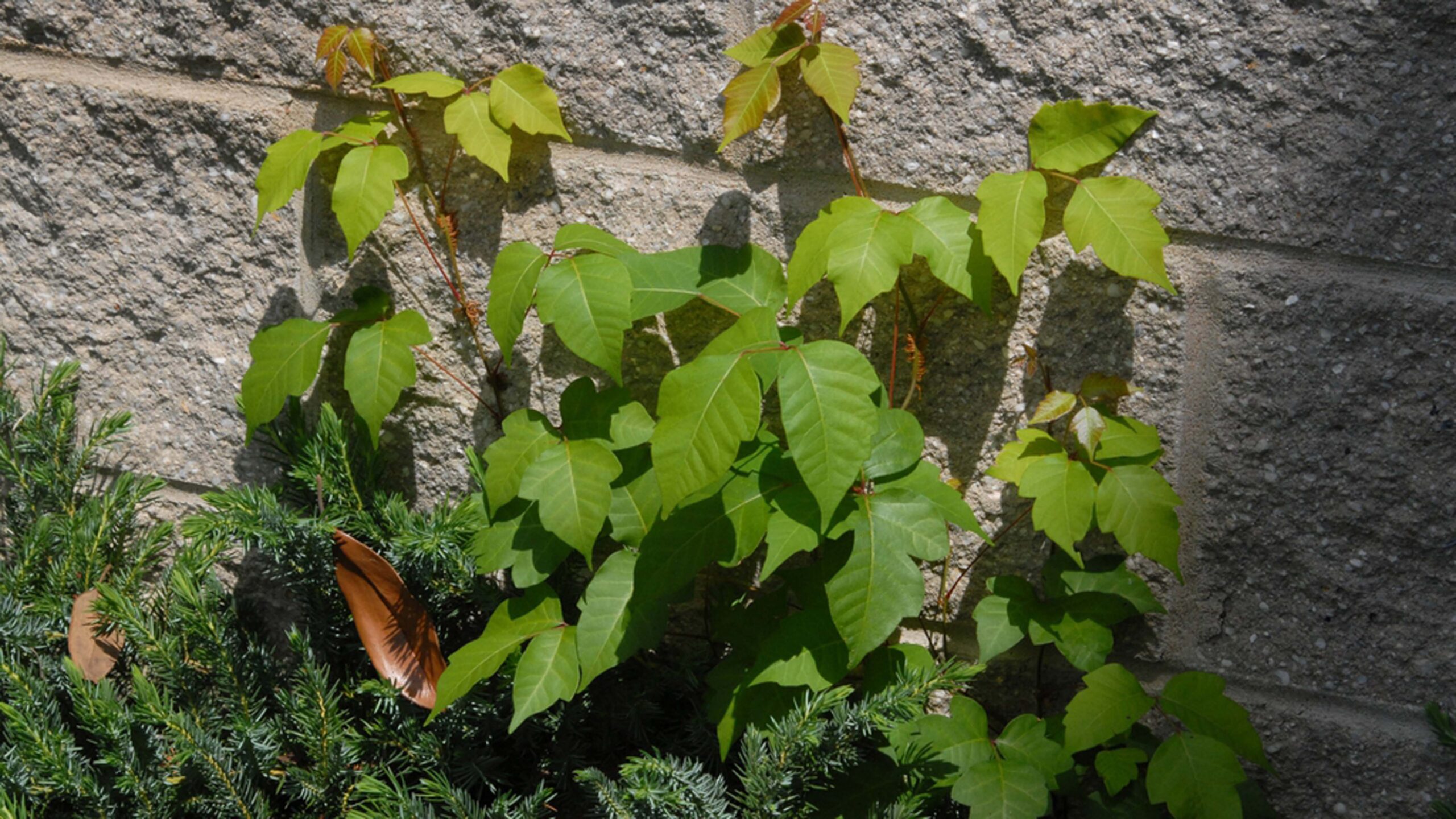
When poison ivy first emerges in spring, the leaves can be red or a mix of red and green. Some people mistake these early leaves for fragrant sumac, which also has red foliage.
Green flower buds appear in spring and gradually open into small white flowers.
In the summer
As temperatures rise and poison ivy matures, older leaves turn fully green while new growth may still start red.
The plant bears small, off-white berries that can be concealed by foliage but are visible along stems if you look closely.
Leaf size ranges from small to quite large.
Leaf margins can vary too. Sometimes the edges are deeply notched, causing the leaves to resemble those of other species such as Virginia creeper or oak.
Individual vines can climb high. If left alone, poison ivy vines can engulf structures and spread extensively along the ground.
In the fall
As days shorten and temperatures cool, poison ivy’s leaves shift to bright orange, yellow, or red. It’s strikingly colorful then, but still unsafe to touch.
In the winter
In cold months, poison ivy leaves darken to deep red before withering and dropping.
Roots may be exposed and appear either hairy or bare. Those roots can also cause a rash and will continue to grow, attaching to trees, walls, or ground cover.
Exposed white berries may be visible on the bare branches during winter.
You might notice thin, bare poison ivy stems poking through snow in wintertime.
Identify poison ivy online
PoisonIvy.org provides photographs of poison ivy throughout the year you can browse. You can also upload your own photo to confirm whether it’s poison ivy or a look-alike.
Poison ivy vs. poison oak
Like poison ivy, poison oak contains urushiol, the oil that provokes allergic responses.
Poison oak closely resembles poison ivy. It commonly has three leaves but can display up to seven leaflets per cluster. Leaves may be green, red, or a combination.
Poison oak’s leaf edges are often more deeply lobed than poison ivy’s and may have a textured, slightly hairy surface.

Poison ivy vs. poison sumac
Poison sumac also carries urushiol and should not be handled.
Unlike poison ivy and oak, poison sumac’s leaves are always arranged in larger clusters of 7 to 13 leaflets per stem. It doesn’t form ground cover; it grows taller and resembles a shrub or small tree.
How to remove poison ivy
If poison ivy is growing near your home, you’ll want to eliminate it safely and promptly. Remember the don’ts as well as the do’s when removing it.
Don’t
- try to remove leaves, branches, roots, or vines with bare hands or exposed skin, even if you’ve never reacted before; repeated exposure can trigger sensitivity
- burn poison ivy, because inhaling smoke, steam, or vapors containing urushiol can be dangerous
Do
- pull poison ivy up by the roots and place it in sealed plastic bags, making sure to remove the entire root to prevent regrowth
- wash or discard clothing, hats, and gloves in very hot water and shower at once
- eradicate poison ivy with a homemade spray of vinegar, salt, and dish soap (instructions below)
Make a spray
- Dissolve 1 cup of coarse salt in 1 gallon of white vinegar.
- Warm the solution until the salt fully dissolves.
- Add 8 to 10 drops of dishwashing liquid.
- Spray or pour directly onto all poison ivy plants. This mixture will kill any vegetation it contacts, so protect desirable plants.
About poison ivy
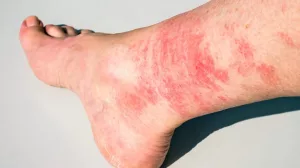
Poison ivy is a toxic plant that produces a red, blistering, intensely itchy rash.
You can’t catch poison ivy from another person, but you can develop a reaction by touching something that has urushiol on it, such as a pet or clothing.
Urushiol, the oily irritant
Urushiol is an oily, resin-like compound that causes allergic reactions and rashes. It can remain on clothing and surfaces for two years or more unless washed away.
Urushiol is present in all parts of the poison ivy plant, including:
- leaves
- flowers
- berries
- roots
- bark
- stems
Can irritate your skin in all seasons
People often associate poison ivy with spring and summer because it’s more visible then, but don’t assume it poses no risk at other times.
Most individuals remain highly sensitive to the plant during its entire life cycle, including winter.
Types of poison ivy
There are two main varieties, Eastern and Western. Despite the names, both can be found across the country because they interbreed. Features to note include:
- Both types look similar and usually have clusters of three leaflets on slender stems.
- Leaves may range from green to red or orange and vary in shape.
- Leaf tips may be pointed or rounded, with edges that are either jagged or smooth.
- Poison ivy produces dull white berries and very small white flowers.
- Eastern poison ivy can grow as a ground-hugging vine or a climbing vine. Western poison ivy can be a woody shrub or a climbing woody vine that may reach 3 to 9 feet.
- In some cases, poison ivy can become so dense and tall that it resembles a shrub or small tree.
What to do if you get the rash
- A poison ivy rash can show up anywhere from 12 hours to several days after exposure to urushiol.
- If you suspect contact with poison ivy, remove clothing while wearing disposable gloves and wash your skin promptly.
- Take an oral antihistamine to help reduce the allergic response and ease itching.
- Apply hydrocortisone cream or calamine lotion gently to affected areas.
- Use colloidal oatmeal baths or compresses to soothe the skin.
- Avoid scratching.
- If symptoms are severe, consult your doctor.
Key takeaways
Poison ivy typically has leaves of three, but other plants do too. A sensible rule: if you suspect it might be poison ivy, keep your distance.
Exposure to urushiol — the oily compound that causes reactions — can occur from touching any part of the plant or anything that has urushiol on it.
Poison ivy can provoke an allergic reaction and an itchy rash at any time of year, not only in spring and summer.



















Leave a Reply
You must be logged in to post a comment.