
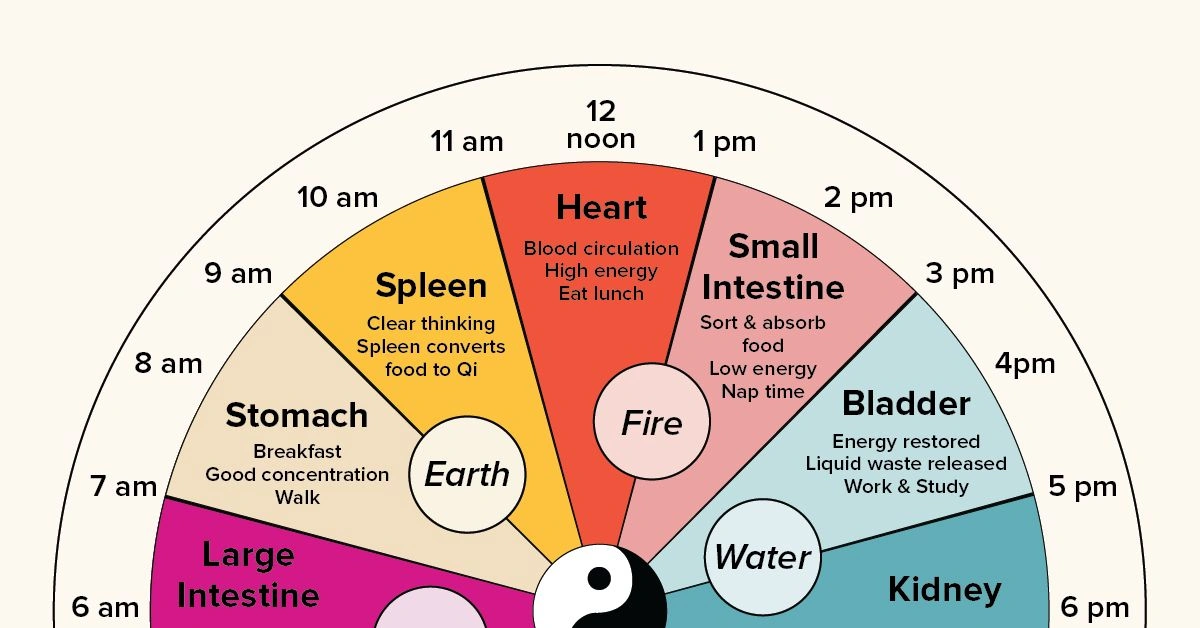
You may be familiar with the body’s biological clock, but have you come across the Chinese body clock?
Originating from traditional Chinese medicine, this clock rests on the idea that you can optimize your energy and organ function by aligning activities with the times those organs are believed to be most active.
The peak times for different organs are not the same. For instance, the lungs are thought to be most active between 3 a.m. and 5 a.m.
But does that imply you should rise with the dawn to exercise and take advantage of these organ peaks? Are there meaningful benefits to following the principles behind the Chinese body clock?
Below, we’ll explore what the concept entails, why proponents consider it helpful, and what scientific research has to say.
What is the Chinese body clock?
To grasp the Chinese body clock, you first need to understand the idea of qi. In short, qi is the term used in Chinese medicine to describe life energy. It encompasses energy in many senses — from the Earth to your body, and even thoughts and emotions.
Qi is also seen as dynamic. It continually shifts and transforms as it flows within the body or between people and things.
The Chinese body clock is founded on this movement of qi. Over a 24-hour period, qi is believed to circulate through organ systems in 2-hour phases. While you sleep, qi is thought to withdraw and replenish the body.
One key 2-hour window is 1 a.m. to 3 a.m., when the liver is considered to be purifying the blood. Around this interval, the body begins readjusting so qi can move outward again.
The table below links organs with their corresponding 2-hour intervals on the Chinese body clock.
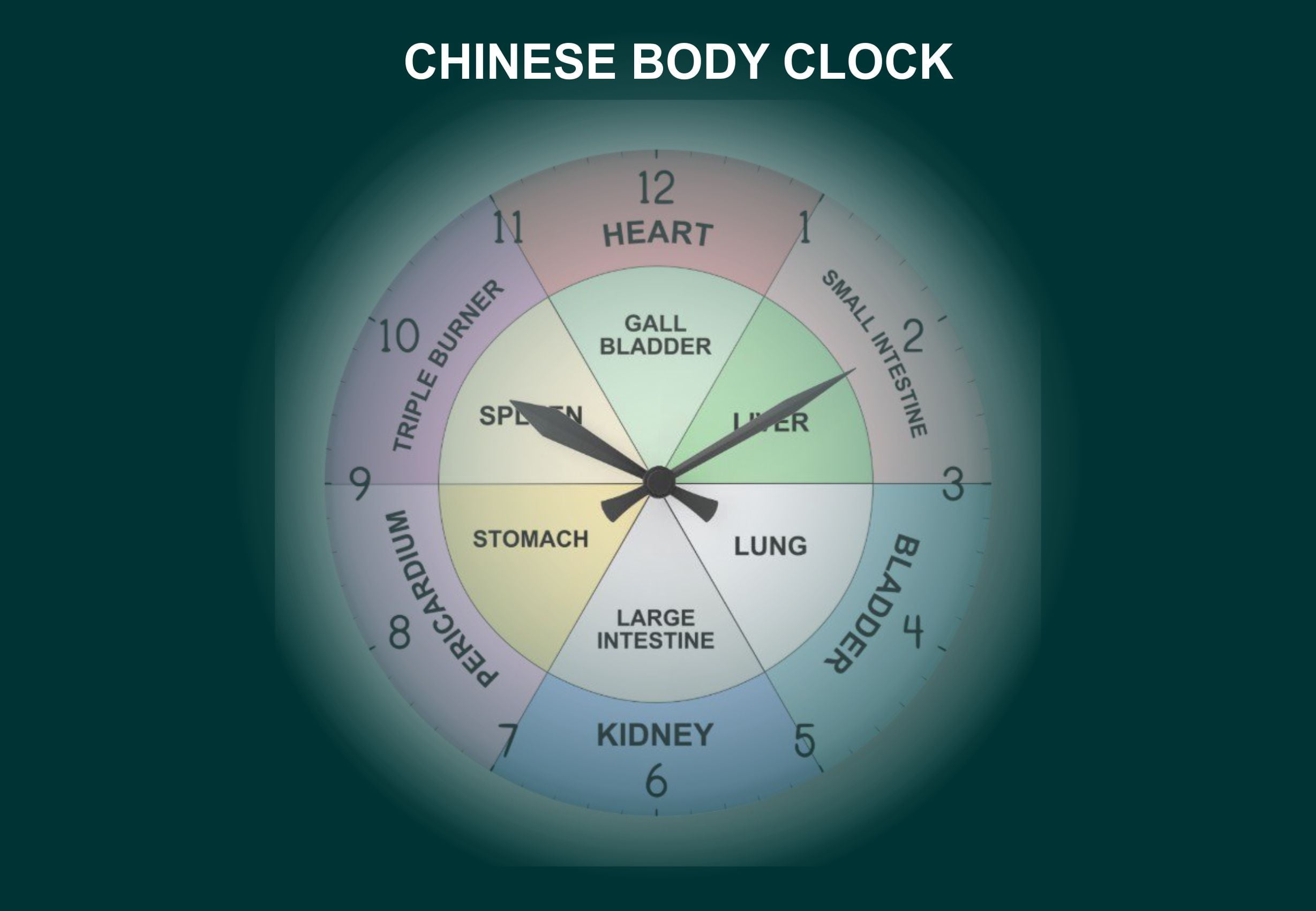
| 2-hour interval | Organ and peak function |
| 3–5 a.m. | Lung: This window is when lung energy is said to be at its highest. It’s considered an ideal period for exercise, rather than later in the day. |
| 5–7 a.m. | Large intestine: This is thought to be the time to allow the large intestine to perform its elimination functions. |
| 9–11 a.m. | Spleen: The spleen is viewed as connected to the stomach and responsible for receiving and processing food and drink. During this period, qi is believed to be pushed upward by the spleen. |
| 11–1 p.m. | Heart: Since the heart symbolizes calmness, supporters recommend minimizing stress during this time. |
| 1–3 p.m. | Small intestine: Heavier meals are thought to be better tolerated in this window, as qi expands and reaches a midday crest. |
| 3–5 p.m. | Bladder/kidney: The kidney is believed to hold qi and is closely linked to the bladder. Together they eliminate waste from the body. |
| 7–9 p.m. | Pericardium: The pericardium is seen as the protector of the heart. This period is when qi is supposedly balanced to prevent issues like nausea or vomiting. |
| 9–11 p.m. | Triple burner: The triple burner denotes the organ system as a whole, and it’s thought to produce its greatest heat during this interval. |
| 1–3 a.m. | Liver: Adherents recommend keeping the liver’s workload light during this time so it can focus on cleansing functions. That often means finishing dinner earlier and eating lightly in the evening. |
How might you apply the clock to improve health?
By following the Chinese body clock framework, proponents believe you can better utilize particular organs and bodily processes when they are strongest.
For example, because the lungs are said to peak between 3 a.m. and 5 a.m., waking early for exercise at that time is suggested as a way to take full advantage of lung function.
Some people also pair these timing ideas with practices such as acupuncture, dietary timing, or tuina massage to support organ health according to traditional beliefs.
What does the science say?
There is limited scientific evidence validating the accuracy of the Chinese body clock or confirming that adhering to these 2-hour windows improves organ performance.
That said, the body does possess internal timing mechanisms. A substantial body of research supports the existence of a biological clock that influences aspects like sleep and athletic performance.
Your body also follows circadian rhythms, which regulate temperature, eating and digestion patterns, and other physiological functions.
Takeaway
The Chinese body clock maps different organs to times of the day and centers on qi, or vital energy. Followers believe that timing activities to coincide with an organ’s peak can help you harness your qi and better support bodily functions.
However, there is minimal scientific proof that strictly following the Chinese body clock produces measurable health benefits.






















Leave a Reply
You must be logged in to post a comment.