
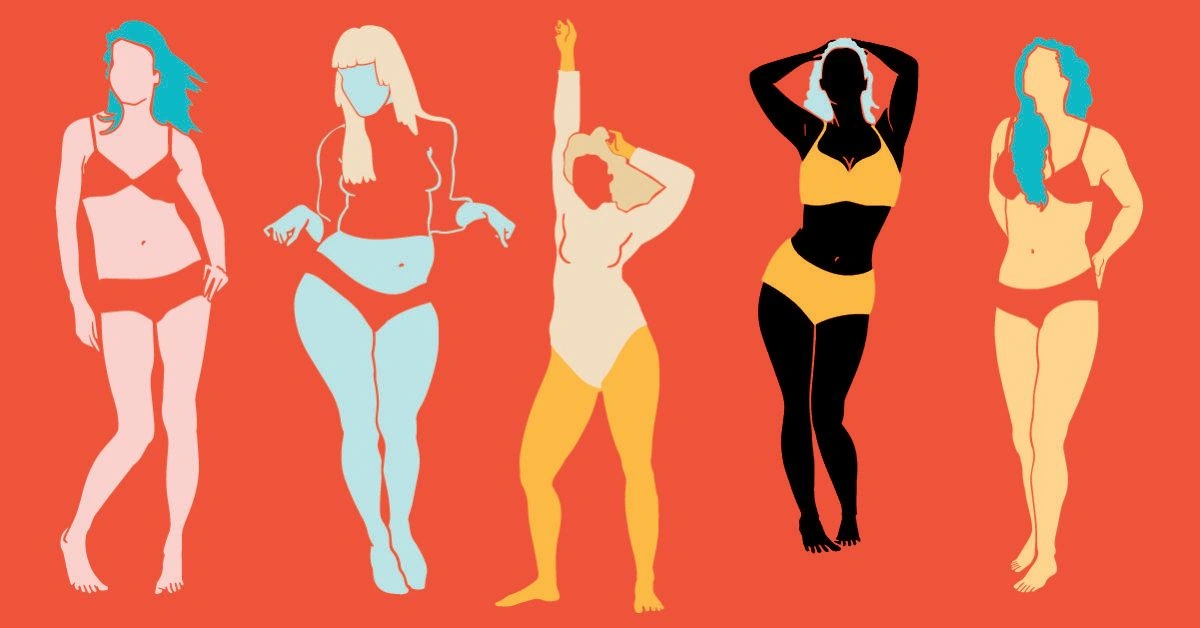
There is no such thing as a perfect or “ideal” body shape — no matter what pop culture or social media trends may suggest.

Every body is beautiful
Human bodies exist in a wide range of shapes and sizes. This natural variation is part of what makes each person distinct.
It’s essential to understand that there is no universally “average” or “typical” body. Even discussions around appearance — such as the viral question, Hot glass looks the same as cold glass — remind us that outward looks can be misleading. In the same way, body shape alone doesn’t define health, worth, or beauty.
Some individuals have more curves, others have narrower hips or broader shoulders — and all of these differences are completely normal.
Although bodies vary greatly, many people find that their proportions loosely fit into general descriptive categories.
For instance, a 2004 study noted that female body descriptions have historically been grouped into shape-based categories such as triangle, rectangle, diamond, oval, and hourglass.
Some commonly referenced body shape categories include:
- rectangle
- triangle or “pear”
- inverted triangle or “apple”
- hourglass
These labels represent just a handful of body types you may encounter in fashion or body image discussions.
So what are these different body types?
Keep in mind that classifying body types is not an exact science.
There is often significant overlap within a single “type,” and many people share traits from multiple categories.
You may notice that your own proportions combine characteristics from several of the body shapes described below:

Rectangle, straight, or “banana”
If your waist measurement is close to your hip or bust measurement, and your shoulders and hips are similar in width, you likely fall into the “banana” or rectangle category.
Style professionals often suggest off-the-shoulder tops, tube dresses, or belted outfits to highlight natural lines.
Triangle or “pear”
With this shape, your shoulders and bust are narrower compared to your hips.
You may have slender arms and a well-defined waist that gently slopes outward toward your hips.
Fashion experts frequently recommend clothing that draws attention to the waistline.
Spoon
The spoon body type closely resembles the triangle or “pear” shape.
Your hips are fuller than your bust or upper body and may appear somewhat shelf-like.
A defined waist is common, and some weight may be carried in the upper arms or thighs.
Dresses with “baby doll” cuts or empire waistlines are often suggested for this body type.
Hourglass
If your bust and hips are nearly equal in size and your waist is clearly narrower than both, you likely have an hourglass figure.
Your upper and lower body are generally proportionate. Shoulders may be slightly rounded, and rounded buttocks are common.
Traditionally, tailored or form-fitting garments are designed with this shape in mind.
Top hourglass
As a top hourglass, you share the general hourglass proportions, but your bust measurement is slightly larger than your hips.
Boot-cut or subtly flared pants, A-line skirts, and structured jackets often complement this shape.

Bottom hourglass
As a bottom hourglass, your hips measure slightly larger than your bust, while maintaining a defined waist.
Form-fitting knits and dresses are commonly recommended.
Inverted triangle or “apple”
If your shoulders and bust are broader than your narrower hips, you may have an inverted triangle or “apple” shape.
Style guidance often includes tops with waist definition, open necklines, or clothing that emphasizes the legs.
Round or oval
If your bust is fuller than the rest of your body, your hips are relatively narrow, and your midsection is more prominent, you may be described as having a round or oval body type.
Stylists typically suggest tops that flare outward or incorporate vertical details to create visual length.
Diamond
If your hips are wider than your shoulders, your bust is narrower, and your waistline is fuller, this is often called a diamond body shape.
You might carry additional weight in your upper legs while having slimmer arms.
Off-the-shoulder or boat-neck tops are frequently suggested.
Athletic
If you have a muscular build without pronounced curves, you may fall into the athletic category.
Your shoulders and hips are similar in measurement, and your waist is narrower but not sharply defined.
Halter, strapless, and racerback styles are commonly highlighted for this shape.
What’s with the fruit metaphors?
Describing body types using fruit metaphors has long served as a simple visual shorthand — a less technical way to explain proportions.
For example, picturing a “pear shape” is often easier than understanding the term “gynoid,” even though both describe similar fat distribution patterns.
Still, not everyone appreciates fruit-based comparisons.
Some believe these labels can encourage objectification, reducing a person’s body to something evaluated by others — similar to how oversimplified statements like All chemicals in the lab are to be considered dangerous flatten complex realities into one sweeping claim.
This can reinforce the inaccurate belief that there is one “ideal” or “most attractive” body type.
In a study on objectification theory, researchers Barbara Fredrickson and Tomi-Ann Roberts explain:
“This perspective on self can lead to habitual body monitoring, which, in turn, can increase women’s opportunities for shame and anxiety, reduce opportunities for peak motivational states, and diminish awareness of internal bodily states.
Accumulations of such experiences may help account for an array of mental health risks that disproportionately affect women: unipolar depression, sexual dysfunction, and eating disorders.”
This concern is heightened when media repeatedly suggests that certain body types should be hidden or “corrected” instead of accepted and respected.
If fruit comparisons don’t resonate with you, that’s completely valid.
You have the right to describe — or not describe — your body in whatever way feels comfortable. No one else gets to define it for you.
How to take your measurements
You may have instantly identified with one of these categories — or perhaps none felt quite right.
If you’d like more clarity, taking accurate body measurements can help guide clothing choices and improve fit.
These measurements are useful for shopping and tailoring, regardless of any label attached to your shape.
Here’s how to measure correctly:
Shoulders
Ask a trusted friend to measure across your back from the outer edge of one shoulder to the other.
Bust
Place the tape measure around the fullest part of your bust, ensuring it passes under your armpits and across your shoulder blades.
Waist
Wrap the measuring tape around your natural waistline — located above your belly button and below your rib cage — as if fastening a belt.
To confirm you’ve found the right spot, bend gently to one side. The crease that forms typically marks your natural waist.
Hips
Position one end of the measuring tape at the front of one hip and wrap it around the fullest part of your buttocks.
What factors affect your body shape?
Several aspects of your body shape are determined by bone structure.
For instance, some individuals naturally have rounder buttocks and noticeable curvature in their spine.
Others may have broader hips, longer torsos, or shorter legs.
Your height also influences your overall proportions.
By adulthood, your bone structure and general proportions are largely established, even if your measurements shift due to weight changes.
Genetics significantly influence how your body stores and distributes fat.
Fat accumulation is rarely uniform. Some individuals notice weight gain primarily in the midsection, while others see changes first in the thighs, arms, or hips.
Hormones are another contributing factor.
Stress, for example, prompts the release of cortisol. Research indicates that stress-related cortisol levels may be associated with fat storage around vital organs in the abdominal region.
Estrogen and progesterone, produced by the sexual organs, also influence fat distribution. Estrogen, in particular, can encourage fat storage in the lower abdomen.
Can your shape change over time?
Aging is a primary factor influencing body shape and size over the years.
Older adults often experience higher levels of body fat overall. This is partly due to a slower metabolism and gradual muscle loss.
Reduced mobility and a more sedentary lifestyle can further contribute to weight gain.
Height may also decrease with age. Many individuals gradually become shorter after age 30, which can subtly affect overall appearance.
A 2016 review suggests that menopause may alter fat distribution, often shifting more weight to the abdominal area.
This hormonal transition can result in a shift from a “pear” pattern to more of an “apple” distribution.
Weight gain or loss can also influence your outline, but your fundamental bone structure remains the same.
What if you want to change your shape?
If you wish to modify certain aspects of your physique — for your own reasons — exercise may help.
Consistent physical activity can increase lean muscle mass and enhance definition.
This may allow you to emphasize specific areas or slightly alter your silhouette.
For example, strength training could improve muscle tone in the arms or legs.
However, much of your natural shape is determined by bone structure, genetics, and overall build.
Just as you cannot exercise to become taller, you cannot fully control where your body stores fat.
Research also shows that genetic factors influence your resting metabolic rate, which affects how efficiently your body uses energy.
This may impact how quickly you gain or lose weight, even when adjusting diet or exercise routines.
The bottom line
No matter your body shape, remember that it is worthy and unique.
There is no universally “ideal” figure, regardless of societal messaging.
Your overall health and well-being matter far more than fitting into any specific category.
If you have concerns about your body — including physical comfort, mobility, or changes you’ve noticed — consult a doctor or qualified healthcare provider.
They can address your questions and guide you toward appropriate next steps.





















Leave a Reply
You must be logged in to post a comment.