Normal Sleep Cycle vs. Narcolepsy: What to Know

- The normal sleep cycle, stage by stage
- What changes in narcolepsy
- Normal sleep cycle vs narcolepsy: side-by-side comparison
- How the pattern changes across the night — and across a lifetime
- Narcolepsy type 1 vs type 2
- How narcolepsy is diagnosed, step by step
- Step 1: Symptom review, sleep log, and actigraphy
- Step 2: Overnight polysomnography (PSG)
- Step 3: The Multiple Sleep Latency Test (MSLT)
- A note on sleep trackers and home tests
- Step 4 (selected cases): Hypocretin testing and HLA typing
- Conditions that can look like narcolepsy
- What happens after diagnosis
- When to see a doctor
- Sources
Every night, a healthy brain moves through a predictable sequence of sleep stages — light sleep, deep sleep, then dreaming sleep — repeating the cycle four to six times before morning. Narcolepsy breaks that pattern at its foundation. It is a neurological disorder in which the brain cannot properly control the boundaries between wakefulness and sleep, so pieces of dreaming (REM) sleep intrude into the day and nighttime sleep shatters into fragments.
Understanding the normal cycle first makes the differences stark. This article lays out both patterns stage by stage, compares them side by side, and then explains exactly how narcolepsy is diagnosed — including the two sleep studies and the precise numbers doctors look for.
The normal sleep cycle, stage by stage
A full sleep cycle lasts about 90 minutes (roughly 80–110 minutes), and most adults pass through four to six cycles per night. Each cycle runs through three stages of non-REM (NREM) sleep and ends with REM sleep. Deep sleep dominates the first half of the night, while REM periods grow longer toward morning — which is why vivid dreams cluster near waking.
| Stage | What happens | Share of the night | Key features |
|---|---|---|---|
| N1 — light sleep | The transition from wakefulness to sleep | About 5% | Lasts only a few minutes; easy to wake from; may include sudden muscle twitches (hypnic jerks) |
| N2 — intermediate sleep | The brain settles into stable sleep | About 45–50% | Marked by sleep spindles and K-complexes on EEG; body temperature and heart rate fall |
| N3 — deep (slow-wave) sleep | The deepest, most restorative stage | About 15–25% | Slow delta brain waves; hard to wake; growth hormone release, tissue repair, and immune support occur here; concentrated early in the night |
| REM — dreaming sleep | The brain becomes highly active while the body is paralyzed | About 20–25% | Rapid eye movements, vivid dreaming, temporary muscle paralysis (atonia); first REM period normally begins 70–100 minutes after falling asleep |
Two features of this architecture matter for the comparison below: in normal sleep, REM is kept waiting — you must pass through NREM first — and the sleep stages stay on their own side of the sleep–wake boundary, so you do not dream while awake or feel paralyzed while conscious.
What changes in narcolepsy
Narcolepsy results from a failure of the brain’s sleep–wake switch. In type 1 narcolepsy, the cause is the loss of brain cells that produce hypocretin (also called orexin), a chemical messenger that stabilizes wakefulness and keeps REM sleep in its proper place; experts suspect an autoimmune process destroys those cells. With the switch unstable, sleep and REM phenomena leak into the wrong states:
- Excessive daytime sleepiness (EDS): An overwhelming, persistent need to sleep that is present in everyone with narcolepsy, even after a full night’s sleep. It is usually the first symptom.
- Sleep attacks: Sudden, irresistible episodes of falling asleep — during a conversation, a meal, or dangerously, while driving. They may last from a few minutes to about half an hour, and short naps are often briefly refreshing before the sleepiness returns.
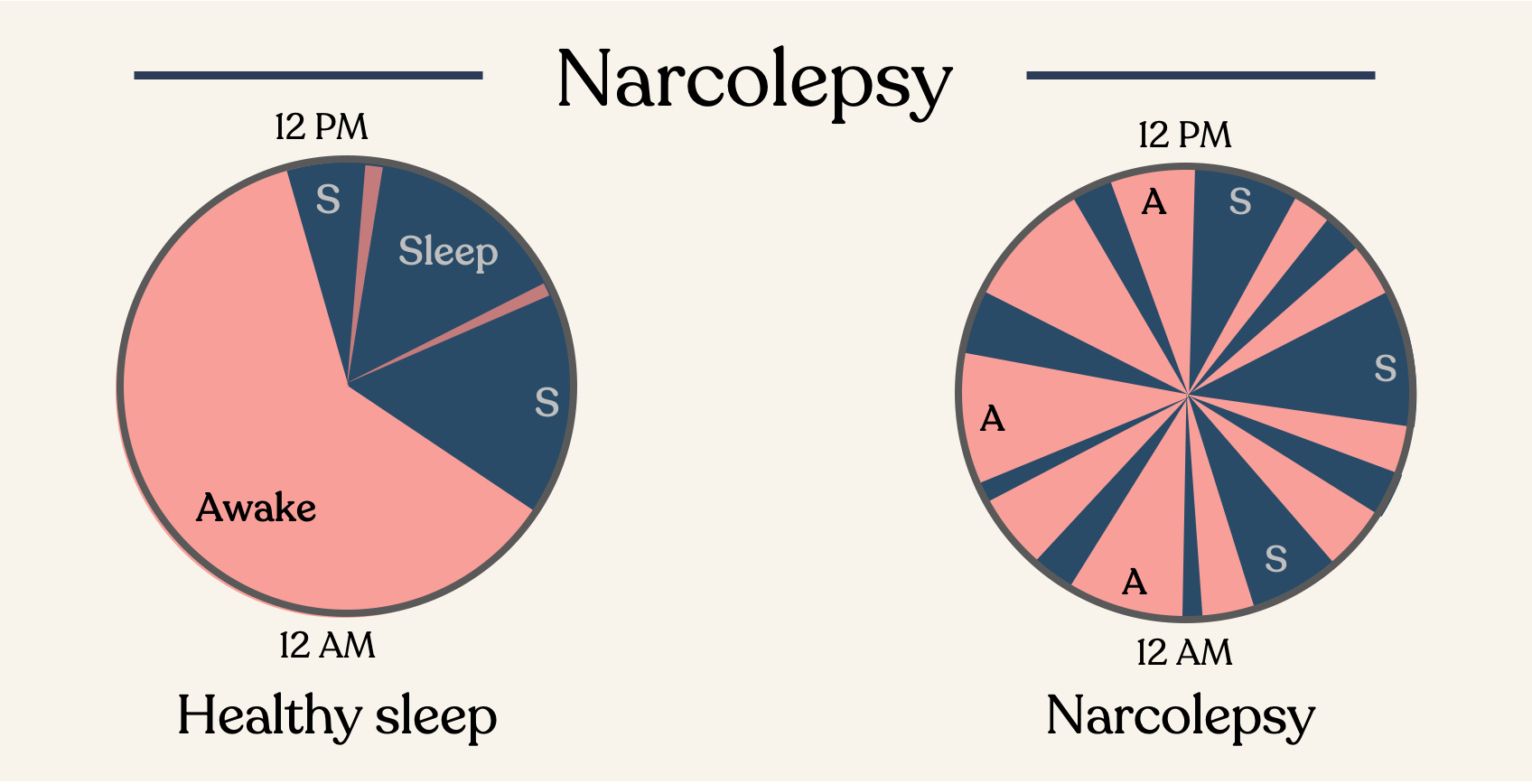
- Very rapid REM onset: Instead of waiting 70–100 minutes, a person with narcolepsy may enter REM sleep within 15 minutes of falling asleep — sometimes almost immediately — at night and during daytime naps.
- Cataplexy: Sudden, brief loss of muscle tone triggered by strong emotions such as laughter, surprise, or excitement, while fully conscious. It ranges from a drooping jaw or buckling knees to collapse. Cataplexy occurs only in type 1 narcolepsy.
- Sleep paralysis and hallucinations: Being temporarily unable to move, or experiencing vivid dream-like images, while falling asleep or waking up — REM components appearing while the mind is half-awake.
- Fragmented nighttime sleep: Despite being profoundly sleepy by day, people with narcolepsy often wake repeatedly during the night and sleep poorly overall.
Normal sleep cycle vs narcolepsy: side-by-side comparison
| Feature | Normal sleep cycle | Narcolepsy |
|---|---|---|
| Time to first REM sleep | 70–100 minutes after falling asleep | Within 15 minutes, sometimes immediately |
| Nighttime sleep | Mostly continuous, 4–6 orderly cycles | Fragmented, with frequent awakenings |
| Daytime alertness | Stable after adequate sleep | Overwhelming sleepiness despite adequate sleep |
| Falling asleep in the day | Only when sleep-deprived or in monotonous settings | Sudden, uncontrollable sleep attacks anywhere |
| Muscle tone while awake | Normal | Cataplexy (type 1): sudden weakness triggered by emotion |
| Dreaming | Confined to REM sleep at night | Dream-like hallucinations at sleep onset/waking; vivid dreams in daytime naps |
| Sleep paralysis | Rare, occasional isolated episodes | Recurrent, as part of the disorder |
| Underlying mechanism | Intact sleep–wake regulation | Loss of hypocretin signaling (type 1); unstable sleep–wake control |
How the pattern changes across the night — and across a lifetime
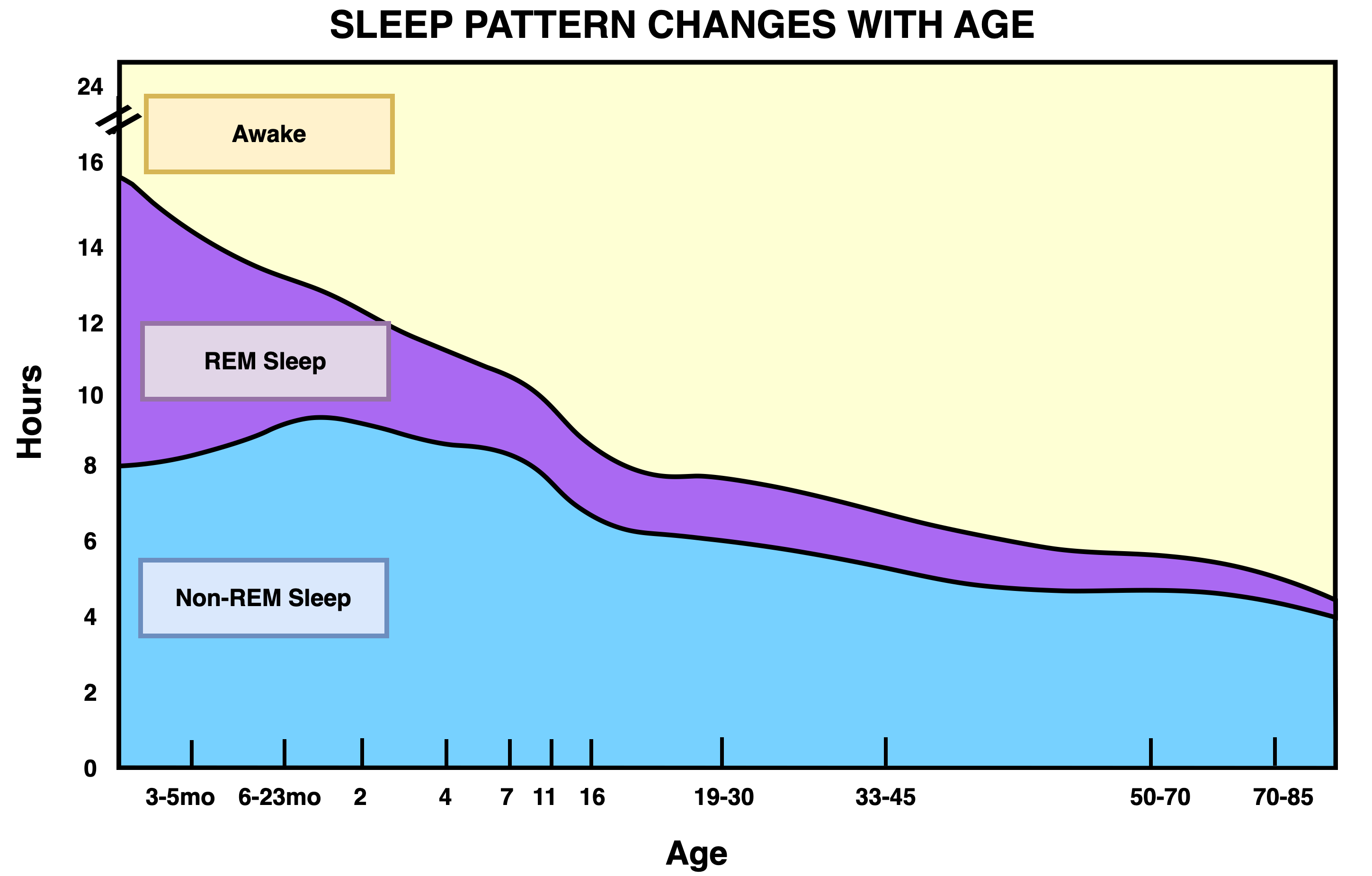
The order of stages is not the only thing that changes. Within a single night, the balance shifts: the first two cycles are rich in deep N3 sleep and short on REM, while the final cycles are mostly light NREM and long stretches of REM. This is why waking from an early alarm can feel like surfacing from the bottom of a pool (you were probably in deep sleep), whereas morning awakenings often interrupt a dream. Across a lifetime the architecture shifts too — babies spend about half their sleep in REM, children get large amounts of deep slow-wave sleep, and older adults sleep more lightly, with less N3, more awakenings, and earlier waking times.
Narcolepsy scrambles both patterns. On a sleep recording (hypnogram), a normal night looks like a regular staircase descending into deep sleep and rising to REM at widening intervals. A night with narcolepsy looks jagged instead: REM appears at the very start, stages switch abruptly, and wakefulness keeps breaking in. During the day the same instability produces naps that plunge straight into dreaming — something a normal sleep cycle almost never does outside of severe sleep deprivation or infancy.
Narcolepsy type 1 vs type 2
The diagnosis is split into two types. Type 1 involves cataplexy and/or measurably low hypocretin in the cerebrospinal fluid, reflecting the loss of hypocretin-producing neurons. Type 2 produces the same excessive daytime sleepiness and abnormal nap-test results, but without cataplexy and with normal (or unmeasured) hypocretin levels. The distinction matters because type 1 has a confirmatory biomarker while type 2 does not, and about 1 in 10 people first labeled type 2 later develop cataplexy and are reclassified as type 1.
How narcolepsy is diagnosed, step by step
Narcolepsy cannot be diagnosed from symptoms alone — several other conditions cause daytime sleepiness — so the evaluation follows a set pathway, usually coordinated by a primary care clinician with referral to a sleep specialist.
Step 1: Symptom review, sleep log, and actigraphy
The clinician takes a detailed history and may use the Epworth Sleepiness Scale questionnaire to quantify daytime sleepiness. You will typically keep a sleep diary for one to two weeks, sometimes with a wrist actigraph that tracks movement, to prove you are getting enough sleep opportunity — important, because simple chronic sleep deprivation can imitate narcolepsy on later testing.
Step 2: Overnight polysomnography (PSG)
You sleep one night in a sleep laboratory while sensors record brain waves, eye movements, muscle tone, breathing, oxygen levels, and leg movements. For suspected narcolepsy, the PSG has three jobs: confirm you slept adequately (usually at least 6 hours) so the next day’s test is valid; rule out other disorders that fragment sleep, above all obstructive sleep apnea; and look for an early clue — REM sleep beginning within 15 minutes of sleep onset, which appears in about a third of people with type 1 narcolepsy and strongly supports the diagnosis.
Step 3: The Multiple Sleep Latency Test (MSLT)
The following day comes the decisive test. Still wired with sensors, you are given five nap opportunities, spaced about two hours apart, in a dark, quiet room, and asked to try to sleep. The MSLT measures two numbers:
- Mean sleep latency — how quickly you fall asleep, averaged across the naps. An average of 8 minutes or less indicates pathological sleepiness.
- Sleep-onset REM periods (SOREMPs) — naps in which REM sleep begins within 15 minutes of falling asleep. Two or more SOREMPs (a SOREMP on the previous night’s PSG can count as one of them) is the signature finding of narcolepsy.
Meeting both numbers — mean latency ≤8 minutes plus ≥2 SOREMPs — in someone with at least three months of daily daytime sleepiness fulfills the standard diagnostic criteria used by sleep specialists (ICSD-3). Preparation matters: your sleep schedule must be stable for a week or more beforehand, and because many antidepressants suppress REM sleep and can mask the key finding, the sleep team may ask you to pause such medication before the study, under medical supervision only. Home sleep tests cannot diagnose narcolepsy, because they do not record the brain activity needed to identify REM sleep.
A note on sleep trackers and home tests
Many readers arrive here after a wearable or phone app has flagged “abnormal REM” or fragmented sleep. Consumer trackers estimate sleep stages from movement and heart rate; they are reasonable at telling sleep from wake, but they cannot stage REM reliably and are not validated for diagnosing narcolepsy. An odd tracker report is a fine reason to talk to a doctor — it is not a diagnosis, and a normal-looking tracker report does not rule narcolepsy out either. Only the laboratory combination of PSG and MSLT can make or exclude the call.
Step 4 (selected cases): Hypocretin testing and HLA typing
If the picture remains unclear, a lumbar puncture can measure hypocretin-1 in the cerebrospinal fluid; low levels essentially confirm type 1 narcolepsy. A blood test for the genetic marker HLA-DQB1*06:02 is sometimes checked, but it is found in many people without narcolepsy, so it can support — never make — the diagnosis on its own.
Conditions that can look like narcolepsy
Before narcolepsy is confirmed, clinicians work through a differential list: obstructive sleep apnea, the most common cause of daytime sleepiness, which the overnight PSG is designed to catch (see our dedicated comparison of narcolepsy vs sleep apnea); idiopathic hypersomnia, which causes long, unrefreshing sleep and nap-test sleepiness but without the early REM periods; chronic sleep deprivation and shift-work schedules; and medical or psychiatric causes such as depression or an underactive thyroid. This is also why excessive daytime sleepiness always deserves a work-up rather than an assumption.
What happens after diagnosis
Narcolepsy is a lifelong condition, but it is manageable. Treatment combines wake-promoting or stimulant medication for daytime sleepiness, medicines that consolidate nighttime sleep and reduce cataplexy, and behavioral strategies — brief scheduled naps, a strict sleep schedule, and avoiding alcohol and sedating drugs in the evening. Safety planning is part of care: people with uncontrolled sleep attacks or cataplexy must talk with their clinician about driving and hazardous work. Because diagnosis is often delayed by years, simply having an explanation — and a treatment plan — is a major step for most patients.
When to see a doctor
Book an evaluation if daytime sleepiness has persisted for three months or more despite adequate sleep, if you fall asleep at inappropriate or dangerous moments, if you experience episodes of sudden muscle weakness with laughter or emotion, or if sleep paralysis and vivid sleep-transition hallucinations happen regularly. These are not features of a normal sleep cycle, and they warrant a referral to a sleep specialist.
Sources
- Mayo Clinic — Narcolepsy: Symptoms and causes
- Sleep Foundation — How to Diagnose Narcolepsy: Tests and Diagnostic Criteria
- Harvard Medical School, Division of Sleep Medicine — Testing for Narcolepsy
- Stanford Health Care — Diagnosing Narcolepsy
This article is for general information only and is not medical advice. Excessive daytime sleepiness has many causes; only an in-person evaluation with sleep studies can diagnose narcolepsy.
Frequently Asked Questions
About 90 minutes (roughly 80–110). Each cycle passes through NREM stages N1, N2, and N3 and ends with REM sleep, and most adults complete four to six cycles per night, with deep sleep concentrated early and longer dream periods toward morning.
Within 15 minutes of falling asleep — sometimes almost immediately. In a normal sleep cycle, the first REM period does not begin until 70–100 minutes after sleep onset, after passing through the NREM stages.
An overnight polysomnogram (PSG) followed the next day by a Multiple Sleep Latency Test (MSLT). The PSG rules out other disorders such as sleep apnea; the MSLT measures nap sleep latency and early REM periods. In selected cases, cerebrospinal fluid hypocretin is measured by lumbar puncture.
A mean sleep latency of 8 minutes or less across the five naps, plus REM sleep starting within 15 minutes of sleep onset in at least two naps (sleep-onset REM periods). A REM period within 15 minutes on the prior night’s PSG can count toward the two.
No. Cataplexy — sudden muscle weakness triggered by emotion — occurs only in type 1 narcolepsy, which is linked to low hypocretin levels. Type 2 narcolepsy causes the same daytime sleepiness and abnormal MSLT results without cataplexy.
No. Home tests do not record brain activity, so they cannot identify REM sleep or measure sleep latency accurately. Narcolepsy requires in-laboratory polysomnography and MSLT.
Its main symptom — daytime sleepiness — is easily attributed to poor sleep habits, depression, or laziness, and rarer symptoms like cataplexy can be mistaken for fainting or seizures. Many cases are only confirmed years after symptoms begin, once a sleep study is finally performed.
Read Next

How to Find a Hearing Aid Provider That Accepts Medicaid: A Step-by-Step Guide

How Administrative Barriers Affect Access to Mental Health Care

Is Bronchitis Contagious?

How Long Can an Average Person Hold Their Breath?

Hiya Vitamins Review By a Mom Who Is a Dietitian
Sleep Paralysis: Why It Happens and How to Stop the Episodes
Related Posts

10 of the Best Devices for People with Epilepsy
Oct 5, 2026 • 20 min read
10 Ways to Boost Serotonin Naturally and Without Medication
Sep 7, 2026 • 16 min read
Understanding Foot Supination
Sep 15, 2026 • 7 min read
10 Ways to Stretch and Strengthen Your Lats
Sep 15, 2026 • 3 min read
Heat Rash (Prickly Heat) Pictures: The 3 Types and How to Tell Them Apart
Nov 13, 2026 • 7 min read