
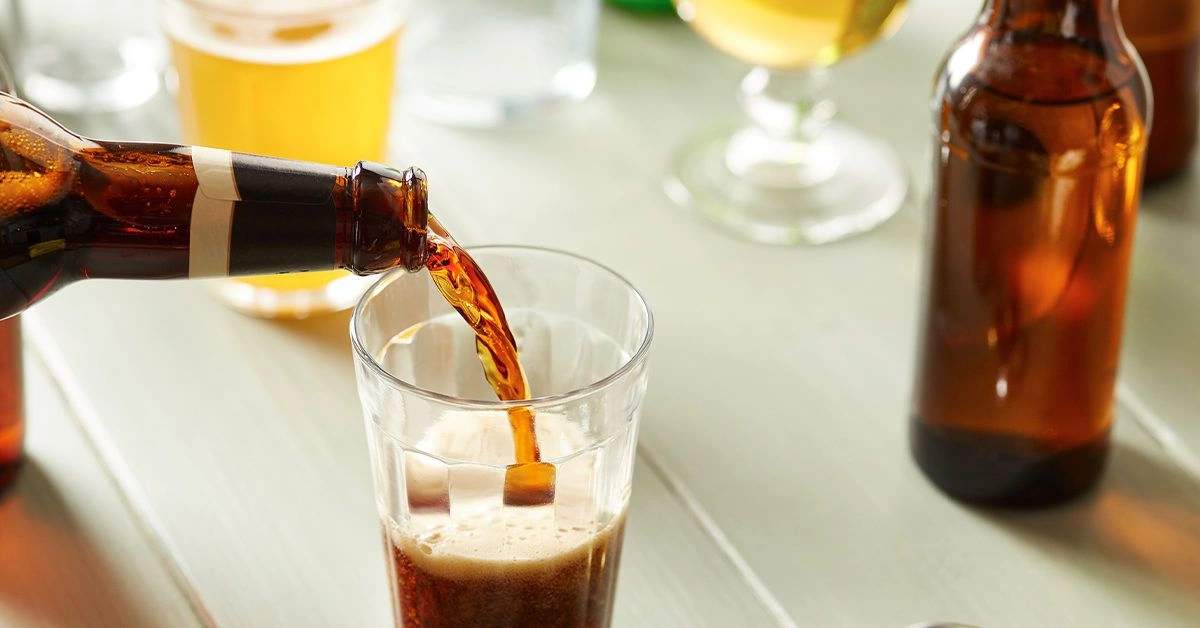
Most beers contain very little sugar, although some light varieties such as Miller Lite may have a touch more. Beer does, however, contain carbohydrates, which can influence your blood glucose. It’s also a notable source of calories.
Although recipes vary by brand, beer is typically produced from grains, hops or other flavoring botanicals, yeast, and water.
Even though sugar isn’t listed as a direct ingredient, it plays a crucial role in creating alcohol.
So you might be asking: is there sugar in beer, and if so, how much?
This article examines the sugar levels found in beer.
The brewing process
To estimate how much sugar a beer contains, it helps to understand how beer is brewed.
The core components are grains, flavoring botanicals, yeast, and water. Barley and wheat are the most commonly used grains, while hops are the primary source of bitterness and aroma.
The brewing sequence generally includes these stages (1):
- Malting. This phase allows the grain to germinate in a controlled way. Germination is important because it converts stored starch into fermentable sugars, predominantly maltose.
- Mashing. Mashing involves crushing, heating, and steeping the germinated grain in hot water. The output is a sugary liquid known as wort.
- Boiling. Hops or other flavoring agents are added during boiling. Afterward the wort is cooled and clarified to remove plant solids.
- Fermentation. Yeast is introduced to the wort and ferments the sugars into alcohol and carbon dioxide.
- Maturation. In this final stage, the beer is conditioned and aged.
As shown, sugar is integral to brewing.
It’s not mixed in directly; rather, it’s produced from the grains and then consumed by yeast to form alcohol.
Summary: Sugar is vital to brewing beer, but it originates from grain processing rather than being an added ingredient.
Beer gravity
Beer gravity measures the wort’s density compared with water during different fermentation phases, and it largely reflects sugar concentration.
A wort with a high sugar level is referred to as a high-gravity wort.
As yeast ferments the wort, sugars decline while alcohol rises, lowering the gravity and producing beers with higher alcohol by volume (2).
Hence, beers have an initial and final gravity, and the gap between them reveals how much sugar was transformed into alcohol.
Ale vs. lager
Ales and lagers are distinct beer families, mainly differentiated by the yeast strains employed.
Ales are fermented with Saccharomyces cerevisiae strains, while lagers use Saccharomyces pastorianus (3).
Brewing yeasts are generally very effective at fermenting sugars (4).
Multiple factors influence a yeast’s fermentation efficiency, such as fermentation temperature and rising alcohol levels. Once alcohol reaches a level intolerable to the yeast, fermentation halts (5).
While both yeast types produce alcohol, ale strains typically tolerate higher alcohol concentrations than lager strains — so ales often finish with higher alcohol and less residual sugar (2, 6, 7).
Consequently, ales commonly contain less remaining sugar than lagers.
Summary: Beer gravity indicates sugar levels. As yeast consumes sugar, gravity drops and alcohol rises. Ale yeast strains have higher alcohol tolerance, often leaving less residual sugar.
Sugar content in beer
Sugars are a form of carbohydrate. In fact, sugar is the simplest building block of carbs.
Carbohydrates are classified as mono-, di-, oligo-, or polysaccharides, depending on whether a molecule contains 1, 2, 3–10, or more than 10 sugar units, respectively (8).
The principal sugar in beer is maltose, which consists of two glucose molecules and is therefore a disaccharide — a simple sugar.
That said, maltose and other simple sugars account for roughly 80% of the wort’s fermentable sugars, while the remaining ~20% are oligosaccharides that yeast cannot ferment (3, 5).
However, humans also lack the enzymes to digest oligosaccharides, so they behave like non-digestible fibers — acting as prebiotics that feed gut bacteria rather than adding calories (9).
Therefore, although beer contains a fair amount of carbohydrates overall, its actual sugar content tends to be low.
Summary: About 80% of beer’s fermentable sugars are digestible by yeast, while 20% are oligosaccharides that neither yeast nor humans break down. As a result, finished beer often has a low sugar level.
How much sugar is in various types of beer?
As noted, a beer’s sugar level depends on its original gravity and the yeast strain that ferments it.
Brewers may also add sugar-containing adjuncts such as honey or corn syrup to achieve a specific flavor profile.
In the United States, labeling rules for alcoholic beverages don’t require disclosure of sugar content (10, 11).
Some producers list carbohydrate values, but most only provide alcohol by volume. That can make it tricky to know the sugar quantity in a given beer.
Below are sugar and carbohydrate amounts in a 12-ounce (355-ml) serving for several beer categories and popular brands (12, 13, 14, 15, 16, 17, 18, 19):

- Regular beer: 12.8 grams carbs, 0 grams sugar
- Light beer: 5.9 grams carbs, 0.3 grams sugar
- Low-carb beer: 2.6 grams carbs, 0 grams sugar
- Non-alcoholic beer: 28.5 grams carbs, 28.5 grams sugar
- Miller High Life: 12.2 grams carbs, 0 grams sugar
- Miller Lite: 3.2 grams carbs, 0 grams sugar
- Coors Banquet: 11.7 grams carbs, 0 grams sugar
- Coors Light: 5 grams carbs, 1 gram sugar
- Coors Non-alcoholic: 12.2 grams carbs, 8 grams sugar
- Heineken: 11.4 grams carbs, 0 grams sugar
- Budweiser: 10.6 grams carbs, 0 grams sugar
- Bud Light: 4.6 grams carbs, 0 grams sugar
- Busch: 6.9 grams carbs, sugar not reported
- Busch Light: 3.2 grams carbs, sugar not reported
Notice that light beers sometimes show slightly higher sugar than regular beers. This can be related to differences in their fermentative treatment.
Light beers are often brewed with the enzyme glucoamylase, which breaks down leftover carbohydrates into fermentable sugars, reducing calories and alcohol (20).
Also, because sugars aren’t fermented into alcohol in non-alcoholic beers, they typically carry the highest sugar amounts.
Remember that even if sugar content is low, regular beers still provide carbs that can affect blood glucose.
And regardless of reported sugars, alcohol itself contributes substantial calories.
Summary: Regular beers are usually sugar-free, with light beers reporting about 1 gram or less per can. Non-alcoholic beers generally have the most sugar.
Beer and blood sugar
Although beer’s sugar content may be modest, its alcohol can lower blood glucose.
Alcohol disrupts carbohydrate metabolism by inhibiting gluconeogenesis and glycogenolysis — the processes that produce and release stored glucose — which are essential for maintaining blood sugar balance (21, 22).
Thus, drinking alcohol can precipitate hypoglycemia, which is why consuming it with a meal that contains carbohydrates is often advised.
However, if you pair alcohol with rapidly absorbed simple carbs that spike blood sugar, the resulting insulin surge may later cause low blood sugar as well (21, 22).
Alcohol may also interfere with blood-glucose-lowering medications (21).
Summary: Even with low sugar levels, beer as an alcoholic beverage can reduce blood glucose.
The bottom line
Sugar is fundamental to brewing because yeast converts it into alcohol.
Although several variables affect yeast’s conversion efficiency, yeast is generally effective. Consequently, except for alcohol-free beers, most beers end up with low sugar levels.
Still, bear in mind that alcoholic drinks can lower your blood sugar.
To reduce health risks, drink in moderation — defined as up to one standard drink per day for women and up to two for men (23).
For additional practical info on beer nutrients, you may find this article helpful: calorie carb protein in beer, and for more on fermentation-related ingredients check brewers yeast.






















Leave a Reply
You must be logged in to post a comment.