

Key takeaways
- Insulin is vital for controlling blood glucose in type 2 diabetes, enabling the body to use sugar for fuel.
- Various insulin classes — from rapid-acting to long-acting — have different effects and can be combined.
- Your clinician will weigh blood sugar readings, medical history, and daily habits when selecting the most appropriate insulin, and this choice can evolve.
If you have type 2 diabetes, your clinician may recommend insulin therapy to help control your blood sugar. Insulin is a hormone produced by the pancreas that manages blood glucose and allows your body to convert sugars into usable energy.
People with type 2 diabetes often still produce insulin, but their bodies don’t respond to it properly. For that reason, some people with type 2 diabetes require prescribed insulin.
Types of insulin therapy
There are several insulin formulations available, but the four primary categories are:
- rapid-acting
- regular- or short-acting
- intermediate-acting
- long-acting
There are also less common subtypes, such as ultra–long-acting, premixed, and rapid-acting inhaled insulin.
Insulin cannot be taken orally because the digestive system would break it down like food. As a result, the hormone would not reach the bloodstream where it is needed.
Depending on your medical background, your provider might prescribe a single insulin type or a combination. Some patients use a strategy known as combination therapy, which pairs insulin with non-insulin oral medications.
The following chart-like description outlines the main insulin categories and their effects. Within each class there are multiple formulations that alter onset, peak, or duration.
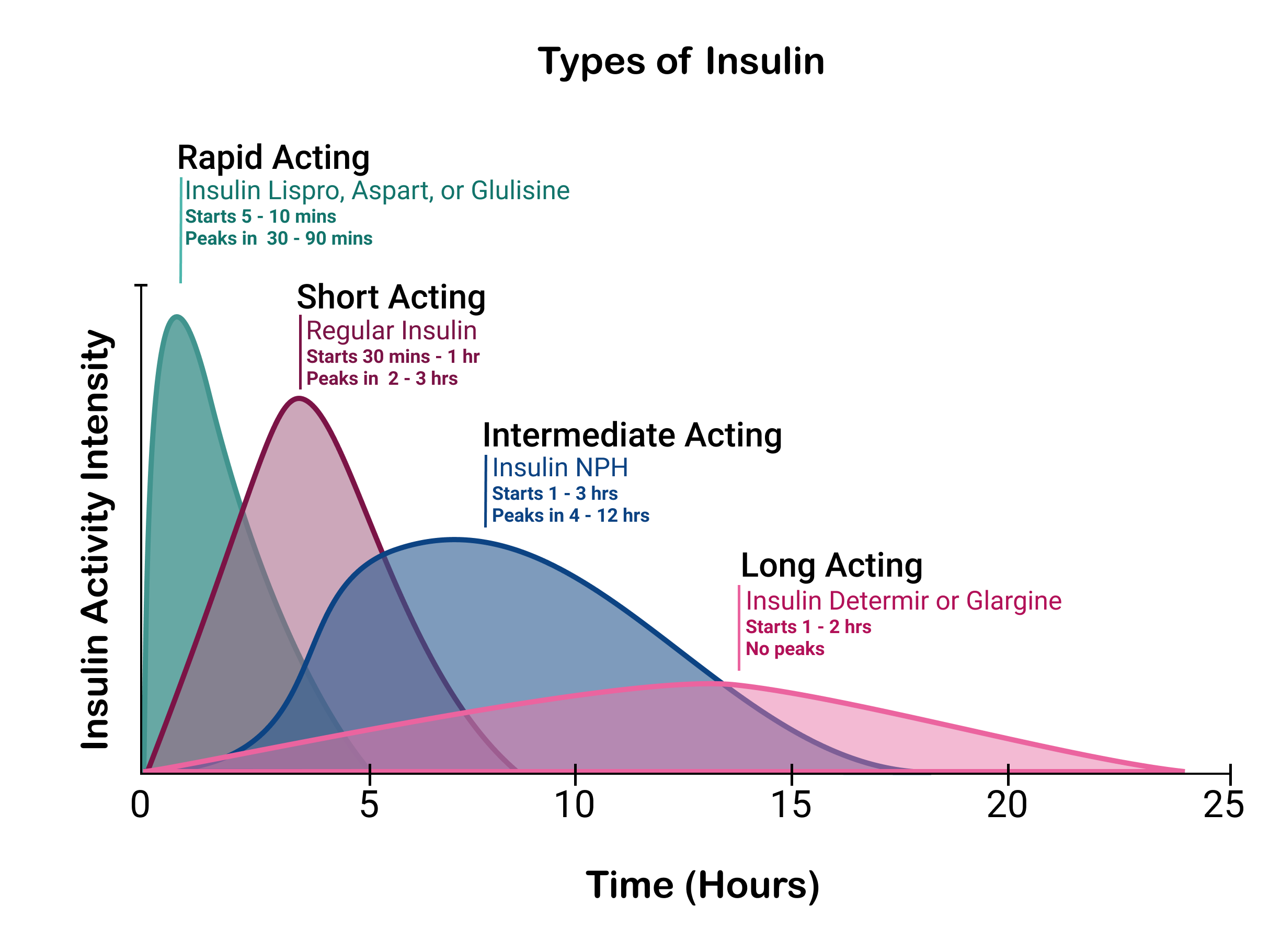
Insulin can be given through different delivery systems, including syringes, injection pens, insulin pumps, and inhalers. For information about syringe options see insulin syringes sizes.
Brands of insulin
While insulin falls into a few types, many prescription brands supply the medication in those forms. Brands differ by insulin formulation, dosing options, and delivery methods, among other aspects. Below is an overview of common brands and products:
Rapid-acting insulin options include:
- insulin aspart (NovoLog)
- insulin glulisine (Apidra)
- insulin lispro (Humalog)
Regular- or short-acting products usually contain insulin regular, such as:
- Humulin R
- Humulin R U-500
- Humulin R U-500 KwikPen
- Novolin R
- Novolin R InnoLet
- Novolin R PenFill
- ReliOn/Humulin R
- ReliOn/Novolin R
Intermediate-acting preparations mainly use insulin isophane, including:
- Humulin N
- Humulin N KwikPen
- Humulin N Pen
- Novolin N
- Novolin N InnoLet
- Novolin N PenFill
- ReliOn/Novolin N
Long-acting insulin products include:
- insulin detemir (Levemir, Levemir FlexPen, Levemir FlexTouch, Levemir InnoLet, Levemir PenFill)
- insulin degludec (Tresiba FlexTouch)
- insulin glargine (Basaglar KwikPen, Lantus, Lantus OptiClik Cartridge, Lantus Solostar Pen, Toujeo Max Solostar, Toujeo SoloStar)
Some makers also offer premixed combinations of short- and intermediate-acting insulins in one vial or pen. Examples of premixed products include:
- mixtures of insulin isophane and insulin regular (Humulin 50/50, Humulin 70/30, Humulin 70/30 KwikPen, Novolin 70/30, ReliON/Novolin 70/30)
- mixtures of insulin lispro and insulin lispro protamine (Humalog Mix 75/25, Humalog Mix 75/25 KwikPen)
Which insulin is right for you?
If you’re prescribed insulin, you may question which option suits you best. Your clinician will evaluate several factors when suggesting an insulin plan. They may look at:
- your typical blood glucose readings
- how long you’ve had type 2 diabetes
- other medications you’re taking
- your daily routine and overall health
- your insurance and coverage
Your insulin requirements can shift over time, and your clinician might recommend changes. It’s normal for a treatment regimen to be adjusted as circumstances evolve.
Takeaway
If you’re unclear about why a particular insulin was suggested, discuss it with your clinician. They can outline the benefits and drawbacks of different options and explain why one choice could be a better match for you.




















Leave a Reply
You must be logged in to post a comment.