

A free prostate-specific antigen (free PSA) test is often used to clarify results from a standard PSA test, which helps determine whether you might have prostate cancer.
The free prostate-specific antigen (free PSA) test measures the portion of PSA in your bloodstream that is not attached to proteins. When levels are elevated, it may point to a noncancerous issue such as an enlarged or inflamed prostate—or it could indicate prostate cancer. In certain situations, this test can be used instead of proceeding directly to a prostate biopsy to help rule out malignancy. However, if your free PSA results suggest increased risk, a biopsy may still be necessary for confirmation.
Understanding how free PSA fits into the broader picture of PSA velocity by age, total PSA values, and other prostate cancer risk markers can help you and your healthcare provider make informed decisions. Continue reading to explore how free PSA testing works and what your results may signify.
What is PSA vs. free PSA
Prostate-specific antigen (PSA) is an enzyme that attaches to proteins in semen and helps break them down.
PSA is produced primarily by the prostate gland and released into semen. During ejaculation, a small amount of PSA enters the bloodstream through the prostate’s extensive blood supply. Two types of PSA circulate in the body:
- Free PSA refers to PSA that is not bound to proteins.
- Bound PSA is PSA that has attached to proteins in the blood.
PSA can be evaluated in two main ways. A free PSA test measures only the unbound PSA in your bloodstream. A standard PSA test assesses total PSA, which includes both bound and free forms.
Free PSA test purpose
The free PSA test is sometimes used instead of a biopsy when total PSA levels are mildly elevated. It can also help your doctor evaluate how aggressive a cancer may be if it has returned following treatment.
PSA testing involves drawing a blood sample, typically from your arm. The specimen is sent to a laboratory for analysis, and the findings are reviewed with your doctor.

Despite its usefulness, PSA testing has several limitations.
- The PSA test is associated with a high rate of false positives.
- It is possible to have prostate cancer even when PSA levels fall below the limits typically considered suspicious.
- Up to 91% of individuals with elevated PSA do not have cancer.
- Normal PSA reference ranges were largely established in white males, though PSA values can vary depending on your ethnicity, with healthy Black men often showing higher PSA levels than white or Hispanic men.
- Test results can vary between laboratories or due to differences in testing techniques.
Because of these limitations, doctors frequently assess PSA velocity by age and other trends over time rather than relying on a single measurement.
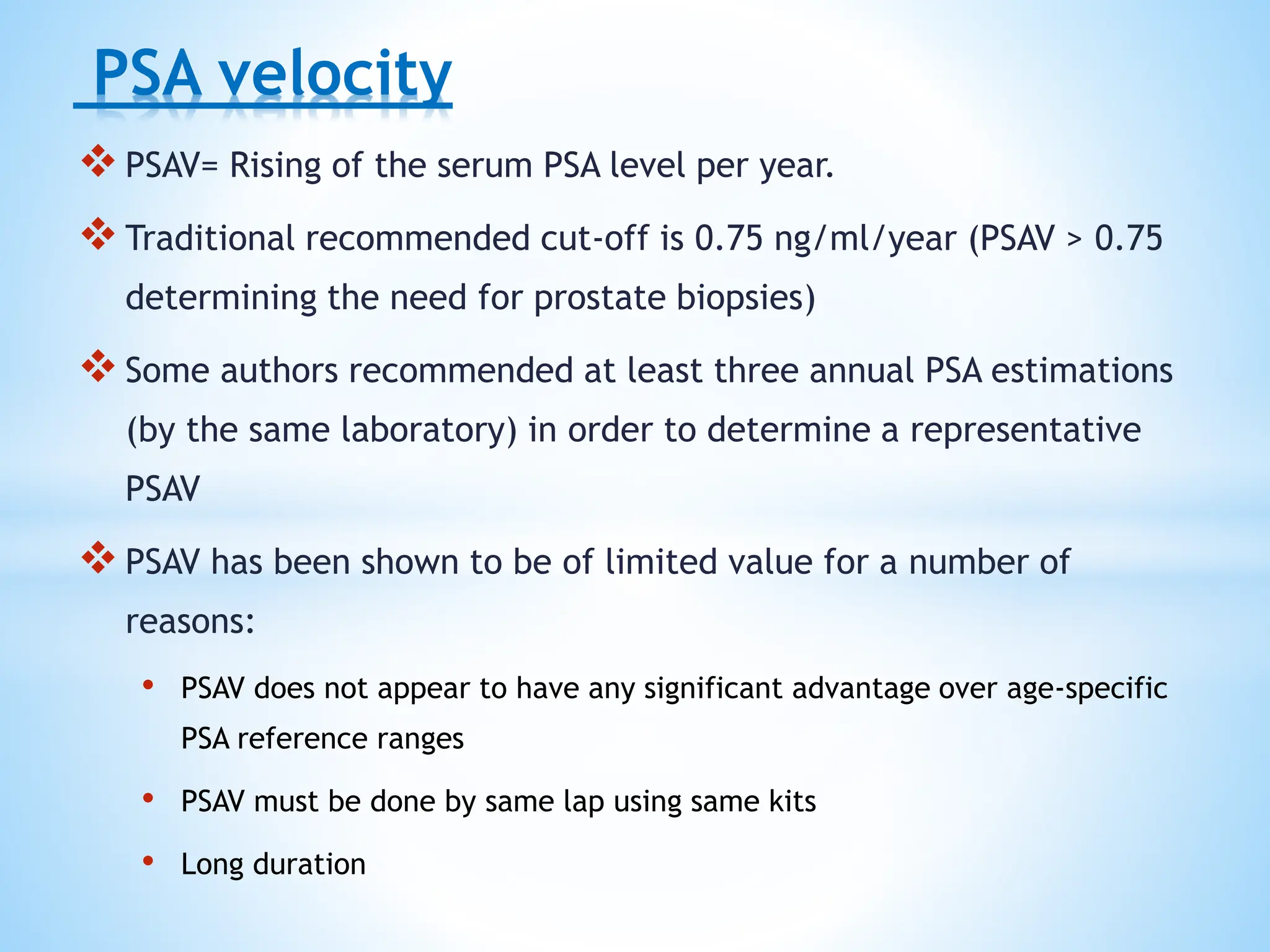
PSA levels by age
A PSA value greater than or equal to 4 nanograms per milliliter (ng/mL) is widely accepted as the threshold for additional prostate cancer evaluation. If results are under 4 ng/mL, further testing may not be recommended. However, PSA levels naturally rise as men age, which led to the development of age-adjusted reference ranges and greater emphasis on PSA velocity by age when assessing long-term risk.
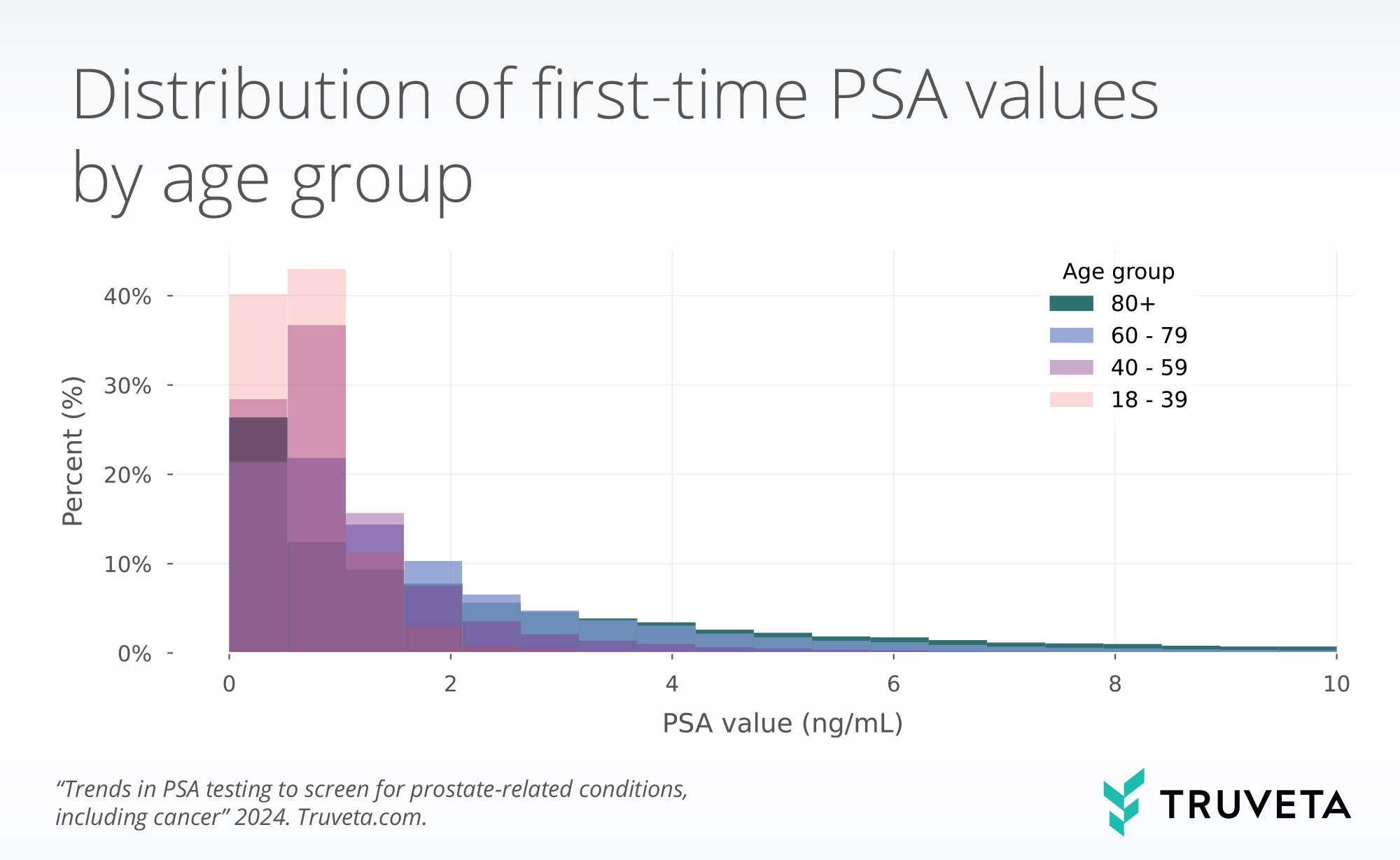
| Age | Total PSA, normal reference range (ng/mL) |
|---|---|
| 40—49 | Less than or equal to 2.5 |
| 50—59 | Less than or equal to 3.5 |
| 60—69 | Less than or equal to 4.5 |
| 70 and older | Less than or equal to 6.5 |
Monitoring how PSA changes over time—rather than focusing solely on one number—can provide a clearer picture of prostate health.
What do your test results mean?
Generally speaking, the higher your PSA level and the lower your free PSA percentage, the greater your risk of prostate cancer. Age-based ranges are used because PSA typically increases over time, even in the absence of cancer.
In addition to total PSA and free PSA percentage, physicians evaluate other PSA-related indicators:
- PSA velocity: The rate at which PSA levels rise over time is known as PSA velocity. A rapid increase, especially when considered in the context of PSA velocity by age, may signal a higher likelihood of prostate cancer. For a deeper explanation, see What is a dangerous PSA velocity.
- Doubling: PSA doubling time refers to how quickly PSA levels double. A shorter doubling time is linked with a greater risk of aggressive prostate cancer. Doctors also use this metric to evaluate whether cancer has progressed in men already diagnosed.
Free PSA
Free PSA is calculated as the percentage of free PSA relative to total PSA. Based on older research that continues to guide clinical practice, in men whose total PSA falls between 4 ng/mL and 10 ng/mL:
- If free PSA accounts for less than 10% of total PSA, the cancer risk is 50%.
- If free PSA makes up more than 25% of total PSA, the cancer risk is less than 10%.
These percentages are used alongside digital rectal exam findings, imaging, family history, and PSA velocity by age to estimate overall risk and determine whether a biopsy is appropriate.
Factors that affect PSA levels
An elevated PSA does not automatically mean prostate cancer is present. Multiple factors can influence PSA measurements, either increasing or decreasing them.
- benign prostatic hyperplasia (BPH), a common, non-cancerous enlargement of the prostate
- prostatitis, or inflammation of the prostate
- urinary tract infections
- pressure on the prostate from activities such as motorcycle or bicycle riding
- digital rectal exam
- ejaculation
- medications used to treat enlarged prostate
- hepatitis
- prostate surgery
- obesity
- exposure to Agent Orange and certain agricultural chemicals
Because these factors can temporarily alter PSA levels, your doctor may repeat testing or track PSA velocity by age before recommending further procedures.
Free PSA test costs
If you do not have prostate cancer symptoms or a strong family history, a free PSA test can be a practical next step when total PSA is elevated. In some cases, it may help avoid a biopsy, which is considerably more costly and invasive.
Healthcare expenses vary by location and provider. A free PSA test is a straightforward blood test that usually costs under $100. You may also be responsible for an office visit fee. With many insurance plans, seeing a specialist often results in higher out-of-pocket costs compared to visiting a primary care physician.
If performed in a urologist’s office rather than an outpatient surgical center, a biopsy will still be substantially more expensive. Costs may include:
- consultation for the urologist
- ultrasound guidance for needle placement
- pathology consultation to examine biopsy samples
- additional medical supplies
Free PSA vs. biopsy
According to a 2021 study, free PSA testing can reduce unnecessary prostate biopsies by 85.5%. It also helps estimate the likelihood of prostate cancer. However, if results indicate a significant risk, a biopsy remains essential to confirm the diagnosis.
During a prostate biopsy, a urologist removes small tissue samples from the prostate using a specialized hollow needle. These samples are examined under a microscope to detect cancer cells.
Side effects are relatively common but rarely severe. They may include:
- bleeding at the biopsy site
- blood in urine or semen
- difficulty urinating
Pros and cons
Choosing a free PSA test instead of immediately proceeding to biopsy offers several benefits for men with elevated total PSA:
- A prostate biopsy is invasive and carries a higher risk of infection and other complications.
- Even with local anesthetic, many men report discomfort or pain during the procedure.
- The financial cost of a biopsy is significantly higher than that of free PSA testing.
The main advantage of a biopsy is that, if cancer is present, the tissue samples provide detailed information about tumor size and aggressiveness. Biopsy results allow doctors to assign a stage and grade to the cancer, guiding treatment decisions such as active surveillance, surgery, radiation, or other therapies.
Should you have a free PSA test?
If your total PSA level is elevated, a free PSA test is often a reasonable intermediate step before committing to a biopsy. Evaluating free PSA alongside PSA velocity by age and other clinical factors can offer a more complete assessment of prostate cancer risk. Ultimately, the decision should be made after a thorough discussion with your doctor, taking into account your age, medical history, symptoms, and personal preferences.




















Leave a Reply
You must be logged in to post a comment.