

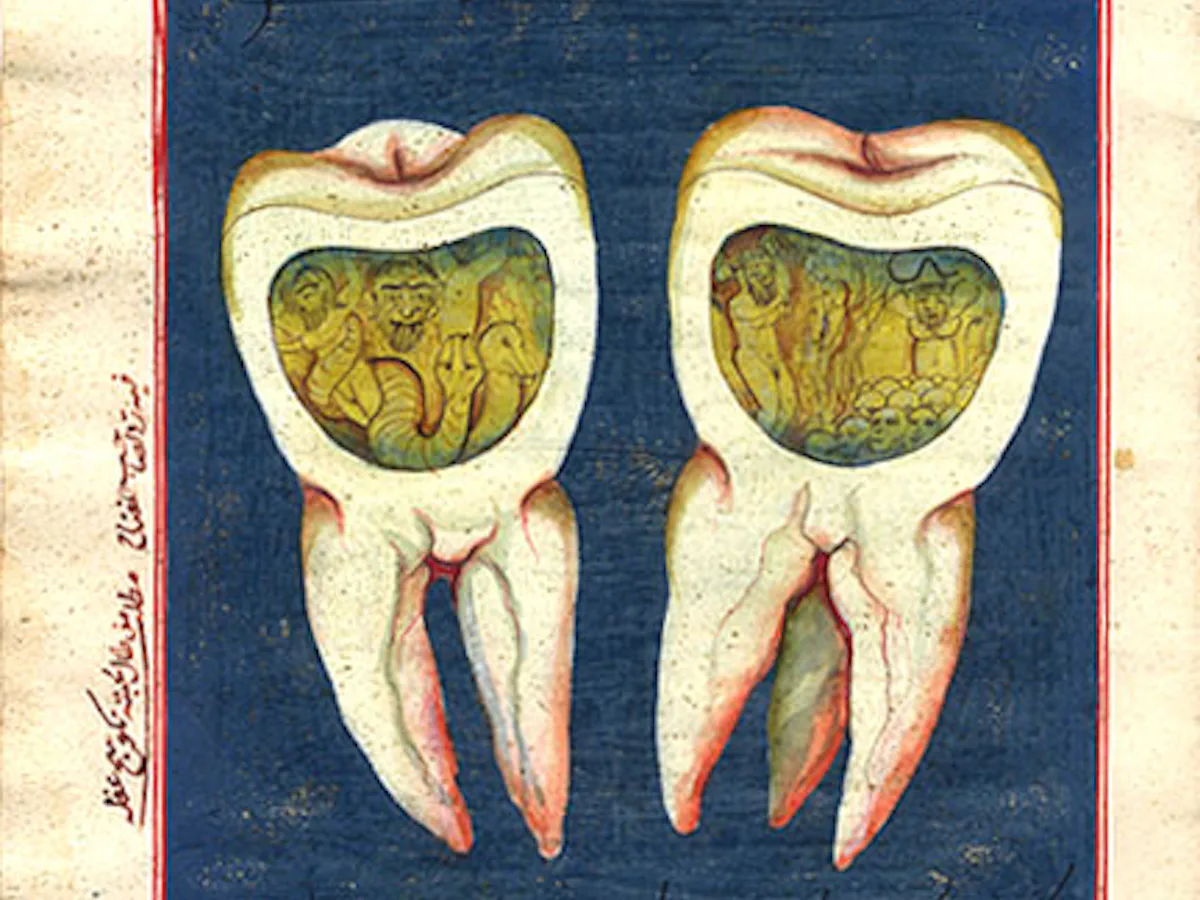
Humans have suffered from dental cavities for millennia. Long before modern dentistry, many cultures attributed tooth decay to tiny worms living inside teeth. This explanation was widely accepted across various civilizations.
The notion endured for thousands of years, but developments in dental science have shown that tooth worms do not actually exist.
Tooth decay results from dental plaque — a sticky film made up of saliva, bacteria, acids, and food debris. When plaque accumulates and wears away the tooth’s outer surface, decay follows, producing what we call cavities or dental caries.
Despite the scientific evidence, the tooth-worm belief persists in some places. Continue reading to explore the myth’s origins and how it may have arisen.

Where did the idea linking worms to tooth decay come from?
The tooth-worm concept dates as far back as 5000 B.C. A Sumerian document from that era lists tooth worms as the cause of dental deterioration.
References to tooth worms also appear in ancient Chinese writings from around 1500 B.C. One inscription on bone describes a worm attacking the mouth and teeth.
People in the Roman world and throughout the Middle Ages likewise believed in tooth worms.
Generally, these worms were thought to gnaw at teeth and create decay, and were sometimes said to inhabit gums and cavities.
There are several plausible explanations for why this idea took hold. Possible theories include:
Contaminated water with Guinea worms
One hypothesis is that observers were actually seeing Guinea worms (Dracunculus medinensis) emerging from water sources. A pregnant female Guinea worm can release hundreds of thousands of larvae into cool water.
Guinea worms rely on small crustaceans called cyclopoids, which are commonly present in drinking wells.
If people drank or used well water, they might have witnessed Guinea worms expelling offspring and misattributed those sights to teeth.
Worm-like formations inside teeth
Another possibility is the presence of cylindrical, hollow structures within teeth. Researchers at the University of Maryland Dental School have noted tiny, tube-like formations attached to the dentinal tubules of human teeth.
Scientists don’t yet fully understand these structures. Ancient observers could easily have mistaken them for actual worms.
Treatments using henbane seeds
In Medieval England, people treated so-called tooth worms by inhaling fumes from burned henbane seeds. Henbane is a plant that was historically used for medicinal purposes.
The therapy involved heating the seeds on charcoal and having the person with dental pain breathe in the smoke.
Interestingly, the ash left by burned henbane seeds resembled worm-like shapes. The plant’s narcotic effects also eased pain, which likely reinforced the belief in tooth worms.
Were there other historic explanations for cavities?
Across history, various causes were proposed for cavities, including:
- chemical agents
- abnormal saliva
- inflammation of the alveolar bone (the jaw portion that supports teeth)
- sudden temperature shifts
- physical injury
What actually causes tooth decay?
Modern dental knowledge identifies the true cause of tooth decay.
Food particles, bacteria, and saliva combine to form plaque that adheres to teeth. When sugars and starches linger on tooth surfaces, plaque bacteria consume them and produce acids.
These acids attack the enamel, the hard outer layer of the tooth, creating small holes known as cavities.
Over time, acids and bacteria penetrate beyond enamel into dentin, the layer beneath. If they reach the pulp — the tooth’s core — an infection can develop, producing severe swelling and intense toothache.
How to prevent cavities
Preventing cavities requires good oral hygiene habits, including:
- brushing teeth twice daily
- flossing between teeth
- using an antimicrobial mouth rinse
- attending routine dental cleanings and exams
- reducing frequent snacking and sipping sugary beverages
- applying fluoride treatments when advised by a dentist
Conclusion
The idea of tooth worms is an ancient misconception. Scientific evidence confirms that worms are not responsible for dental decay.
The true culprits are bacteria and the acids they produce, which form plaque on teeth.
Maintaining proper oral care and receiving regular professional cleanings are effective ways to prevent tooth decay. If you suspect a cavity, consult a dentist.























Leave a Reply
You must be logged in to post a comment.