
Many people search for What famous person died of Huntington’s disease when trying to better understand how this inherited neurological disorder has affected public figures. While this article highlights well-known individuals diagnosed with Parkinson’s disease, it’s important to distinguish between Parkinson’s disease and Huntington’s disease, as they are separate neurodegenerative conditions with different causes and genetic patterns.
Parkinson’s disease is a widespread nervous system disorder and is considered progressive in nature. Early signs, such as tremor and slowed movement, can be so subtle that they remain unnoticed for years. As the condition advances, however, these symptoms typically become more pronounced and harder to ignore. A number of respected actors, athletes, politicians, and other public personalities have been diagnosed with Parkinson’s disease and have chosen to speak candidly about their journeys.
If you’re researching neurological disorders in public figures, you may also want to explore stories about Famous people with Huntington’s Disease and Athletes with Huntington’s disease, which provide additional insight into how different neurodegenerative diseases impact lives and careers.
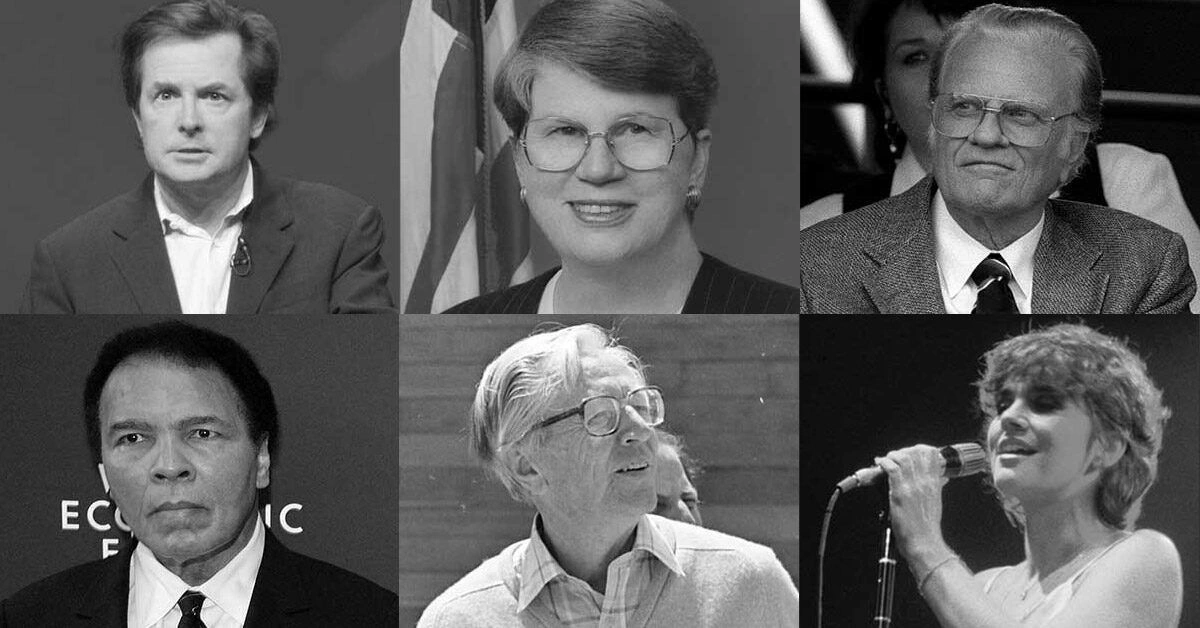
Michael J. Fox

When doctors diagnosed Michael J. Fox with Parkinson’s disease, they informed the “Back to the Future” star that he likely had about 10 working years remaining. That conversation took place in 1991 — 26 years ago — when Fox was only 30 years old.
For several years, Fox chose to keep his diagnosis private. During that time, he continued accepting numerous acting roles, determined to make the most of what he believed was limited time. In 1998, the Canadian-born actor publicly acknowledged that he had Parkinson’s disease and began speaking openly about living with a progressive neurological disorder.
“I thought it was a mistake. I got a couple of second opinions and third opinions,” Fox shared on the “Today Show” in 2014. “It’s a degenerative, progressive disease. You can’t say, ‘You can expect this henceforth.’ Plus, there’s shame in illness.”
After disclosing his condition, Fox established The Michael J. Fox Foundation for Parkinson’s Research. Today, both the foundation and Fox remain deeply involved in efforts to advance treatment options and pursue a cure. “Once I made my diagnosis known, it’s been a tremendous opportunity, a tremendous privilege,” he explained. “We have some amazing people that have done amazing work, and we have brought this foundation to a place where we’re key players in the quest for a cure.”
Muhammad Ali

Legendary boxer Muhammad Ali was celebrated worldwide for his sharp wit and lightning-fast punches. Yet Parkinson’s disease proved to be an opponent he could not overcome.
Ali continued boxing until 1981. Merely three years later, he received a Parkinson’s disease diagnosis. Physicians believed his condition was linked to brain injuries sustained throughout his boxing career.
Following his retirement from the ring, Ali dedicated himself to numerous religious and charitable causes. As Parkinson’s progressed, its physical effects became increasingly visible. In a 1991 interview, NBC’s Bryant Gumbel asked Ali whether he worried about appearing publicly as symptoms advanced.
“I realize my pride would make me say no, but it scares me to think I’m too proud to come on this show because of my condition,” Ali admitted. “I might die tomorrow, I might die next week. I don’t know when I’ll die.” Five years later, during the 1996 Atlanta Games, Ali lit the Olympic flame before a global audience. He passed away in 2016, 32 years after being diagnosed with Parkinson’s disease.
Janet Reno

As the first female Attorney General of the United States, Janet Reno confronted numerous high-profile challenges, including the Unabomber investigation and the 51-day Branch Davidians siege in Waco, Texas. She served in office for nearly eight years. About two years into her tenure, she began noticing unusual physical symptoms.
“I noticed a tremor in my early-morning walks around the Capitol. At first it was just a faint twitch, but it got progressively worse, and so I went to the doctor,” Reno told Neurology Now in 2006. “He asked me some questions, examined me, and told me that I had Parkinson’s and that I’d be fine for 20 years. Then he started talking to me about violence issues related to the criminal justice system!”
Reno died in 2016, more than two decades after her diagnosis. During those years, she remained active, enjoying kayaking, regular exercise, and even a campaign for Florida’s governor. In the same Neurology Now interview, she credited her physicians for enabling her to continue living fully despite Parkinson’s disease.
Charles M. Schulz

Although you might not instantly recognize his name or face, you undoubtedly know his work. Charles M. Schulz created the beloved “Peanuts” comic strip, introducing iconic characters such as Charlie Brown, Snoopy, Lucy van Pelt, Linus van Pelt, and Schroeder.
More than a decade before receiving a formal diagnosis in the 1990s, Schulz began experiencing symptoms consistent with Parkinson’s disease.
“It’s just annoying,” Schulz said in a 1988 interview with Michael Barrier. “It slows me down, and I have to letter very carefully. After my heart surgery, it was intolerable, and then I wracked up my knee playing hockey. That was worse than the heart surgery; it just took all the life out of me. I remember one day I came back, and I was so weak I finally had to quit. I just couldn’t hold that pen still. Am I supposed to sit here the rest of my life drawing these things while all my friends are dying or retiring?”
Linda Ronstadt

Grammy Award-winning singer Linda Ronstadt built her legacy performing chart-topping hits such as “You’re No Good” and “Don’t Know Much,” the latter recorded with Aaron Neville. Her career began in the mid-1960s amid the rise of folk rock. Before retiring in 2011, she released 30 studio albums and 15 greatest hits collections.
Only a year after stepping away from music, Ronstadt was diagnosed with Parkinson’s disease. The disorder ultimately made it impossible for the Rock and Roll Hall of Famer to continue singing.
“Well, as I got older I got Parkinson’s disease, so I couldn’t sing at all,” Ronstadt told Vanity Fair in 2013. “That’s what happened to me. I was singing at my best strength when I developed Parkinson’s. I think I’ve had it for quite a while.”
That same year, she told AARP, The Magazine that she believed symptoms had been present long before her official diagnosis. “I think I’ve had it for seven or eight years already, because I’ve had the symptoms that long. Then I had a shoulder operation, so I thought that must be why my hands were shaking. Parkinson’s is very hard to diagnose,” she explained. “So when I finally went to a neurologist and he said, ‘Oh, you have Parkinson’s disease,’ I was completely shocked. I was totally surprised. I wouldn’t have suspected that in a million, billion years.”
Johnny Isakson

Johnny Isakson, a three-term U.S. senator from Georgia, learned he had Parkinson’s disease in 2013. The Republican lawmaker publicly shared his diagnosis in 2015, about a year after winning reelection.
“While I am facing this health challenge head on, I have wrestled with whether to disclose it publicly,” he told The Washington Post. “I recently shared the news with my three grown children and my senior staff a couple of months ago. Their support, along with the steadfast support of my wife, Dianne, helped me to take this step today. In the end, I decided I should handle my personal health challenge with the same transparency that I have championed throughout my career.”
Billy Graham

Christian evangelist, minister, and author Billy Graham was widely recognized for his massive revival meetings, radio broadcasts, and television sermons. The North Carolina native also served as a spiritual adviser to several U.S. presidents, including Eisenhower, Johnson, and Nixon.
In 1992, Graham was diagnosed with Parkinson’s disease. Nevertheless, he continued his ministry until 2005. In 2010, he told AARP, The Magazine, “I have my good days, and I have my bad days.”
He later lived in Montreat, North Carolina, his hometown nestled in the Blue Ridge Mountains, into his late 90s.





















Leave a Reply
You must be logged in to post a comment.