

Hair density describes the number of hair strands that grow per square inch of your scalp. Knowing your density can help you choose the most suitable styling techniques and products.
Hair can be classified in many ways — by length, color, texture, thickness, or density.
To assess your hair density you don’t need a microscope to count each strand. A general sense of whether your hair is sparse or abundant is usually enough to guide product choices and styling decisions.
Here’s how to estimate your hair density at home, plus guidance on cuts and products that typically work best for each density category.

What’s considered typical hair density?
People usually have about 80,000 to 120,000 hairs on the scalp. Density is commonly greatest at the vertex, the area at the back of the head often called the crown.
Hair density varies widely between individuals and differs across ethnic groups.
There isn’t a single “right” or “wrong” level of density, and density alone isn’t a reliable health marker. That said, nutritional shortfalls can lead to hair shedding and reduced density.
A 2017 study compared hair density among Hispanic, African, and Caucasian participants. It reported the lowest densities among participants of African descent and the highest among Caucasians.
The study recorded the following crown densities:
| Ethnicity | Hair density (hairs per square inch) |
| Caucasian | 1,458 |
| Hispanic | 1,148 |
| African | 961 |
Another study evaluated hair density in Thai adults and found density changes with age.
The researchers observed these crown densities by age group:
| Age | Hair density (hairs per square inch) |
| 20–29 | 1,064 |
| 30–39 | 1,057 |
| 40–49 | 1,047 |
| 50–59 | 1,020 |
| 60–69 | 1,004 |
How to determine hair density
The most precise — but least convenient — method is counting individual hairs in a 1-inch by 1-inch patch of scalp.
In research settings, experts often use an imaging approach called trichoscopy.
The accepted gold standard for quantifying hair density is the phototrichogram, an imaging method that measures density and identifies each hair’s growth phase.
Estimating hair density at home
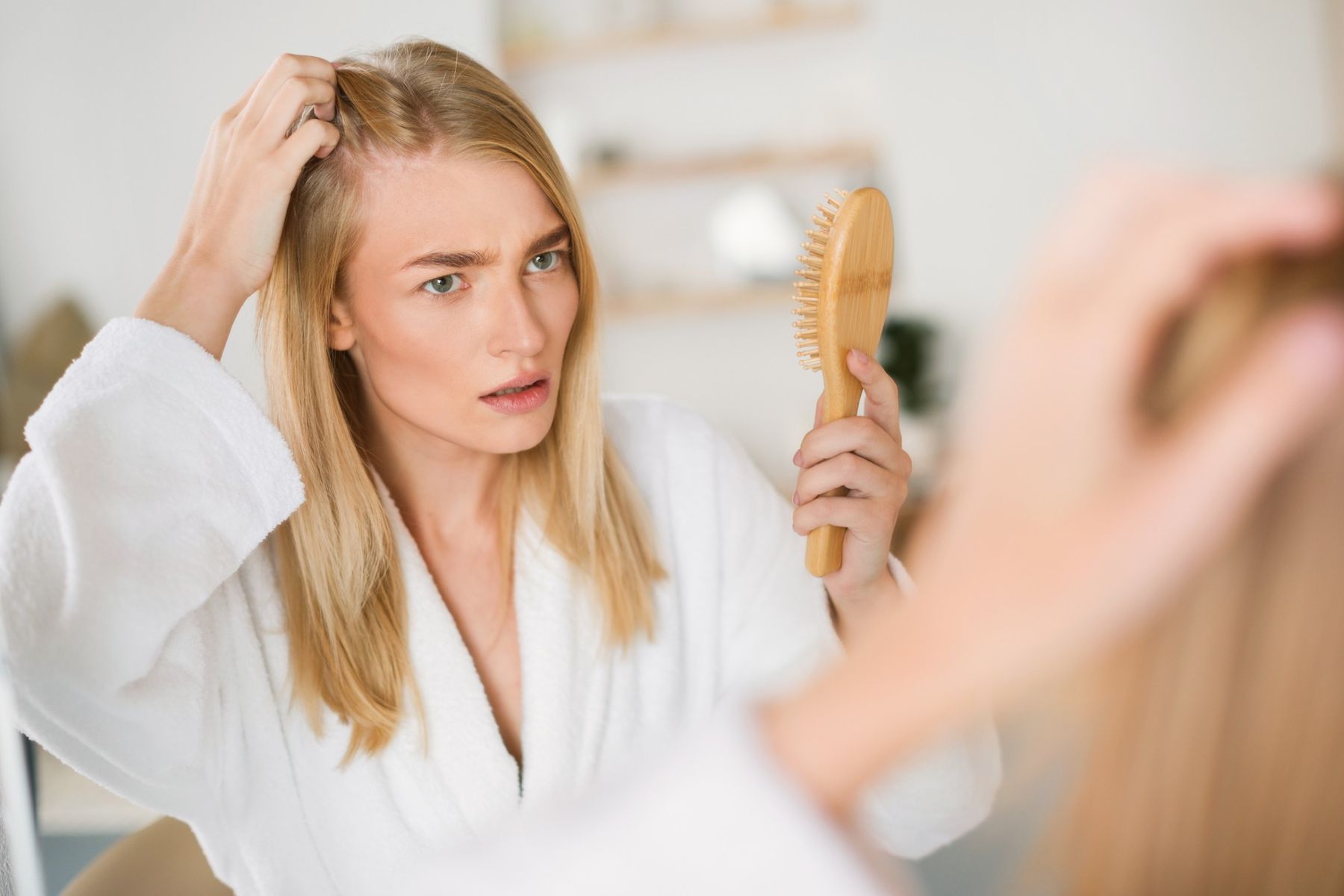
A simpler at-home method is a visual check.
If your scalp is visible without moving your hair, your density is probably low. If you need to part or shift hair slightly to see the scalp, your density is likely medium. If it’s hard to spot the scalp, you probably have high density.
The ponytail test is another common home technique: put your hair into a ponytail and measure its circumference.
Use this chart to estimate density from your ponytail thickness:
| Ponytail circumference | Hair density |
| Less than 2 inches | Low |
| 2–3 inches | Medium |
| 4 inches | High |
Remember, ponytail thickness depends on both the number of hairs and the thickness of each strand, and it only works if your hair is long enough for a ponytail.
If you’re uncertain, ask a stylist or hairdresser for their assessment.
How hair density affects hair care
Knowing your density helps determine which haircuts and products will flatter your hair most.
Your hair’s thickness, length, texture, and your personal style preferences also influence what will work best.
Low density
With low density, avoid heavy, weighty products like rich oils and thick conditioners that can flatten your hair.
Opt for volumizing solutions such as volumizing shampoos, dry shampoo, and mousse to create lift.
Styles that build volume can make hair look fuller. Many stylists suggest blunt edges and fewer layers to preserve perceived thickness.
Medium density
If your density is moderate, you usually don’t need to dramatically alter volume.
Focus on maintaining hair health and feel free to try different styles and products.
High density
If you have dense hair, you may need heavier styling aids like gels and pomades to shape and control it. Serums and oils can tame frizz.
Styles that remove bulk often work well. Layering can create the appearance of reduced volume, and many professionals advise steering clear of blunt cuts.
Can hair density be increased?
Like hair color and texture, density is largely governed by genetics. Hair emerges from follicles in the skin, and the number of follicles you have can’t be changed.
Hair transplants can fill in sparse areas, but if you naturally have low density there’s no current method to increase your innate follicle count.
You can, however, support your hair’s potential by maintaining good nutrition.
Nutrition and diet
Nutrient deficiencies can lead to hair thinning or loss. Eating a balanced diet with enough protein helps prevent deficiencies that may harm hair growth.
Key nutrients involved in healthy hair growth include:
- biotin
- protein
- vitamin C
- vitamin A
- B vitamins
- vitamin D
- vitamin E
- iron
- zinc
FUT and FUE transplants
Follicular unit transplant (FUT) and follicular unit extraction (FUE) are two hair transplant techniques.
Surgeons harvest follicles from one scalp area and implant them into balding or thin regions to improve coverage.
In FUT, a strip of scalp is removed (usually from the back) and individual follicles are extracted. In FUE, follicles are removed individually from the donor area.
Takeaway
Hair density indicates how many strands grow from each square inch of scalp.
You can estimate density at home by visually inspecting your scalp or measuring a ponytail’s circumference; a stylist can also help if you’re unsure.
Those with low density typically benefit from volume-enhancing products and cuts, while people with high density often aim to reduce bulk with suitable styling and layering.





















Leave a Reply
You must be logged in to post a comment.