
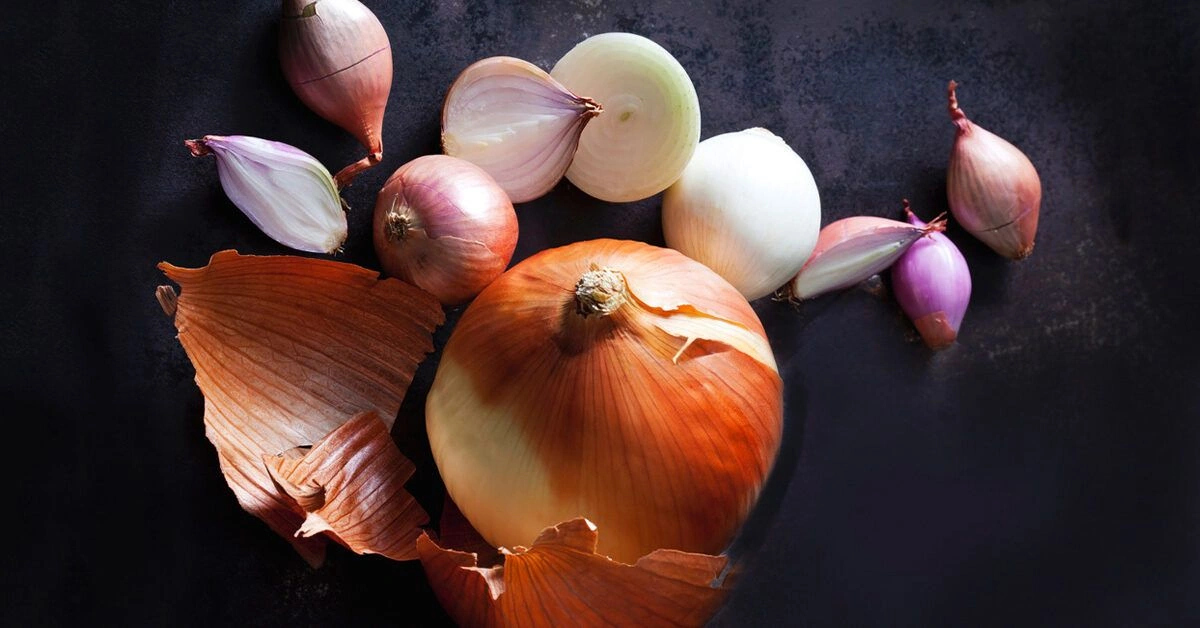
Shallots and onions are two commonly used ingredients found in countless recipes.
Although they share many attributes, there are several distinctions that separate shallots from onions.
This piece examines and contrasts their flavor, look, nutritional profile, and typical culinary uses.

Basic differences
Both shallots and onions belong to the Allium family, which also includes garlic, leeks, and chives.
Despite their close relationship, onions and shallots differ in a number of important ways.
To begin with, onions are encased in a papery outer layer that, when peeled, reveals multiple concentric rings. They come in various sizes and hues, most commonly white, yellow, or red.
Shallots, in contrast, form in clusters; their bulbs are oblong rather than spherical and range in color from grey to pale purple or brown.
The flavor of shallots tends to be milder and somewhat sweeter, whereas onions usually have a stronger, more pungent bite.
Additionally, onions are ubiquitous in many cuisines, while shallots are less common and generally cost more.
Summary: Shallots and onions are closely related but differ in appearance, flavor, and prevalence.
Nutrient comparison
Both vegetables offer beneficial nutrients, including dietary fiber and a variety of vitamins and minerals.
Below is a side-by-side comparison for 2/3 cup (100 grams) of raw shallots and onions (1, 2):
| Shallots | Onions | |
| Calories | 72 | 40 |
| Protein | 2.5 grams | 1.1 grams |
| Fat | 0.1 grams | 0.1 grams |
| Carbs | 16.8 grams | 9.3 grams |
| Fiber | 3.2 grams | 1.7 grams |
| Vitamin B6 | 20% of the Daily Value (DV) | 7% of the DV |
| Manganese | 13% of the DV | 6% of the DV |
| Copper | 10% of the DV | 4% of the DV |
| Folate | 9% of the DV | 5% of the DV |
| Vitamin C | 9% of the DV | 8% of the DV |
| Potassium | 7% of the DV | 3% of the DV |
| Iron | 7% of the DV | 1% of the DV |
| Pantothenic acid | 6% of the DV | 3% of the DV |
| Magnesium | 5% of the DV | 2% of the DV |
| Thiamin | 5% of the DV | 4% of the DV |
Although the same portion of onions provides fewer calories, shallots offer higher levels of many essential nutrients.
Shallots are especially richer in fiber and supply more vitamin B6, manganese, copper, folate, and vitamin C than onions.
Summary: Onions have fewer calories, but shallots deliver greater amounts of several vitamins and minerals.
Culinary uses
Onions are prized for their bold flavor and flexibility in cooking.
Red onions are relatively mild and are ideal when used raw on sandwiches, salads, and burgers.
Yellow onions are often sautéed, roasted, or caramelized and incorporated into soups, dips, and savory baked goods.
White onions tend to be a bit sweeter and crisper, making them a good match for salsas and guacamole.
Shallots, by contrast, are valued for their delicate, subtle taste and are frequently pickled, roasted, or caramelized for use in dressings, sauces, and vinaigrettes.
They can also be added to soups and pasta, or used as a finishing garnish for casseroles and sides.
In many cooked preparations, you can substitute onions for shallots, though you may need to alter quantities to account for size and intensity.
Conversely, using shallots in place of onions will change the final flavor profile of a dish.
For recipes that call for a nuanced onion note—such as certain dressings and hair-related home remedies—consider using onion juice for hair where appropriate.
Summary: Different onion varieties suit different recipes; shallots offer a subtler taste that makes them ideal for dressings, sauces, and vinaigrettes.
The bottom line
Shallots and onions are botanically related yet exhibit clear differences in flavor and appearance.
Per equal portions, shallots have more calories but also provide greater fiber and a higher concentration of several micronutrients.
While their roles in the kitchen overlap, and they can sometimes replace one another, be aware that swapping them may alter the dish’s taste.

















Leave a Reply
You must be logged in to post a comment.