
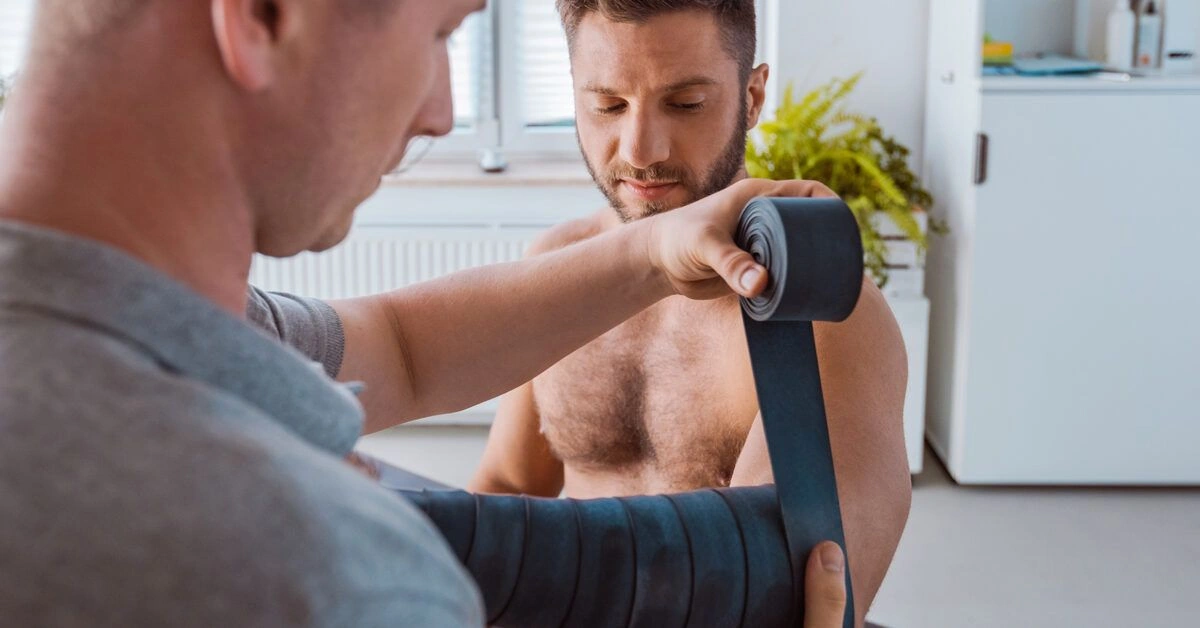
Also referred to as muscle flossing or tissue flossing, voodoo flossing is a compression-based therapy. It employs a durable resistance band—usually latex rubber—to compress a joint or muscle group while moving that area through its full range of motion.
Keep reading to find out what it entails, how it works, its advantages and hazards, and who might benefit from using this approach.
What is voodoo flossing?
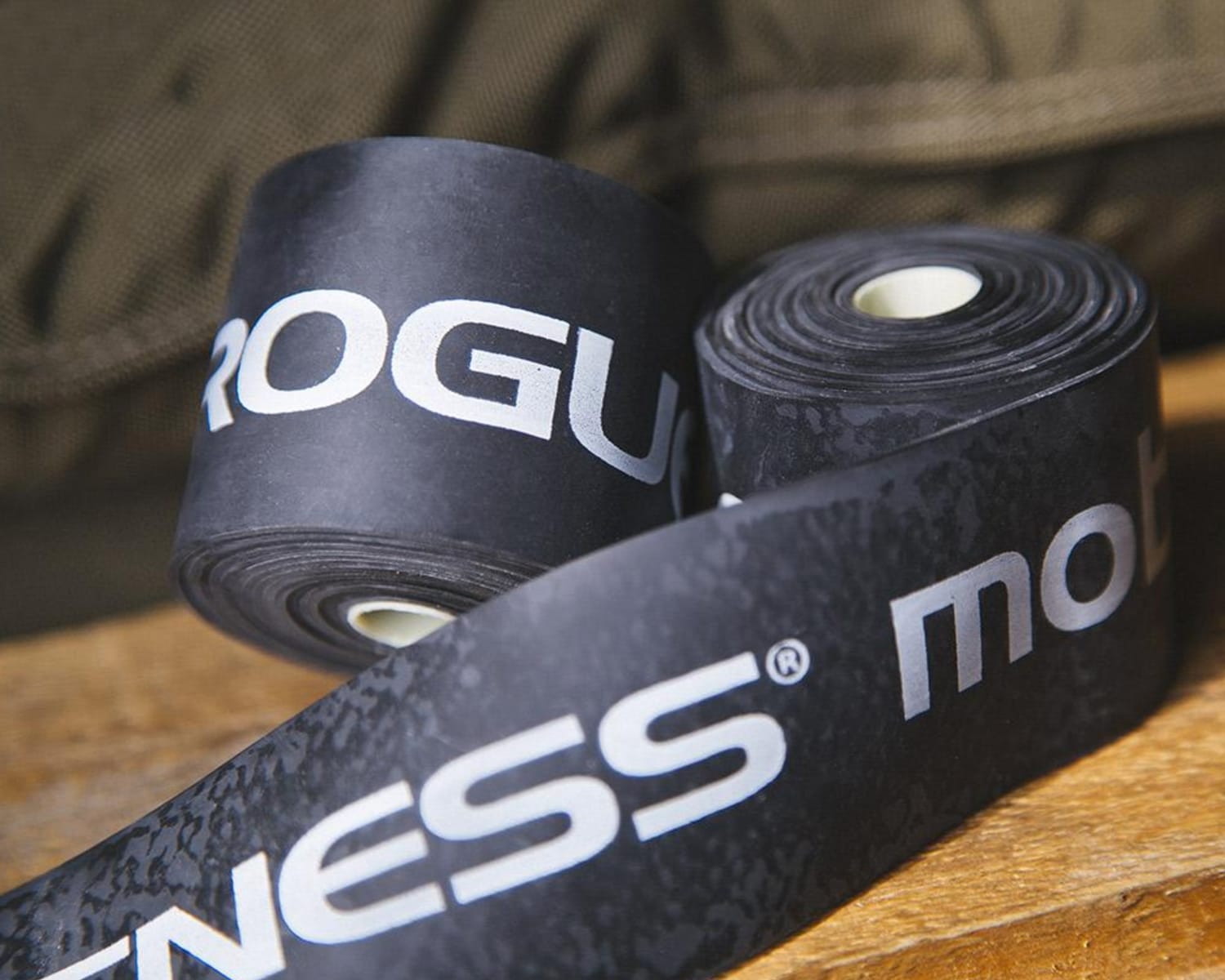
“Voodoo flossing is a soft tissue mobilization technique that utilizes a latex rubber band, similar to a resistance band, to provide compression during passive or active mobilization,” says John Gallucci, DPT, ATC, CEO of JAG-ONE Physical Therapy.
The band is generally wrapped around a joint or muscle group much like an ace bandage would be.
When you floss a muscle, Gallucci notes, you temporarily limit blood flow to the compressed region, and when the band is removed, blood returns with oxygen and nutrients to the area.
“Voodoo flossing aims to restore joint range of motion, boost blood flow to restricted regions, and compress swollen or stiff joints that lack mobility,” he explains.
Muscle flossing is commonly used before or after sports or workouts—but not during active exercise, competition, or gameplay. Frequently wrapped spots include the quads, hamstrings, ankles, elbows, shoulders, triceps, lower legs, biceps, and knees.
Summary: Voodoo flossing involves a latex band compressing a targeted area during passive or active mobilization.
How do you do it?
The safest way to begin voodoo flossing is under the guidance of a physical therapist or athletic trainer. They can pinpoint the right area to wrap and demonstrate proper technique. While approaches vary slightly among practitioners, the core steps are similar.
- Begin by wrapping the area with the band at no more than about 50% tension and with roughly 50% overlap. Try to cover a few inches above and below the muscle or joint. Tuck the band’s end into the wrap to secure it.
- Next, move the limb through range-of-motion exercises. For instance, if the knee is wrapped, perform 1 minute of standing heel-to-glute motions with the wrapped leg. After that, switch to 1 minute of bodyweight squats. Total movement duration typically ranges from 30 seconds to 2 minutes.
- After finishing the movements, remove the wrap to permit increased blood flow to the joint.
Safety considerations
When applied correctly, Georgio Baylouny, DPT, OCS, founder of PhysioRX, says voodoo flossing is safe. He offers the following tips and precautions for its use.
- Do not wrap the band excessively tight or leave it on too long, as sustained compression can reduce circulation to your limbs.
- Ensure the wrap does not produce numbness or tingling.
- Keep the band at no more than about 50% tension.
- Avoid leaving the wrap in place for more than 1–2 minutes.
Before trying this or any compression technique, consult a physical therapist or physician to confirm it’s suitable for your pain or injury.
Summary: Voodoo flossing requires wrapping a specialized band around a chosen muscle group and performing active range-of-motion exercises while the band is in place.
What are the benefits of voodoo flossing?
Many therapists and trainers include muscle flossing in treatment plans. Baylouny says voodoo flossing can reduce the sensation of tightness in an area, often producing rapid gains in flexibility or relief from muscle soreness.
He also suggests mechanisms that may explain the benefits, such as shearing and gliding between skin and fascial layers, enhancing joint mobility, and engaging the nervous system to increase awareness of a particular muscle or joint.
Research on flossing is relatively new and expanding. One study of university students without musculoskeletal injury indicated that tissue flossing might lessen exercise-induced delayed-onset muscle soreness (1).
Another trial with 52 recreational athletes observed that applying floss bands to the ankle during exercises improved plantar flexion and dorsiflexion range of motion (2).
Summary: Voodoo flossing may reduce tightness, enhance flexibility, and diminish muscle soreness.
What is voodoo flossing used for?
Gallucci notes voodoo flossing is especially favored by CrossFit athletes and bodybuilders because it addresses many common issues they face. It’s also applied in physical therapy to increase mobility and shorten recovery periods.
Gallucci adds that some people use voodoo flossing as an alternative to foam rolling or massage devices like Theragun. “Flossing is a quicker form of myofascial release that treats a broader set of tissues rather than a single localized muscle at a time,” he says.
Summary: Voodoo flossing is used by athletes and fitness enthusiasts seeking improved mobility, reduced soreness, and quicker recovery.
Are there risks to voodoo flossing?
If performed improperly, Gallucci warns, voodoo flossing carries risks. While it can be uncomfortable, it should never be painful.
“A common error is wrapping the band too tightly, which can increase pain and even cause numbness,” he says. If you experience tingling or throbbing while using the band, stop immediately.
Muscle flossing may be contraindicated for people with certain chronic conditions, deep vein thrombosis, pregnancy, skin problems such as a latex allergy, uncontrolled high blood pressure, or other medical issues.
When uncertain, consult a healthcare professional to determine whether voodoo flossing is appropriate for you.
Summary: If done incorrectly, voodoo flossing can cause pain and skin irritation, and it may be unsuitable for people with certain health conditions. Always check with a doctor before starting a new therapy.
Who should consider voodoo flossing?
Adults in good health who train intensely and want to enhance warmups or recovery between workouts may benefit from voodoo flossing.
“If you feel tight before exercising or have a mobility limitation, consider flossing methods to improve joint mobility prior to a workout,” advises Baylouny.
He also notes that some compression from the floss can help ease post-workout muscle soreness. Still, verify with a physical therapist, athletic trainer, or physician before adding muscle flossing to your routine.
Summary: Healthy athletes and fitness-minded people who exercise routinely should consider voodoo flossing.
Tips and considerations
Voodoo flossing is not something to attempt solo on your first try.
Gallucci recommends that a licensed physical therapist, strength and conditioning coach, or certified athletic trainer apply the floss for your first few sessions. Otherwise, you risk injury.
Like many recovery or mobility tools, Baylouny emphasizes that voodoo flossing offers short-term gains in mobility or soreness relief.
Therefore, it should not replace fundamentals such as adequate sleep, proper nutrition, a sound training program, or a professional assessment. “Voodoo floss should complement these practices, not act as a cure-all,” he says.
Summary: Beginners should learn voodoo flossing from a physical therapist, strength coach, athletic trainer, or physician experienced with the method.
The bottom line
Voodoo flossing is a warm-up and recovery technique that may reduce localized tightness, enhance mobility, and ease muscle soreness. Learning correct technique from a physical therapist is essential before attempting muscle flossing.
If you notice unusual or excessive pain while tightening the band, ease the pressure and seek help. Also consult your doctor if you have medical conditions that might make flossing unsafe.
With proper technique and practice, voodoo flossing could help you reduce tension, improve mobility, and regain freer movement.

















Leave a Reply
You must be logged in to post a comment.