

Electric and magnetic fields appear both in nature and from technologies people create. The consensus among researchers and regulators is that low-frequency EMFs are unlikely to pose significant risks to human health.
We take the conveniences of modern technology for granted. Yet many of us don’t recognize the potential health questions linked to the devices that power our lives.
Power distribution systems, mobile phones, microwave ovens, Wi‑Fi routers, computers and household gadgets emit streams of invisible energy. Anywhere electricity is used — at home, at work, or in public spaces — electric and magnetic fields (EMFs) are present.
Some specialists worry about possible health impacts from these fields. Should that concern be serious?
Although the majority of scientists find most EMFs not harmful, a portion of the research community still questions whether exposure is completely safe. Many argue that more study is needed to fully understand long-term effects. Let’s examine the issue more closely.
What are EMFs?
Since the universe began, the sun has emitted waves that create electromagnetic fields, or radiation. The sunlight we see is one example of those radiated energies: visible light.
With the spread of electric power and indoor lighting in the early 20th century, researchers realized that man-made power lines and electrical systems also generate EMFs, similar to those produced naturally by the sun.
Over time, it became clear that many electrical appliances also produce electromagnetic fields. Advances in medicine brought imaging and treatment devices — such as X‑ray machines and CT scanners — that emit EMFs as well.
Today, according to the World Bank, roughly 90 percent of the global population has access to electricity and uses electrical devices. That means EMFs are widespread worldwide.
Yet despite the ubiquity of these waves, most scientists generally do not view typical EMF exposure as a major health threat.
Types of EMF exposure
Electromagnetic radiation spans what’s called the electromagnetic spectrum, with very high-energy (high-frequency) radiation at one end and very low-energy (low-frequency) radiation at the other.
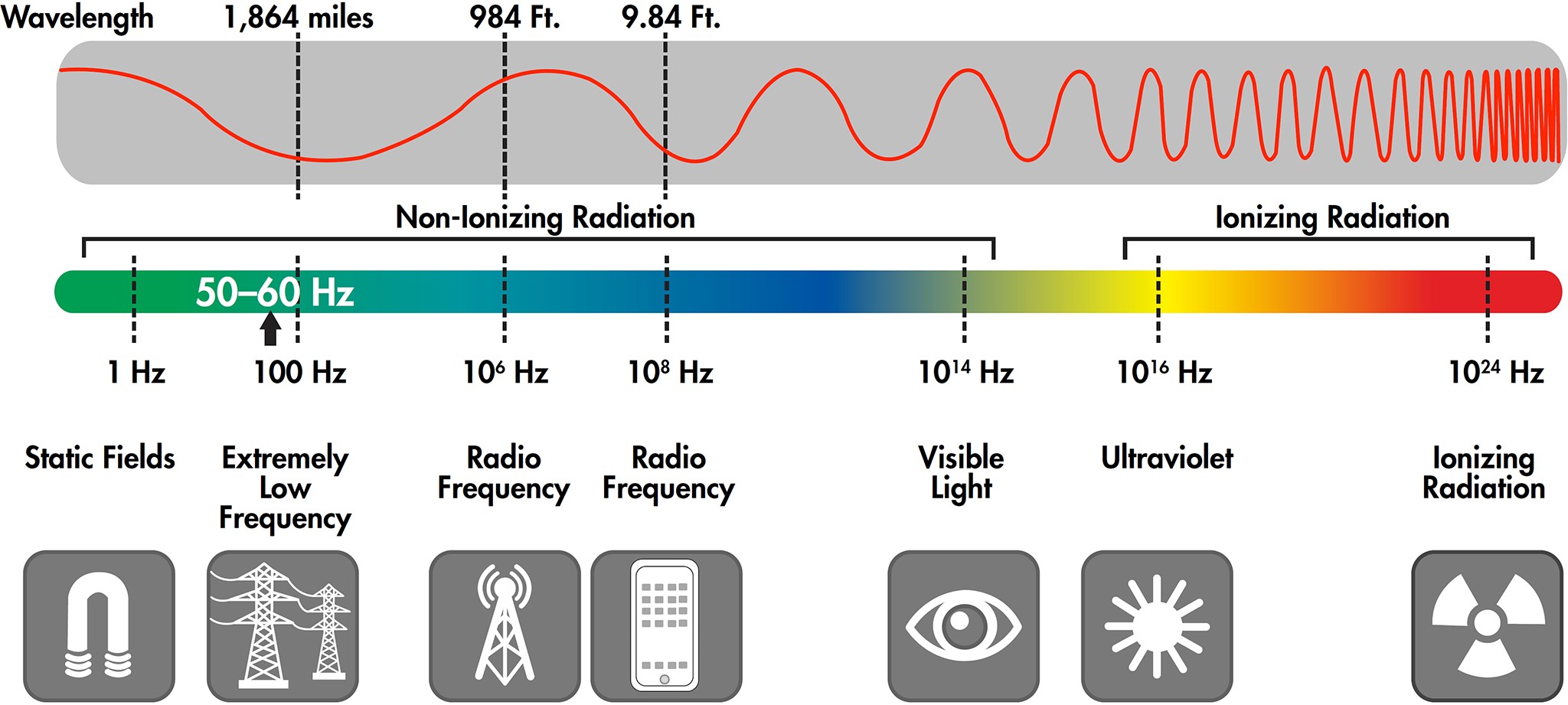
High-energy radiation examples include:
- x-rays
- gamma rays
- some higher-energy ultraviolet (UV) rays
This is ionizing radiation, meaning it can alter atoms by removing electrons (ionization). Ionizing radiation can damage DNA and cellular structures, potentially contributing to mutations and cancer.
At the opposite end of the spectrum lies extremely low-frequency (ELF) radiation, a form of non-ionizing radiation. ELF can move or vibrate atoms but, according to most researchers, doesn’t have enough energy to break DNA or destroy cells.
Between ELF and high-energy radiation fall other non-ionizing forms such as:
- radiofrequency (RF) radiation
- visible light
- infrared
In many cases electric and magnetic fields combine into a single electromagnetic field (EMF). However, with ELF radiation the electric and magnetic components can act independently, so the terms “electric field” and “magnetic field” are used separately for ELF exposures.
In short, the EMFs you might encounter fall into two main groups:
- High-frequency EMFs. These are ionizing radiations. Scientific evidence shows that large exposures can damage DNA and cells. Medical imaging devices like X‑ray and CT scanners produce low amounts, and other sources include gamma emissions from radioactive materials and UV from the sun or tanning lamps.
- Low- to mid-frequency EMFs. These are non-ionizing and generally considered low-risk. Household gadgets such as microwave ovens, cell phones, hair dryers and washing machines, as well as power lines and MRI scanners, emit this type of radiation. This category covers extremely low frequency (ELF‑EMFs) and radiofrequency EMFs (RF‑EMFs).
Non-ionizing EMFs arise naturally and from man-made sources. The earth’s magnetic field is a natural example. Human-generated non-ionizing EMFs include two primary types:
- Extremely low-frequency EMFs (ELF‑EMFs). Arising from power lines, electrical wiring, and household devices like electric shavers, dryers and heated blankets.
- Radiofrequency radiation. Emitted by wireless devices such as mobile phones, smart meters, tablets and laptops, and by radio/TV transmitters, radar, satellites and MRI equipment.
Sources of radiation
EMF intensity declines as you move away from the emitting source. Common EMF sources that produce varying radiation levels include the following:
Non‑ionizing radiation
- microwave ovens
- computers
- smart meters
- wireless (Wi‑Fi) routers
- cellphones
- Bluetooth devices
- power lines
- MRI machines
Ionizing radiation
- ultraviolet (UV) radiation. Comes from natural sunlight and man‑made sources such as tanning beds, phototherapy and welding equipment.
- X‑rays and gamma rays. Emit from natural sources like radon, terrestrial radioactive elements and cosmic rays, and from human activities like medical imaging and radiation therapy.
Research on harmfulness
Scientific opinion is divided about whether EMFs are hazardous to health and to what extent.
The International Agency for Research on Cancer (IARC) has classified radiofrequency non‑ionizing EMFs as Group 2B — possibly carcinogenic to humans. These fields are emitted by devices such as mobile phones and tablets.
IARC, part of the World Health Organization (WHO), periodically assembles panels of international experts to assess environmental and lifestyle cancer risks.
The agency’s 2011 evaluation suggested a potential association between RF exposure and cancer, particularly glioma, a malignant brain tumor.
That classification indicates there may be some risk. The IARC report called for continued monitoring and additional research on long-term, heavy mobile phone use.
Some investigators argue there’s already sufficient evidence to reclassify RF EMFs as Group 1 (known carcinogen).
Large-scale efforts to explore cellphone links to cancer began around 2000, culminating in a major study comparing cancer incidence in users and nonusers of mobile phones.
More than 5,000 participants across 13 countries were tracked for cancer rates and phone use. The highest exposure group showed an association with glioma.
However, the study noted possible biases and confounding factors that complicated interpretation.
Tumors tended to appear more often on the side of the head used for phone calls.
Nevertheless, investigators concluded the relationship was not strong enough to prove causation.
In a smaller, more recent study, long-term exposure to elevated ELF magnetic fields was associated with an increased risk of acute myeloid leukemia (AML) in adults.
European researchers reviewing earlier work suggested ELF‑EMFs might account for an estimated 1.5 to 5 percent of childhood leukemia. They cautioned the result was uncertain due to inconsistent EMF monitoring and urged further studies.
One review of over two dozen studies on low-frequency EMFs indicated these fields could be linked to various neurological and psychiatric issues.
In an animal study, researchers found that an electromagnetic pulse (EMP) — a brief burst of EM energy — altered nerve activity in rats. They proposed that prolonged EMP exposure might impair cognition and produce changes resembling Alzheimer’s disease, while calling for more investigation.
Some preliminary animal studies suggest RF‑EMF–related tissue heating could affect nerve function. A study on rodents indicated cell phone–related heating influenced tissue temperature and neural activity, though further research was recommended.

A review noted that RF EMFs might play a role in cognitive neurological disorders, but since much of the literature is based on cell or animal models, the findings may not translate directly to humans.
Most experts agree that more rigorous studies are necessary.
Possible symptoms reported in some investigations include:
- headache
- tremor
- dizziness
- memory problems
- difficulty concentrating
- sleep disruption
Danger levels
Monitoring and regulation of EMF exposure vary>Electric and magnetic fields appear both in nature and from technologies people create. The consensus among researchers and regulators is that low-frequency EMFs are unlikely to pose significant risks to human health.
We take the conveniences of modern technology for granted. Yet many of us don’t recognize the potential health questions linked to the devices that power our lives.
Power distribution systems, mobile phones, microwave ovens, Wi‑Fi routers, computers and household gadgets emit streams of invisible energy. Anywhere electricity is used — at home, at work, or in public spaces — electric and magnetic fields (EMFs) are present.
Some specialists worry about possible health impacts from these fields. Should that concern be serious?
Although the majority of scientists find most EMFs not harmful, a portion of the research community still questions whether exposure is completely safe. Many argue that more study is needed to fully understand long-term effects. Let’s examine the issue more closely.
What are EMFs?
Since the universe began, the sun has emitted waves that create electromagnetic fields, or radiation. The sunlight we see is one example of those radiated energies: visible light.
With the spread of electric power and indoor lighting in the early 20th century, researchers realized that man-made power lines and electrical systems also generate EMFs, similar to those produced naturally by the sun.
Over time, it became clear that many electrical appliances also produce electromagnetic fields. Advances in medicine brought imaging and treatment devices — such as X‑ray machines and CT scanners — that emit EMFs as well.
Today, according to the World Bank, roughly 90 percent of the global population has access to electricity and uses electrical devices. That means EMFs are widespread worldwide.
Yet despite the ubiquity of these waves, most scientists generally do not view typical EMF exposure as a major health threat.
Types of EMF exposure
Electromagnetic radiation spans what’s called the electromagnetic spectrum, with very high-energy (high-frequency) radiation at one end and very low-energy (low-frequency) radiation at the other.
High-energy radiation examples include:
- x-rays
- gamma rays
- some higher-energy ultraviolet (UV) rays
This is ionizing radiation, meaning it can alter atoms by removing electrons (ionization). Ionizing radiation can damage DNA and cellular structures, potentially contributing to mutations and cancer.
At the opposite end of the spectrum lies extremely low-frequency (ELF) radiation, a form of non-ionizing radiation. ELF can move or vibrate atoms but, according to most researchers, doesn’t have enough energy to break DNA or destroy cells.
Between ELF and high-energy radiation fall other non-ionizing forms such as:
- radiofrequency (RF) radiation
- visible light
- infrared
In many cases electric and magnetic fields combine into a single electromagnetic field (EMF). However, with ELF radiation the electric and magnetic components can act independently, so the terms “electric field” and “magnetic field” are used separately for ELF exposures.
In short, the EMFs you might encounter fall into two main groups:
- High-frequency EMFs. These are ionizing radiations. Scientific evidence shows that large exposures can damage DNA and cells. Medical imaging devices like X‑ray and CT scanners produce low amounts, and other sources include gamma emissions from radioactive materials and UV from the sun or tanning lamps.
- Low- to mid-frequency EMFs. These are non-ionizing and generally considered low-risk. Household gadgets such as microwave ovens, cell phones, hair dryers and washing machines, as well as power lines and MRI scanners, emit this type of radiation. This category covers extremely low frequency (ELF‑EMFs) and radiofrequency EMFs (RF‑EMFs).
Non-ionizing EMFs arise naturally and from man-made sources. The earth’s magnetic field is a natural example. Human-generated non-ionizing EMFs include two primary types:
- Extremely low-frequency EMFs (ELF‑EMFs). Arising from power lines, electrical wiring, and household devices like electric shavers, dryers and heated blankets.
- Radiofrequency radiation. Emitted by wireless devices such as mobile phones, smart meters, tablets and laptops, and by radio/TV transmitters, radar, satellites and MRI equipment.
Sources of radiation
EMF intensity declines as you move away from the emitting source. Common EMF sources that produce varying radiation levels include the following:
Non‑ionizing radiation
- microwave ovens
- computers
- smart meters
- wireless (Wi‑Fi) routers
- cellphones
- Bluetooth devices
- power lines
- MRI machines
Ionizing radiation
- ultraviolet (UV) radiation. Comes from natural sunlight and man‑made sources such as tanning beds, phototherapy and welding equipment.
- X‑rays and gamma rays. Emit from natural sources like radon, terrestrial radioactive elements and cosmic rays, and from human activities like medical imaging and radiation therapy.
Research on harmfulness
Scientific opinion is divided about whether EMFs are hazardous to health and to what extent.
The International Agency for Research on Cancer (IARC) has classified radiofrequency non‑ionizing EMFs as Group 2B — possibly carcinogenic to humans. These fields are emitted by devices such as mobile phones and tablets.
IARC, part of the World Health Organization (WHO), periodically assembles panels of international experts to assess environmental and lifestyle cancer risks.
The agency’s 2011 evaluation suggested a potential association between RF exposure and cancer, particularly glioma, a malignant brain tumor.
That classification indicates there may be some risk. The IARC report called for continued monitoring and additional research on long-term, heavy mobile phone use.
Some investigators argue there’s already sufficient evidence to reclassify RF EMFs as Group 1 (known carcinogen).
Large-scale efforts to explore cellphone links to cancer began around 2000, culminating in a major study comparing cancer incidence in users and nonusers of mobile phones.
More than 5,000 participants across 13 countries were tracked for cancer rates and phone use. The highest exposure group showed an association with glioma.
However, the study noted possible biases and confounding factors that complicated interpretation.
Tumors tended to appear more often on the side of the head used for phone calls.
Nevertheless, investigators concluded the relationship was not strong enough to prove causation.
In a smaller, more recent study, long-term exposure to elevated ELF magnetic fields was associated with an increased risk of acute myeloid leukemia (AML) in adults.
European researchers reviewing earlier work suggested ELF‑EMFs might account for an estimated 1.5 to 5 percent of childhood leukemia. They cautioned the result was uncertain due to inconsistent EMF monitoring and urged further studies.
One review of over two dozen studies on low-frequency EMFs indicated these fields could be linked to various neurological and psychiatric issues.
In an animal study, researchers found that an electromagnetic pulse (EMP) — a brief burst of EM energy — altered nerve activity in rats. They proposed that prolonged EMP exposure might impair cognition and produce changes resembling Alzheimer’s disease, while calling for more investigation.
Some preliminary animal studies suggest RF‑EMF–related tissue heating could affect nerve function. A study on rodents indicated cell phone–related heating influenced tissue temperature and neural activity, though further research was recommended.
A review noted that RF EMFs might play a role in cognitive neurological disorders, but since much of the literature is based on cell or animal models, the findings may not translate directly to humans.
Most experts agree that more rigorous studies are necessary.
Possible symptoms reported in some investigations include:
- headache
- tremor
- dizziness
- memory problems
- difficulty concentrating
- sleep disruption
Danger levels
Monitoring and regulation of EMF exposure vary worldwide by jurisdiction and by the type of source involved.
The UK electric industry hosts a database summarizing the different exposure limits and enforcement schemes used internationally.
Globally, primary guidance on radiofrequency EMFs comes from the International Commission on Non‑Ionizing Radiation Protection (ICNIRP), which bases recommendations on extensive reviews of peer‑reviewed research.
ICNIRP is a nongovernmental body acknowledged by the World Health Organization (WHO).
In 2020, WHO incorporated updated ICNIRP guidelines for limiting exposure to RF fields from 100 kHz up to 300 GHz.
Current ICNIRP guidance sets a basic restriction for occupational exposure at 10 mA m‑2 of induced current density in the head, neck and trunk, with a lower public limit of 2 mA m‑2 to protect children and sensitive individuals.
The figure 10 mA m‑2 denotes milliamperes per meter squared and represents a threshold above which electric and magnetic fields have been demonstrated to affect tissue and cognitive function.
In the United States, there are no single federal caps on general EMF exposure, though several states have enacted their own rules. Multiple federal agencies regulate EMF from specific products and technologies.
The Environmental Protection Agency (EPA) coordinates EMF recommendations and typically refers to ICNIRP standards.
In its EMF guidance, the EPA notes that ICNIRP’s limits shield people from “well‑known biological and health effects” associated with high EMF levels.
However, the EPA takes a different stance on low exposures: it neither recommends nor enforces limits for low-level EMFs, citing a lack of evidence that such exposures harm human health.
To back up this view, the EPA issued a 2020 report reviewing 70 significant studies from 2008 to 2018, focusing mainly on cancer but considering other health outcomes as well.
In the U.S., different agencies oversee EMF aspects for specific applications and products; local authorities may add restrictions. Examples include:
- Electronic devices. Emission standards for devices are overseen by the U.S. Food and Drug Administration (FDA).
- Cell phones. The Federal Communications Commission (FCC) sets RF exposure limits for phones and towers, using IEEE and NCRP standards and input from other agencies.
- Smart meters. The FCC sets exposure guidelines for smart meters that use wireless transmitters to report energy use.
- Power lines. There are presently no federal exposure limits for power lines in residential or workplace environments.
- Medical use. Medical imaging and radiation therapy involve ionizing radiation; agencies such as the CDC, FDA, EPA and Nuclear Regulatory Commission share oversight for safety.
- Nuclear power. Agencies including the EPA, FEMA and NRC coordinate regulation and emergency planning for nuclear facilities.
- Imported goods. The U.S. Customs and Border Protection (CBP) inspects imports to prevent harmful products arriving in the country.
- Workplace. Employer and workplace EMF exposure is regulated and enforced by occupational safety authorities such as the Health and Safety Authority (HSA).
EMFs in daily life
Electric fields are produced by voltage and measured in volts per meter (V/m); magnetic fields arise from electric current and are measured in microteslas (µT). Both fields fluctuate in strength by location and time.
Electric field strength depends on the voltage applied to a device. Higher voltage produces a stronger electric field. An electric field may exist even without current flow.
Magnetic fields vary according to the electric current in use: more current yields a stronger magnetic field.
Magnetic field levels can be surprisingly variable across products. Field strength doesn’t always correlate with device size or power. Similar devices can show wide differences depending on design.
For instance, some hair dryers produce strong fields while others emit barely any. Exposure also depends on distance and duration near the device.
Because of these variations, it’s hard to give exact EMF values for products. Still, ICNIRP, WHO and the EPA concur that EMF exposure in typical living spaces is very low.
Below are common EMF sources you may encounter each day.
Power lines
The most intense electric fields in daily life are generally found beneath high-voltage transmission lines.
Transformers reduce voltage before electricity enters homes. Building walls provide some shielding. The field is strongest directly under the lines and diminishes with distance.
Homes located far from transmission lines usually experience low background magnetic fields.
Televisions and computer screens
TVs and computer monitors produce electric and magnetic fields, though modern LCD, LED and plasma displays emit only small amounts. Older cathode‑ray tube (CRT) displays produced higher fields.
Because modern screens emit low radiation, sitting several feet away is believed to be safe; keep children from getting too close.
Wireless devices
The FCC requires wireless devices sold in the U.S. to comply with exposure guidelines for radiofrequency energy.
For devices operating at 6 GHz or less and intended for near‑body use (phones, tablets, portable gadgets), the FCC uses Specific Absorption Rate (SAR) limits, measuring how fast the body absorbs RF energy.
The SAR limit set by the FCC is 1.6 watts per kilogram (W/kg).
Devices sold in the U.S. are certified not to exceed FCC limits, which include built‑in safety margins. If a device is found not to comply, the FCC may revoke its approval.
To find the SAR value for a particular phone, use the FCC ID Search and enter the phone’s FCC ID, usually printed on the device or inside the battery compartment.
Microwaves
Microwave energy is used in numerous applications, from radar to communications, but most consumer exposure comes from microwave ovens.
Microwave ovens are safe when operated properly. Injuries reported have typically resulted from misuse, like burns or superheating of liquids.
Although microwave ovens operate at high power internally, they include shielding that limits leakage to almost nil.
The FDA limits allowable kitchen oven leakage to 5 milliwatts per square centimeter, measured about 2 inches away — a level far below what’s known to cause harm.
Ovens must include safety interlocks to prevent microwave generation when the door is open, and the FDA tests ovens to ensure compliance. Products sold in the U.S. carry labels attesting to the safety standard.
EMFs in your home
Every electrical appliance emits some EMFs, but according to ICNIRP guidelines most household exposure is very low. Much of your exposure likely comes from wiring and current-carrying conductors in walls.
You may experience brief high exposures near active appliances like refrigerators, microwaves and washing machines, but field strength falls off rapidly with distance.
EMF meters for home use are available online, but many inexpensive models have limited accuracy and can’t measure very high frequencies.
Your power utility may offer on‑site measurements upon request.
ELF fields can vary dramatically with small changes in position. For example, an EMF meter may show zero to the right of a dryer and a higher reading a foot to the left. Test different spots near devices and along walls where wiring runs.
If you discover higher readings near your bed, consider rearranging furniture to reduce overnight exposure.
Symptoms of EMF exposure
Precise links between EMF exposure and human health effects remain unresolved; ongoing research may clarify this in the future.
Some studies report symptoms potentially related to EMF exposure, but most researchers assert that additional work is required. Many studies use animal or cellular models, limiting applicability to humans.
Certain people report a cluster of non‑specific symptoms they ascribe to electromagnetic hypersensitivity (EHS), though the medical community has not validated EHS as a diagnosis.
While sufferers experience real and sometimes debilitating symptoms, no definitive research has tied EHS to EMF exposure, and further investigation is recommended.
Research has suggested a variety of possible symptoms, including:
- sleep disturbances, including insomnia
- headache
- depressive symptoms
- fatigue
- dysesthesia (painful or itchy sensations)
- poor concentration
- memory changes
- dizziness
- irritability
- loss of appetite and weight loss
- restlessness and anxiety
- nausea
- skin burning or tingling
Protection from EMF exposure
Steps to reduce EMF exposure depend on the radiation type involved. Below are strategies for minimizing both low‑to‑mid frequency and high‑frequency exposures.
Low‑ to mid‑frequency EMFs
This group includes ELF‑EMFs and RF‑EMFs, emitted by nearly all electric devices — from refrigerators and vacuums to TVs and monitors.
According to the WHO, these EMFs are unlikely to cause harmful effects. You can safely use phones and household appliances, and power lines are considered safe if reasonable distance is maintained.
EMF intensity around appliances falls off quickly with distance. At about 1 foot, magnetic fields from many household appliances are over 100 times lower than the ICNIRP public exposure limit.
- Don’t loiter near appliances. Keep time close to active appliances brief. Avoid sitting beside running machines, and discourage children from prolonged proximity.
- Put your phone down. When not using it, keep your phone away from your body and ideally in another room while you sleep.
- Use speakerphone or wired earbuds.
Frequently Asked Questions
What is EMF and where does it come from?
EMF stands for electromagnetic fields, produced naturally (e.g., Earth’s magnetic field, sunlight) and by man-made sources like power lines, mobile phones, Wi‑Fi routers, microwave ovens and many household appliances.
Are everyday EMF levels harmful to health?
Most experts say typical low‑ to mid‑frequency EMF exposure from daily devices is unlikely to cause significant harm, though some studies suggest possible risks with long‑term, heavy exposure and further research is needed.
Which types of EMF are most dangerous?
High‑frequency ionizing radiation (x-rays, gamma rays, some UV) can damage DNA and cells at sufficient doses. Low‑frequency non‑ionizing EMFs (ELF and RF) are generally considered lower risk at common exposure levels.
How can I reduce my EMF exposure at home?
Simple steps include keeping distance from active appliances, not carrying phones against your body, using speakerphone or wired earbuds, unplugging devices when not in use, and rearranging sleeping areas if meters show higher readings.
Should I be worried about children and EMF?
Children may be more sensitive to environmental factors, so using precautionary measures—limiting close, prolonged phone use, keeping devices away from pillows and encouraging breaks from screens—can help minimize unnecessary exposure.
[/faq]





















Leave a Reply
You must be logged in to post a comment.