
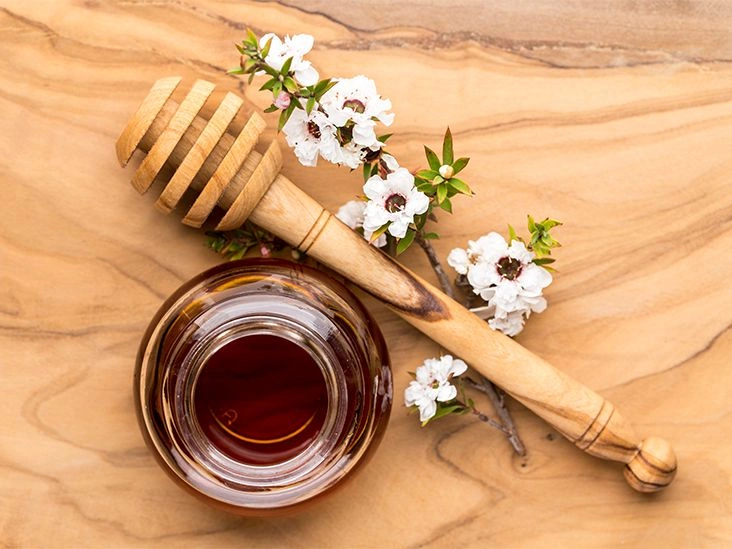
Manuka honey is a distinctive variety of honey made by bees in New Zealand that gather nectar from the Leptospermum scoparium flower, commonly called the Manuka bush.

Bees in southeastern Australia also produce Manuka-style honey. While New Zealand Manuka originates specifically from the Leptospermum scoparium blooms, Australian Manuka honey comes from several species within the Leptospermum genus.
Beyond being a sweetener, Manuka honey is prized for its medicinal qualities.
Bees transform the nectar of Manuka plants into honey that carries distinctive characteristics. One notable constituent is methylglyoxal (MGO), which a 2018 review indicates has antibacterial properties.
MGO is largely responsible for Manuka honey’s stronger antibacterial potency compared with many other honeys.
Manuka honey also contains:
- vitamins
- minerals
- amino acids
Those components contribute to its versatility as a therapeutic substance.
Continue reading to learn what to check for when selecting Manuka honey and some of its typical applications.
Which grade of Manuka honey is best?
The grading structure for New Zealand Manuka honey is intricate, and multiple schemes exist. UMF™ (Unique Manuka Factor) is widely regarded as the most stringent and reputable grading method.
Other systems used in New Zealand include MGS (Molan Gold Standard), K-Factor, and Bio Active. New Zealand labels also often report marker levels such as MGO and NPA.
The UMF figure on a jar reflects the concentration of MGO in the product. UMF values commonly range from UMF 5+ up to UMF 20+ or more. A higher UMF indicates greater antibacterial activity — and therefore a more potent Manuka honey.
MGO (methylglyoxal) is a naturally occurring molecule in Manuka honey that accounts for much of its distinctive antibacterial action.
NPA (non-peroxide activity) is another antibacterial attribute present in Manuka honey, contributing to its unique antiseptic effects.
A 2017 laboratory study found that Manuka honey rated UMF 10+ and higher demonstrated stronger antibacterial effects. UMF 20+ samples also showed activity against antibiotic-resistant bacterial strains.
Australian Manuka honey uses its own certification framework; products may be marked AMHA (Australian Manuka Honey Association) Authentic or Authorised, and labels should disclose the MGO content.
When choosing Manuka honey, seek UMF certification or AMHA Authentic/Authorised markings to confirm the product contains the three signature markers used to validate Manuka honey (Leptosperin, DHA, and MGO).
Leptosperin is an organic marker found uniquely in the nectar of Manuka plants (and very closely related species), and its detection helps verify genuine Manuka honey.
Dihydroxyacetone (DHA) exists in the nectar of Manuka flowers and converts over time into MGO during honey maturation.
Uses of Manuka honey
Laboratory and animal research — including a 2014 lab study and a 2017 rat study — has demonstrated Manuka honey’s antibacterial and anti-inflammatory actions.

It may help resolve infections and accelerate skin repair, according to a 2016 review. For that reason, Manuka honey is sometimes incorporated into wound dressings to support healing after surgery, in diabetic wounds, and for burns.
Smaller studies indicate Manuka honey may also be useful for:
- eliminating oral bacteria that contribute to cavities and gum disease
- easing sinus inflammation
- reducing ocular surface pH and diminishing bacteria and inflammation linked to dry eye
- lessening corneal swelling after eye operations
- relieving mild eczema
- inhibiting H. pylori infections
Manuka honey may also improve skin appearance by helping to balance pH and removing dead skin cell buildup.
As a humectant, Manuka honey can aid skin hydration. It has been added by cosmetic manufacturers to formulations including lip balms, moisturizers, and hair care products.
Bear in mind that many studies of Manuka honey are small and their findings have not yet been consistently reproduced in larger trials. Additional research is necessary to corroborate these potential benefits.
Where to buy Manuka honey
Manuka honey was once uncommon outside New Zealand, but its popularity has made it widely available. Today you can purchase it at many natural food outlets, grocery stores, some warehouse clubs, and online retailers in the United States.
Some physical stores that may carry Manuka honey include:
- select Costco locations
- The Vitamin Shoppe
- Kroger
- Fresh Thyme
- Whole Foods Market
When buying Manuka honey, check the label for UMF or AMHA certification. Those identifiers indicate the honey’s strength and help confirm the product is authentic Manuka honey.
Products produced in New Zealand or Australia are also more likely to be genuine.
Precautions and side effects
Manuka honey can be suitable for minor complaints, but don’t rely on it alone to treat serious infections or conditions. Consult your healthcare provider for guidance. Be sure to understand the grading and certification system before purchasing any Manuka honey.
Avoid Manuka honey products if you have a bee allergy, as they can trigger reactions, according to a 2015 review.
If you have diabetes, consult your doctor before using Manuka honey because its high sugar content can raise blood glucose. Never give raw honey of any kind to infants under 12 months old.
Manuka honey may interact with certain drugs, including some chemotherapy agents. Inform your physician and pharmacist about all medicines, supplements, and alternative remedies you use to avoid potential interactions.
The bottom line
Once rare in the U.S., Manuka honey is now easy to find in health-food stores and online. Before purchasing, look for UMF or AMHA markings on the jar to verify authenticity and potency.
As with any natural product, it’s wise to consult your doctor first. Discuss whether Manuka honey is appropriate for you and whether it may interact with any medications or supplements you take.
For topical uses like treating mild eczema, you may also be interested in reading about manuka honey for eczema.


















Leave a Reply
You must be logged in to post a comment.