

Some people may be able to get a positive pregnancy test as early as 12 days post ovulation (DPO). It’s also possible to notice early signs, like breast soreness.
The two-week wait between ovulation and taking a pregnancy test can feel interminable. To fill the time, you might monitor your post-ovulation symptoms hoping for an indication of whether you’ll see that coveted BFP (big fat positive) this cycle.
In those searches you’ll discover that by 12 DPO there’s a chance a home pregnancy test could show positive. It’s an exciting — and sometimes nerve-wracking — moment.
Below is more about the timing of conception and implantation, when it’s best to take your first pregnancy test, and which early symptoms you might (or might not) notice before a missed period.
Can you take a pregnancy test at 12 DPO?
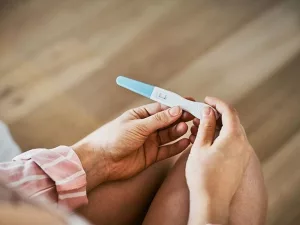
In short, yes — you can test at 12 DPO. It’s possible to see a positive result by 12 days post ovulation. But it helps to review the sequence of events and why testing this early can be premature.

For pregnancy to occur, a precise sequence must take place:
- Sperm must reach the uterus (via intercourse or assisted reproductive techniques) and travel up the fallopian tubes.
- The egg must be released by the ovary during ovulation and be captured by the fallopian tube for transit. Ovulation typically occurs around 14 days before the next period. You can monitor ovulation using store-bought ovulation predictor kits (OPKs) that detect a surge in luteinizing hormone (LH), which usually peaks about 24–48 hours before ovulation.
- The sperm and egg must meet in the fallopian tube for fertilization so the embryo begins developing. The egg can be fertilized only within about 12–24 hours after release, so timing matters.
- The embryo must travel to the uterus and implant into the uterine lining to continue developing. Implantation may occur as early as 5–6 days after fertilization or as late as 11+ DPO. Older studies show that days 8, 9, and 10 DPO are among the most common for successful implantation.
- After implantation, cells around the embryo produce human chorionic gonadotropin (hCG), the hormone that causes a pregnancy test to turn positive. hCG starts very low and rises steadily during the first weeks of a normal pregnancy.
There are many variables, but if ovulation, fertilization, and implantation proceed properly, you may become pregnant. However, this process takes time. At 12 DPO, people with predictable 28-day cycles are still a couple of days away from a missed period.
Whether a positive appears at this early stage depends on the timing of those events and how much pregnancy hormone has accumulated in your body.
So while a positive at 12 DPO is possible, a negative result doesn’t rule out pregnancy for the cycle.
When should you test?
Home pregnancy tests (HPTs) claim up to 99 percent accuracy when used exactly as instructed, but real-world reliability can be lower due to user error and other factors.
Some brands say you can test several days before your expected period and still get a positive; others are less sensitive. Read packaging closely to understand the test’s sensitivity.
Regardless of brand, a test cannot turn positive without enough hCG circulating.
Experts recommend waiting until the morning of your expected period to test. For a typical 28-day cycle this corresponds to about 14 DPO. For those with longer cycles, a test may not be positive until later.
Testing earlier isn’t inherently wrong, but it can generate false negatives when hCG levels are still too low to detect.
There’s also the possibility of a chemical pregnancy — an extremely early miscarriage — which may account for an estimated 50 to 75 percent of early pregnancy losses.
In a chemical pregnancy you might see a positive test around the time your period is due, then experience bleeding and notice the line fades or disappears on subsequent tests.
People who don’t take early tests may never realize fertilization occurred in such cases.
Will you have symptoms at 12 DPO?
Timing is crucial when it comes to symptoms at 12 DPO, and experiences vary widely between individuals.
Keep that variability in mind when comparing with friends or reading trying-to-conceive forums. You could still be pregnant even if you have no signs at 12 DPO.
Many so-called early symptoms can also stem from hormone shifts before your period (PMS-like changes).
Symptoms might begin as soon as fertilization, in the days before a missed period, or any time afterward. It’s also possible to have no symptoms at all and still be pregnant.
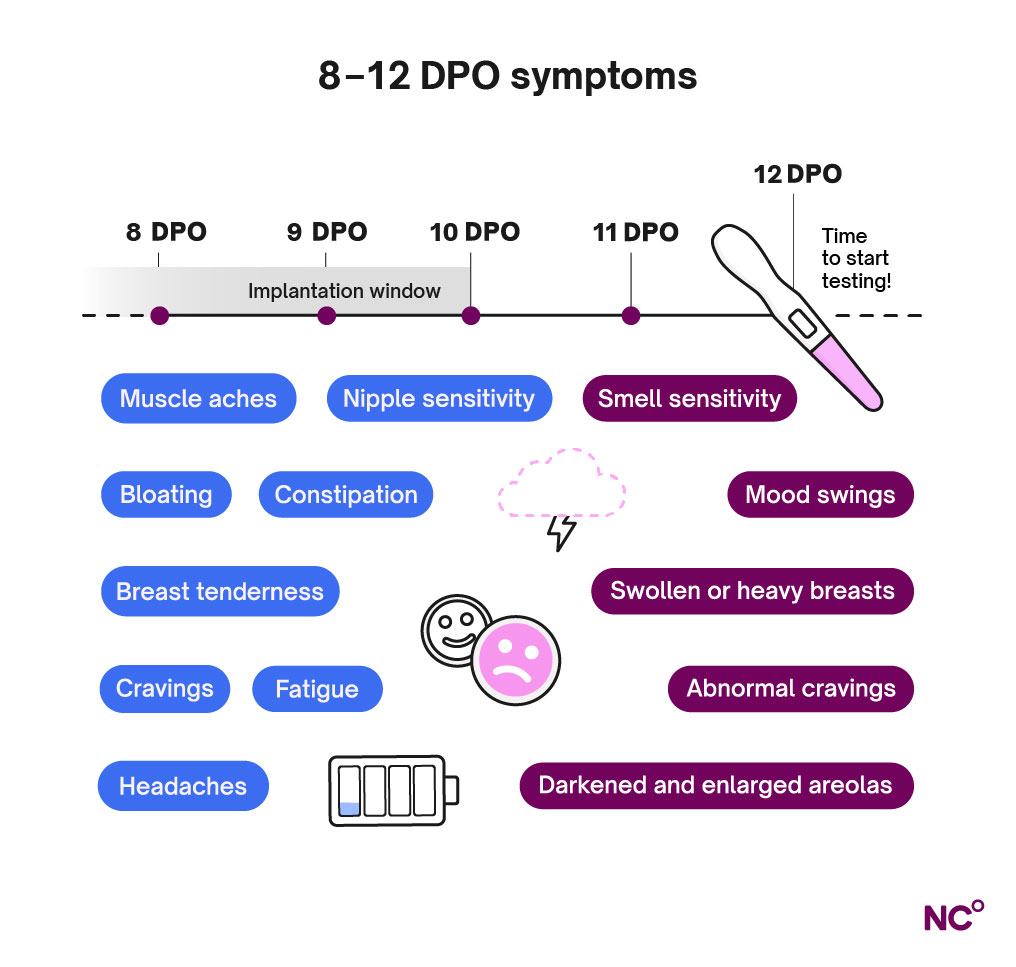
Common early pregnancy signs include:
Breast changes
Hormonal changes, especially progesterone, can make breasts tender or more sensitive than usual. You might also notice breasts feel fuller or heavier.
The areola — the skin around the nipple — may darken. Breast changes are often one of the earliest indications and typically ease after a few weeks or by the end of the first trimester.
Cervical mucus
Vaginal discharge can change in the days before your expected period. Cervical mucus may increase in early pregnancy and appear milky white or slightly sticky, and it generally shouldn’t have a foul odor.
These shifts are due to hormonal changes, increased blood flow to the pelvic area, and alterations in the cervix.
Implantation bleeding
Some people notice light spotting about 10–14 days after conception. It can be mistaken for the start of a period but may indicate implantation.
Implantation bleeding occurs when the embryo embeds into the uterine lining and can range in color from pink or red to brown/black. Usually it’s lighter than a typical period. This is a less common early sign, however.
Cramping
Even without spotting, you may feel cramping related to implantation or early pregnancy. Cramping can come from the embryo burrowing in and from the uterus gradually stretching as it grows.
Basal body temperature increase
If you chart cycles, you might note your basal body temperature (BBT) rises about half to a full degree Fahrenheit after ovulation. BBT may remain elevated if you’re pregnant; otherwise it typically drops back to baseline right before your period, signaling a new cycle.
Morning sickness
Nausea and vomiting often begin around one month into pregnancy, but some people experience these symptoms earlier depending on sensitivity to hormonal shifts. “Morning sickness” can happen at any time of day or night.
Lack of nausea doesn’t imply anything negative — many people never experience sickness during pregnancy.
Increased urination
You may find yourself making more trips to the bathroom early on. Rising hCG levels increase blood flow to the pelvis, including the bladder.
Decreased energy
Fatigue is reported by some as soon as one week after conception. The tiredness may stem from higher progesterone circulating in the body.
Bloating
Elevated progesterone and estrogen can slow digestion, causing bloating, heartburn, or constipation early in pregnancy.
Pregnancy Symptoms: 10 Early Signs That You May Be Pregnant
Takeaway
At 12 DPO you’re in a window where early symptoms and a possible positive test are plausible.
If your test is negative, try not to worry — tests taken on the day of or a few days after a missed period are most reliable. You can also explore information about 14 dpo to understand timing around the expected period.
If you have questions, contact your healthcare provider. They can perform a blood-draw pregnancy test that detects lower levels of hCG and may confirm a BFP sooner than a home test.
Your clinician is also the best resource if you’re having difficulty conceiving. See them if you’ve been trying for over a year (if under 35), over six months (if over 35), or if you have other reproductive health concerns.
No matter the outcome this month, best wishes to you!




















Leave a Reply
You must be logged in to post a comment.