
When you push hard through a demanding training session, expending energy and torching calories, give yourself credit. Why? Because the payoff continues even after you finish.
During vigorous exercise your metabolism ramps up. When you stop, it doesn’t instantly return to baseline; it stays elevated for a while. That means you keep burning extra calories after you’ve cooled down, showered, and eaten your recovery snack.
That extra calorie usage that happens post-exercise is called the afterburn effect.
Try one of the five workouts below to activate the afterburn effect.
What is the afterburn effect?
The scientific term for the afterburn effect is excess post-exercise oxygen consumption, or EPOC. EPOC, sometimes referred to as oxygen debt, is the oxygen needed to bring the body back to its resting condition.
This return to rest includes:
- replenishing oxygen stores
- clearing lactic acid
- repairing muscle and restoring ATP levels (the molecule that fuels bodily processes like exercise)
Research shows EPOC is greatest immediately after exercise but can remain elevated for a longer period. One study found that increased levels could persist for as long as 38 hours.
Evidence indicates that the harder your workout, the more energy your body must expend to return to rest — meaning a larger EPOC. While longer workouts can increase EPOC if intensity is sufficiently high, time alone isn’t as influential as intensity.
The best way to elicit substantial EPOC is through high-intensity interval training (HIIT). These brief bursts of intense effort are interspersed with short recovery periods. Recovery lets your body restore the ATP you used during the intense intervals.
HIIT delivers higher EPOC because it requires more oxygen during exercise, creating a bigger deficit that must be repaid afterward.
Workouts that produce the afterburn effect
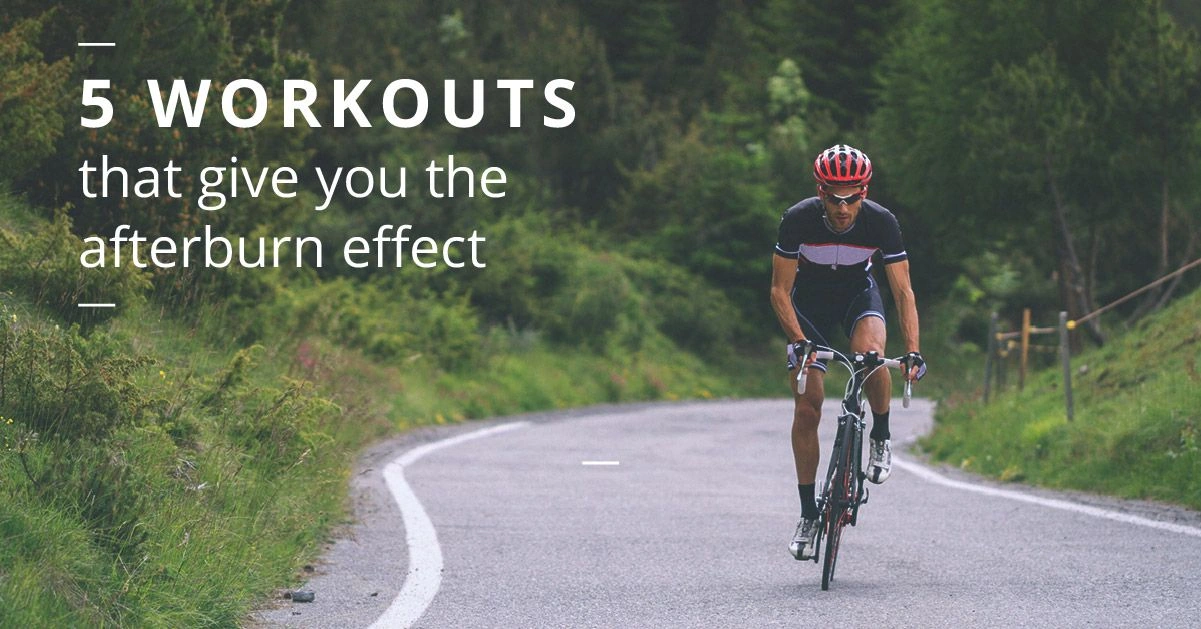
1. Cycling
Cycling blends lower-body resistance work with cardiovascular conditioning.
Try this interval sequence to stimulate the afterburn effect.
Minutes 0–10: Warm up on flat terrain, gradually picking up the pace.
10–12: Increase resistance and stand, riding at about 75% effort.
12–14: Reduce resistance and sit, riding at roughly 60% effort.
14–18: Seated sprint intervals — 30 seconds hard, 30 seconds easy.
18–19: Recover on flat ground.
20–23: Raise and hold resistance, alternating 30 seconds standing and 30 seconds seated at 75% effort.
23–25: Lower resistance and do seated all-out sprints, 30 seconds on, 30 seconds off.
25–30: Cool down.
2. Sprint intervals
Whether you enjoy running or not, sprint intervals are effective at increasing fat loss. They also boost muscular power and cardiovascular fitness. Sprint workouts are a potent way to trigger EPOC.
Try this quick, high-intensity routine.
- Begin with a 5-minute easy jog to warm up.
- Sprint flat-out for 30 seconds.
- Recover with an easy jog or walk for 60–90 seconds.
- Repeat the sprint/recovery cycle for a total of 20 minutes.

3. Plyometrics
Plyometrics are explosive jump movements that build power. They demand intense effort in short bouts by rapidly contracting and lengthening muscles. Plyometrics aren’t recommended for beginners or anyone with an injury due to their high-impact nature.
Perform this circuit 3 times.
- 20 box jumps
- 20 burpees
- 20 jump squats
- 30 mountain climbers
- 20 frog jumps
- 30 plank jacks
- 30 lateral skater jumps
4. Strength circuit training
Using compound lifts and supersets tends to produce a larger EPOC. Heavy loads combined with brief rest periods between movements increase the demand on your body to restore energy during and after the session.
Try this circuit: choose a challenging weight and perform each exercise back-to-back without rest. Rest 2 minutes after finishing the circuit. Repeat 3 rounds total.
- 15 squats
- 15 dumbbell shoulder presses
- 15 deadlifts
- 15 dumbbell rows
- 20 reverse crunches
- 15 pushups
- 20 bicycle crunches
5. Swimming
Swimming is an excellent, low-impact full-body workout. It improves endurance, strength, and coordination, and it adapts well to HIIT formats.
Use this set to boost EPOC.
- 5-minute warmup
- 50-meter freestyle sprint
- 25-meter easy recovery
- 50-meter backstroke sprint
- 25-meter recovery
- 50-meter breaststroke sprint
- 25-meter recovery
- 50-meter freestyle sprint
- 25-meter recovery
- 5-minute cool down
The takeaway
Various forms of HIIT create a meaningful afterburn effect. Keep HIIT sessions to about 30 minutes, and limit them to no more than three times per week to give your body sufficient recovery.



















Leave a Reply
You must be logged in to post a comment.