

What are composite veneers?
If you’ve been thinking about enhancing your smile, dental veneers could be an excellent option.
Veneers are slender shells that sit over the front surfaces of your natural teeth to enhance their look. They’re one of several cosmetic approaches available.
Other alternatives include tooth bonding and enamel reshaping, as well as crowns.
There are two principal categories of veneers: porcelain and composite. As the name implies, porcelain veneers are custom-crafted from porcelain to match your teeth. Composite veneers are typically created from a tooth-colored resin — the same material commonly used in tooth bonding.
Both types have advantages and drawbacks, so it’s wise to weigh the severity of the problem you want corrected and your budget when choosing.
Who can get veneers?
Dental veneers can mask flaws and give you a more uniform, brighter smile.
These flaws can include teeth that are crooked or oddly shaped, chipped, stained or discolored, or teeth with worn enamel.
Veneers cover the front portion of teeth but differ from crowns, which are thicker and encase the entire tooth — front and back. Crowns also usually require more tooth reduction, which may not be necessary with veneers.
If your teeth are generally healthy and you simply want to alter their appearance — their color or form — veneers may be a suitable option.
Crowns tend to be reserved for more extensively damaged teeth. For instance, a broken tooth or a tooth that has had a root canal might be better treated with a crown.
Types of veneers
Your dentist might present three veneer options: direct composite veneers, indirect composite veneers, and porcelain veneers.
Direct composite veneers
Direct composite veneers are made from composite resin applied straight onto your teeth.
Preparing your teeth for these veneers doesn’t take long, and the procedure is regarded as minimally invasive.
Indirect composite veneers
The primary distinction between direct and indirect composite veneers is how they’re applied, not the material itself.
Your teeth are prepared similarly to the direct method, but the veneers are custom-fabricated outside the mouth — either in the dental office or in a lab.
You’ll typically receive temporary veneers while the indirect ones are being made. At a subsequent visit, the indirect composite veneers are bonded to your teeth using an adhesive.
Indirect composite veneers resist wear and fractures better than direct veneers, but they usually cost more.
Porcelain veneers
Porcelain veneers are individually crafted from porcelain to fit your teeth.
Your dentist will take impressions of your teeth so the veneers can be produced from the molds in a dental laboratory, a process that may take a week or longer. You’ll receive temporary veneers during this waiting period, similar to indirect composite cases.
When the porcelain shells are ready, the dentist will cement them to the front of your teeth and shape them to achieve a natural look.
Composite veneers vs. porcelain veneers
Both types of veneers offer benefits and limitations. Consider these carefully before making a decision.
Pros: Composite veneers
- lower expense
- quicker placement when using direct veneers
- able to conceal many cosmetic concerns, such as misshapen teeth, discoloration, and other minor defects
Cons: Composite veneers
- material is less durable than porcelain and may chip more readily
- require more frequent repairs or replacements than porcelain
Pros: Porcelain veneers
- longer lifespan due to stronger material
- custom fabricated
- offers a more lifelike appearance
- can address deeper stains or more severe misalignment than composite veneers
Cons: Porcelain veneers
- most costly veneer option
- placement typically needs multiple visits
- porcelain veneers can detach and may need re-bonding
Composite veneers procedure
The process begins with your dentist thoroughly cleaning your teeth and preparing them for the application.
In some cases, a thin layer of enamel must be removed to help the material adhere. For minor adjustments in shape or shade, tooth reduction might not be necessary.
From that point the steps vary slightly based on whether you choose direct or indirect veneers.
For direct veneers, the dentist will etch the enamel to improve adhesion.
Next, a bonding agent is applied to help the composite resin attach. Then very thin layers of composite are built up on the tooth surfaces.
The layers are “cured” or rapidly hardened using a light.
You and your dentist can select the shade for your veneers. The dentist can blend resin shades to produce a natural appearance.
With indirect veneers, after tooth preparation, the dentist takes an impression of your teeth.
The veneers are then made outside the mouth. When finished, the dentist etches the teeth and applies a bonding agent to secure the veneers.
The composite veneers are placed, and a light is used to harden the adhesive and fix them in place. The dentist will trim any excess and polish the final restorations.
Most patients don’t need anesthesia during the procedure. If anesthesia is used, once it wears off you should be able to resume your normal activities.
How long do composite veneers last?
Composite veneers are more durable now than in the past. On average they last about 5 to 7 years.
After that period you’ll likely need replacement veneers. That lifespan is considerably shorter than porcelain veneers, which can often last 10 to 15 years or more.
You may prolong the life of composite veneers with proper care.
Maintain a routine of regular brushing with a nonabrasive toothpaste, and avoid chewing ice or other hard objects with your front teeth.
Some dentists also advise limiting beverages such as coffee or tea that can stain your restorations. For more on veneer longevity, see how long do veneers last.
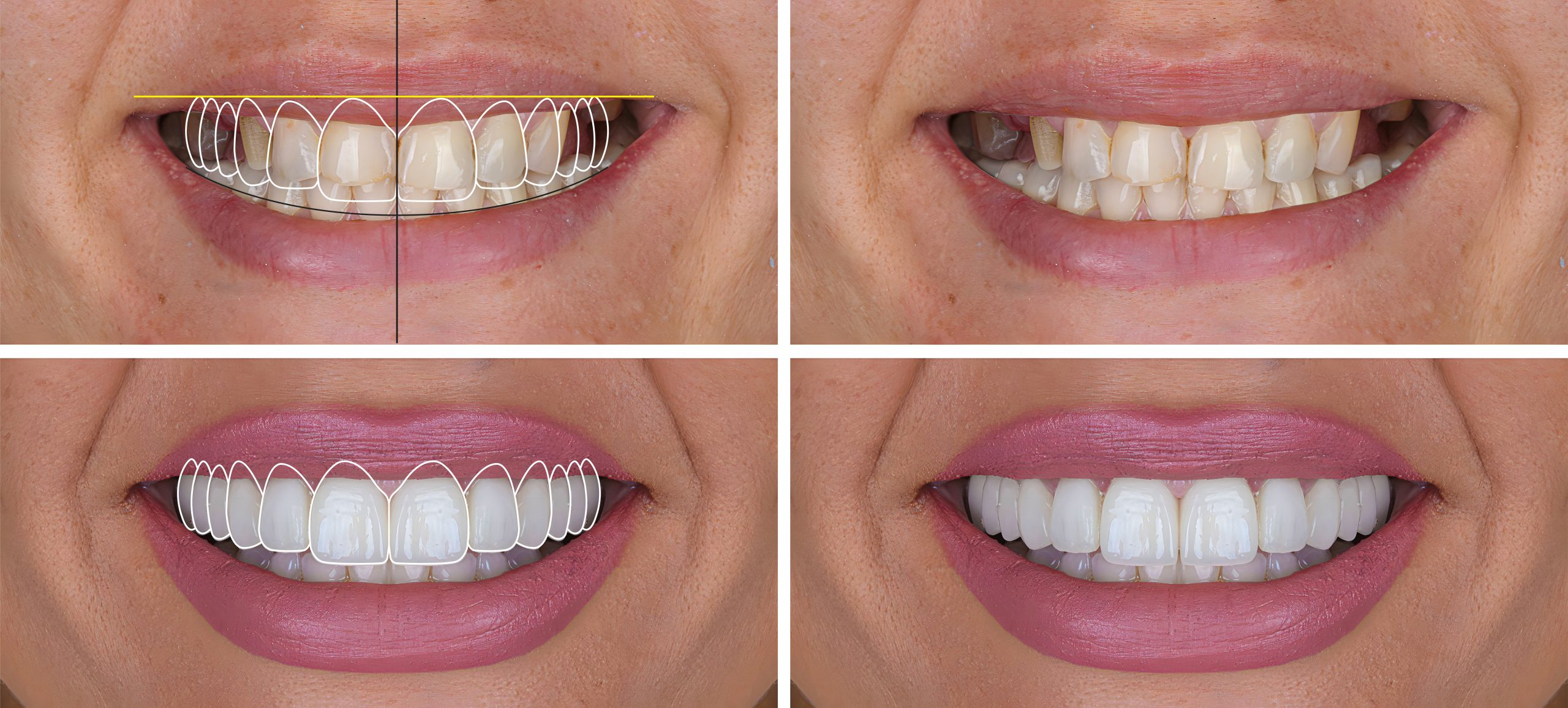
Composite veneers before and after
You’ll notice a marked improvement in your smile’s appearance after having veneers placed.
Can composite veneers be removed?
Composite veneers can be removed and repaired or replaced by adding fresh composite material.
Composite veneers cost
Cost is an important consideration. Veneers can be expensive.
The application is time-intensive, and you want durable materials and skilled workmanship that will look good for years. After all, your smile is immediately visible to others.
While typically less expensive than porcelain veneers, composite veneers still carry a significant price tag.
Prices for composite veneers vary by location, the provider’s setting, and the number of veneers needed.
Composite veneers may range from $250 to $1,500 per tooth.
Who pays? Most likely you. If the procedure is purely cosmetic, insurance usually won’t cover it.
However, if the tooth is damaged, insurance might pay some or all of the cost.
If cost is a concern, discuss financing options with your dentist. You may also receive a reduced rate for having multiple veneers placed at once. If you’re weighing options between restorations, consider researching veneers vs crowns.
Takeaway
If your smile makes you self-conscious, dental veneers could be an effective solution. They offer a relatively long-term way to improve the look of imperfect teeth.
Because veneers — including composite types — can be costly, take time to explore your options and understand the trade-offs of each material. Speak with a dentist about which choice best fits your needs.























Leave a Reply
You must be logged in to post a comment.