
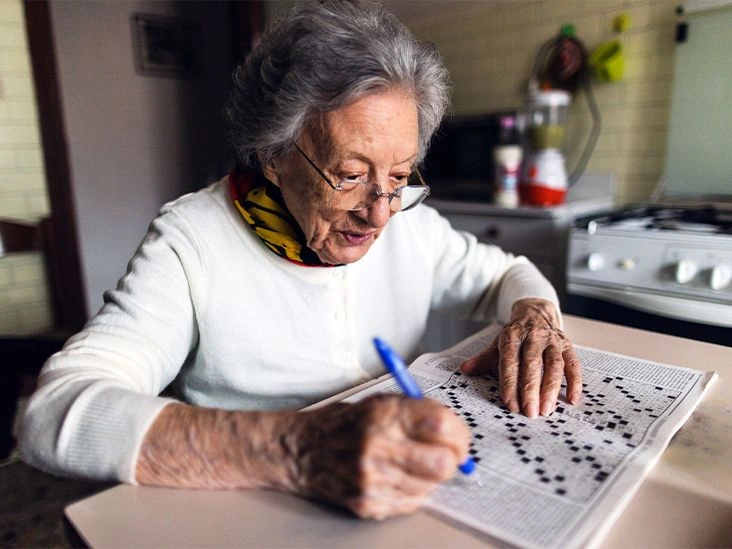

- For individuals with mild cognitive impairment, engaging in mentally stimulating activities may help slow symptoms linked to cognitive decline.
- A recent study found that crossword puzzles outperformed other “brain games” after 18 months.
- Specialists suggest that familiarity with crosswords and their higher cognitive demands could explain the difference.
Roughly 1 in 9 adults in the United States reports worsening confusion or memory problems associated with cognitive decline.
This concern is particularly common among older adults. About 5.6 million Americans age 65 and older are living with some form of dementia, including Alzheimer’s disease.
Dementia does not only affect the person diagnosed; it also significantly impacts family members, caregivers, and communities. As a result, identifying accessible, low-cost strategies to help preserve brain function is a major public health priority.
One increasingly popular option is the use of Free online crossword puzzles and other digital brain-training tools. Over the past two decades, a growing “brain game” industry has introduced web-based and app-based platforms offering cognitive exercises designed to enhance memory, attention, and problem-solving skills.
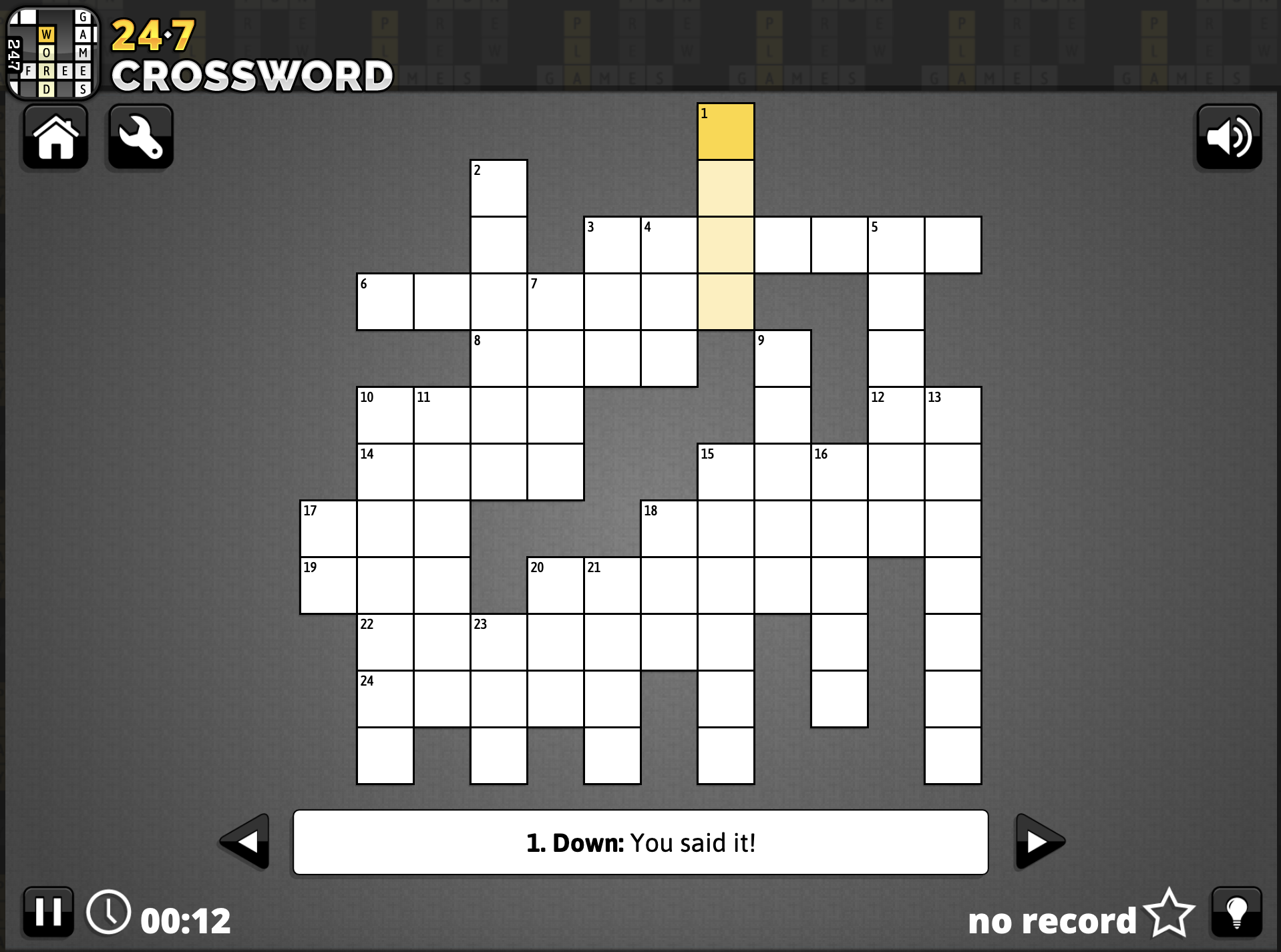
But how do these digital brain games compare with a long-standing favorite: the traditional crossword puzzle? And can Free online crossword puzzles truly make a measurable difference in cognitive health?
To answer these questions, investigators from Columbia University in New York and Duke University in North Carolina partnered on a study published in NEJM Evidence.
Their findings were unexpected.

Crosswords vs other games
The study enrolled 107 participants (45 male, 62 female) between the ages of 55 and 95, with an average age of 71. All participants had mild cognitive impairment (MCI), a condition characterized by noticeable changes in memory or thinking skills that are greater than expected with normal aging but not severe enough to interfere significantly with daily life.
MCI is considered a risk factor for dementia.
Because crossword puzzles and similar word-based activities require language skills, all participants were English speakers.
Researchers randomly assigned participants to one of two groups: 56 individuals completed crossword puzzles, while 51 engaged in other computerized cognitive games.
Both groups received 12 weeks of structured training and continued their assigned activities electronically. Booster training sessions were provided periodically over a total study duration of 78 weeks (approximately a year and a half).
Throughout the study, researchers evaluated cognitive performance and functional abilities. Participants also underwent functional MRI scans to assess hippocampal volume. The hippocampus plays a critical role in long-term memory formation and storage and is one of the brain regions most affected in Alzheimer’s disease.
At the end of 78 weeks, the results showed that participants in the crossword group experienced less decline in both cognitive performance and daily functioning compared with those who played other cognitive games.
Additionally, MRI findings indicated less brain atrophy, or shrinkage, in the crossword group, particularly in areas associated with memory.
These findings suggest that regularly engaging in activities such as Free online crossword puzzles may offer meaningful cognitive benefits for older adults with MCI.
Why crossword puzzles may have performed better
Do these results prove that crossword puzzles are superior to other brain-training activities for preventing cognitive decline?
Stella Panos, PhD, a neuropsychologist and director of neuropsychology at the Pacific Neuroscience Institute at Providence Saint John’s Health Center in California, told HealthEH, “While this was a surprising finding when I read it (and to the authors themselves as they noted), there may be other reasons for this.”
She pointed out that crossword puzzles have been widely available for decades, meaning many participants may have already been comfortable with this format. Familiarity can reduce frustration and improve engagement, which may influence outcomes.
Panos also explained that some computerized brain games target a broad range of cognitive skills. “Computer games may also have stimulated a broader range of cognitive functions which may possibly not have been captured as well with their primary outcome measures,” she said.
Dr. Emer MacSweeney, chief executive officer and consultant neuroradiologist at Re:Cognition Health, told HealthEH, “The more the brain is exercised the better it will be able to function. And the better the quality of the brain exercise the more effective the result is likely to be.”
She emphasized that learning new material is especially beneficial for the brain. “It is the process of learning new information that is most important for the brain. Overall, I suspect the people doing crosswords were continually learning new information, compared to those doing the games, practicing the same or similar processes repetitively,” MacSweeney said.
Crossword puzzles often require participants to recall vocabulary, understand clues, think flexibly, and sometimes research unfamiliar terms. This combination of memory retrieval, language processing, and problem-solving may place higher demands on neural networks.
For those interested in building this habit, options like Play crossword puzzles memory exercise online free provide convenient ways to integrate structured cognitive stimulation into a daily routine.
Other games may not consistently encourage the same depth of new learning or semantic exploration.
Should you do crosswords or other games such as Wordle?
Does this mean that other cognitive games have no benefit, or that you should stop playing games such as the Jumble?
Not at all.
“I’m not certain Wordle and Sudoku will be as effective as crosswords as they do not require looking up and learning new information. But certainly [they’re] very likely to be better than not doing them at all,” said MacSweeney.
Panos added, “In general, if cognitive tasks are stimulating, they may have a positive effect, though different games likely have different cognitive burden and may impact the brain differently. [For example,] Wordle is also about strategy and cognitive burden is lessened once there’s a strategy.”
In other words, consistency and engagement may matter more than the specific format. Activities that challenge memory, language, reasoning, and attention are all valuable components of brain health.
Adults seeking structured options may consider platforms that allow them to Play crossword puzzles memory exercise online free for adults, especially if they are looking for targeted cognitive stimulation tailored to older age groups.
It is also important to remember that cognitive health is multifactorial. Physical activity, social engagement, quality sleep, blood pressure control, and a balanced diet all contribute to maintaining brain function. Brain games, including Free online crossword puzzles, should be viewed as one supportive strategy within a broader healthy lifestyle.
Larger and longer-term studies will be needed to determine whether crossword puzzles can reduce the risk of progression from MCI to dementia. However, current evidence suggests they may play a supportive role.
What to do if you notice signs of dementia
Panos advises seeking medical evaluation if you or someone close to you develops increasing symptoms of cognitive impairment. Early assessment allows healthcare professionals to identify reversible causes, provide appropriate treatment, and plan supportive care if needed.
Warning signs may include:
- repeatedly asking the same question
- difficulty recalling words, phrases, or ideas during conversation
- using incorrect words (for example, saying “couch” instead of “chair”)
- taking longer than usual to complete familiar tasks
- frequently misplacing items around the home
- getting lost while walking or driving in areas that were once familiar
- sudden or unexplained changes in mood, personality, or behavior
If these symptoms are present, consulting a primary care physician or neurologist is an important first step. While there is currently no cure for dementia, early diagnosis and lifestyle interventions — including mentally stimulating activities like Free online crossword puzzles — may help support cognitive function and overall quality of life.



















Leave a Reply
You must be logged in to post a comment.