
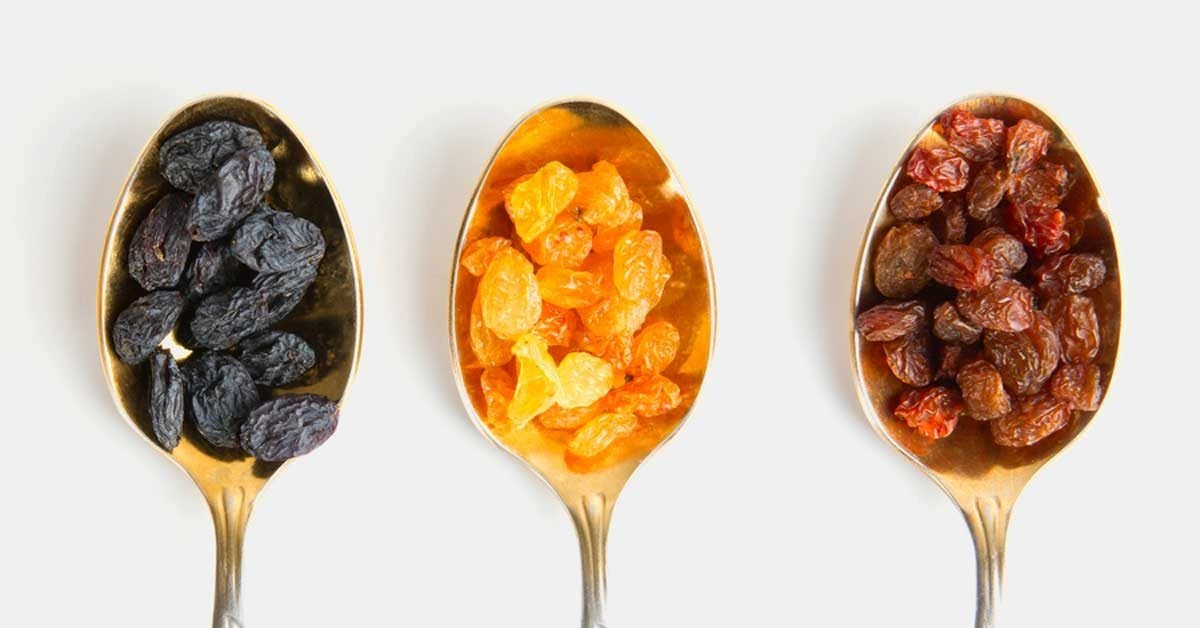
Raisins, sultanas and currants are well-known varieties of dried grapes. Rich in essential vitamins, minerals and antioxidants, they’re used across cuisines worldwide in both sweet and savory dishes.
Despite their widespread use, many people remain uncertain about how these dried fruits differ.
This article clarifies the distinctions between raisins, sultanas and currants.

All are types of dried grapes
In essence, raisins, sultanas and currants are simply distinct kinds of dried grapes.
Still, telling them apart can be tricky, especially when it comes to raisins and sultanas, because the definitions vary by region.
In the United States, the word “raisin” is often used to describe both raisins and sultanas. To differentiate, sultanas are commonly called “golden” raisins.
Elsewhere, including the UK, raisins and sultanas are differentiated based on the grape variety and the drying techniques employed.
Note that “currant” can also refer to members of the gooseberry family, such as red currant and black currant.
To prevent ambiguity, this piece uses the international distinctions for raisins and sultanas.
Raisins
Raisins are grapes that have been dried over a period of roughly three weeks. As the grapes dehydrate, they darken, giving raisins their brown hue.
A number of grape cultivars are used to produce raisins, and their size, flavor and shade depend on the grape variety.
In the US, the Thompson Seedless grape is commonly used for raisins.
In Australia, raisins typically come from larger grape varieties such as Muscat, Lexia and Waltham Cross, which is why Australian raisins are often larger than sultanas.
Raisins are generally dark, soft, sweet and usually bigger than sultanas and currants.
Sultanas
Sultanas are derived from green, seedless grapes—most often the Thompson Seedless type.
Unlike raisins, sultanas are frequently treated with an oil-based solution before drying to speed up dehydration, which often leaves them lighter in color than raisins or currants.
In Australia, some sultanas are produced without the drying solution. Those grapes take longer to dry—up to three weeks—and become dark brown; these are sometimes called “natural” sultanas.
In the US, sultanas are labeled as “golden raisins” or “sultana raisins.” Producers often use sulfur dioxide to preserve their light color.
Sultanas are usually smaller than raisins and tend to be sweeter, juicier and paler in color than both raisins and currants.
Currants
Zante currants, often simply called currants, are tiny dried grapes. They should not be mixed up with Ribes sativum or Ribes nigrum berries, which are also called “currants.”
Despite the shared name, Zante currants are produced by drying small, seedless grape varieties such as Black Corinth and Carina.
Currants are typically dried for around three weeks.
Their small size gives them a concentrated, tangy-sweet flavor that lends texture and sweetness to a wide range of both sweet and savory recipes.
Summary: Raisins, sultanas and currants are all dried grapes. Raisins and sultanas are soft, sweet and juicy, while currants have a more intense, tangy-sweet flavor. Raisins are usually the largest of the three.
They share similar nutrient profiles
All three—raisins, sultanas and currants—are nutritionally dense.
Drying reduces the grape’s water content from about 80% to roughly 16% (2, 3), concentrating calories and nutrients.
The grapes shrink during drying, leaving small but nutrient-rich dried fruits.
The table below outlines nutritional values for 100 grams of raisins, sultanas and currants (4, 5, 6).
| Raisins | Sultanas | Currants | |
|---|---|---|---|
| Calories | 306 | 320 | 280 |
| Carbs | 71 grams | 65 grams | 65 grams |
| Protein | 2.3 grams | 2.8 grams | 2.8 grams |
| Fat | 0 grams | 0 grams | 0 grams |
| Fiber | 5 grams | 6 grams | 6 grams |
| Sugar | 69 grams | 64 grams | 63 grams |
| Potassium | 22% of the DV | 17% of the DV | 17% of the DV |
| Iron | 23% of the DV | 0% of the DV | 13% of the DV |
As shown, the differences are modest. Each is high in natural sugars, roughly 60–75% sugar by weight.
They also supply fiber and potassium and contain beneficial plant compounds, including potent antioxidants (7).
However, drying significantly reduces vitamin C and vitamin K compared with fresh grapes.
Summary: Raisins, sultanas and currants have comparable nutrient profiles: high in fiber, potassium and antioxidants but also high in sugar, with reduced vitamin C and K compared to fresh grapes.
Potential health benefits are similar
Raisins, sultanas and currants may confer many of the same health advantages.
All three are good sources of antioxidants, including various polyphenols (7).
Antioxidants protect cells from damage caused by free radicals and oxidative stress, which are linked to inflammation and numerous diseases, including cancer (8, 9).
They’re also fiber-rich. One ounce (28 grams) offers about 1–2 grams of fiber, roughly 4–8% of recommended daily intake.
Research indicates that diets high in fiber-rich fruits and vegetables can help lower the risk of high blood pressure, heart disease and type 2 diabetes (10, 11, 12).
Specific studies on raisins suggest they may (13, 14, 15, 16):
- Help lower blood pressure
- Improve blood sugar regulation
- Increase satiety
Although sultanas and currants haven’t been studied as extensively, their similar nutrient makeup suggests they’d offer comparable benefits.
Keep in mind that dried fruit is calorie- and sugar-dense and easy to overconsume.
Therefore, enjoy these fruits in moderation and ideally paired with other nutritious foods like nuts, seeds or yogurt.
Summary: Raisins, sultanas and currants can support digestive health, blood sugar control and blood pressure, and reduce inflammation. But they’re calorie- and sugar-rich, so consume them in moderation.
Similar culinary uses
All three dried grape types are very versatile: eaten alone as a snack or added to rice, stews, salads, porridge and baked goods.
Despite minor differences in size and taste, they’re often interchangeable in recipes.
Here are some ways to use them in your meals:
- On a cheese board: Dried grapes add a gourmet touch to a cheese platter. Because they’re the biggest, raisins pair especially well with creamy brie, nuts and crackers.
- As a snack: Enjoy them solo or mixed with yogurt or nuts for a more filling option. You could also make your own trail mix.
- In porridge: A sprinkle of raisins, sultanas or currants adds natural sweetness to your morning oats.
- In baking: Dried grapes enhance muffins, granola bars and cookies. Raisins and sultanas absorb flavors well, improving texture and taste.
- In salads: Currants are particularly useful for adding sweetness and bite to salads, pairing nicely with bitter greens and crunchy nuts.
- In savory dishes: Try adding any of the three to curries, meatballs, chutneys, rice pilafs and couscous. Currants often work best where a small size is desired.
Store raisins, sultanas and currants in a cool, dry, dark spot such as a pantry, inside a sealed bag or glass jar.
Summary: Raisins, sultanas and currants are highly adaptable. Eat them alone or add them to both sweet and savory dishes from muffins and cakes to curries, salads and cheese boards.
Which should you pick?
All three options are nutritious and can typically substitute for one another.
Choose based on the recipe you’re making and your flavor preference.
Be aware that some producers use sulfur dioxide as a preservative to maintain a fresh-looking color—this is most common with sultanas or “golden raisins.”
Some people are sensitive to sulfur dioxide and may experience stomach cramps, skin irritation or asthma symptoms after consuming it (17).
If you’re sensitive, check product labels for this additive.
Summary: Raisins, sultanas and currants are all nutritious and interchangeable in many dishes. Check packaging for sulfur dioxide if you have a sensitivity to that preservative.
The bottom line
Raisins, sultanas and currants are simply different types of dried grapes that provide fiber, potassium and antioxidants.
Raisins come from a variety of grape types, are usually dried naturally and tend to be the largest.
Sultanas originate from seedless green grapes, are often treated before drying to speed the process and usually remain the juiciest and palest.
Currants are produced from very small grape cultivars, are dried naturally and are the smallest with a concentrated, tangy-sweet flavor.
All three are healthy choices in moderation and the one you pick should depend on the dish and your taste. For more on choosing healthy cereals and dried fruits, see is raisin bran healthy.


















Leave a Reply
You must be logged in to post a comment.