

A vertical lip piercing, often called a vertical labret, involves passing jewelry through the center of the lower lip. It’s favored by many in the body modification community because it’s conspicuous and stylish.
Below we’ll explain how the piercing is performed, what to anticipate during and after the procedure, and how to handle possible complications.
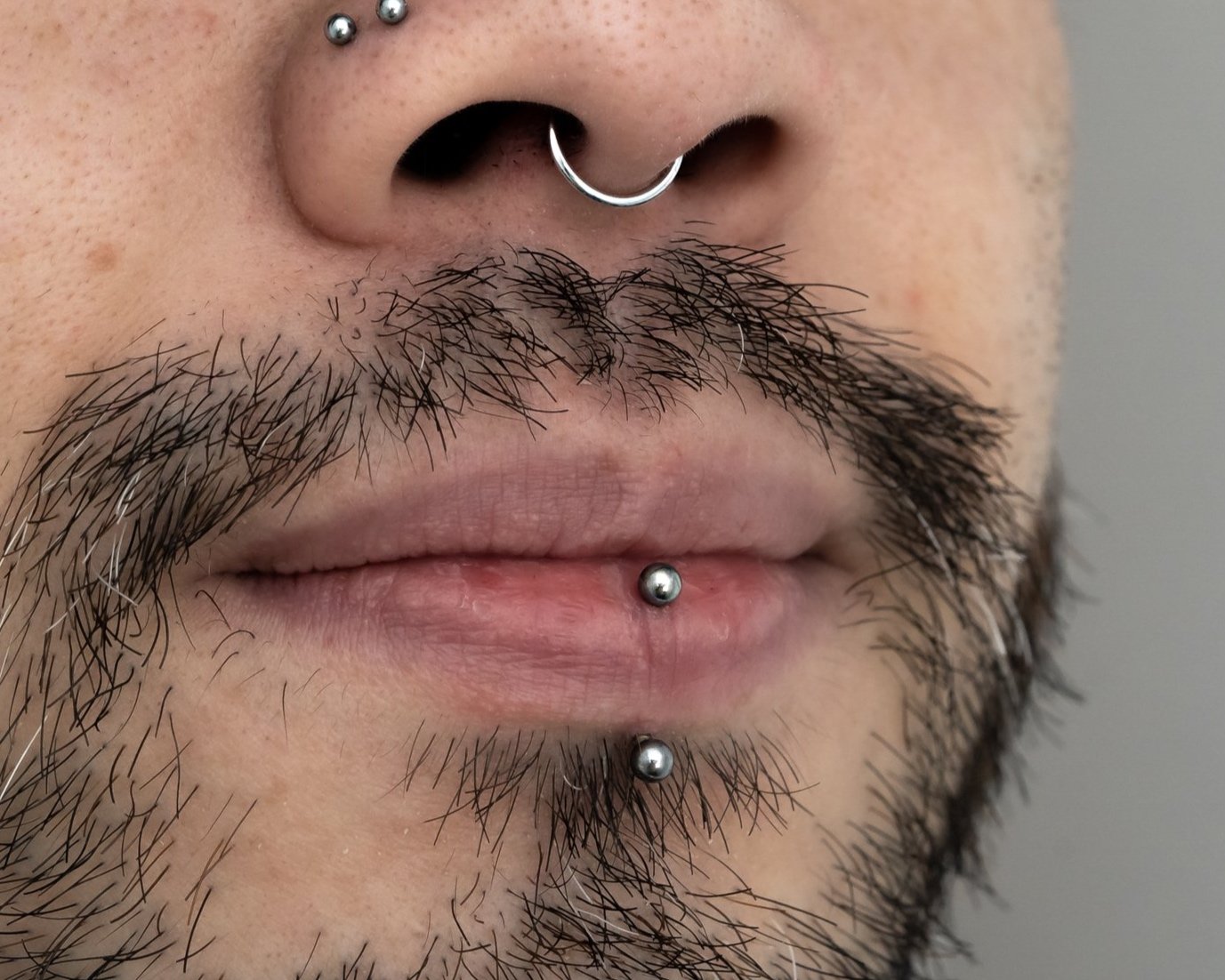
Vertical labret piercing procedure
Be certain to visit a licensed, professional piercer working in a studio that undergoes routine local health inspections. Read online reviews to confirm the shop’s reputation.
The procedure is brief. Typical steps include:
- The piercer will cleanse your lower lip with water and an antiseptic solution.
- You’ll use an antibacterial mouthwash to rinse your mouth, reducing bacteria that could infect the pierced area.
- The piercer will mark the entry and exit points on the inside and outside of your lip with a pen.
- They’ll clamp your lower lip with a specialized instrument to steady it and gently pull the lip outward to better visualize the inside of your mouth.
- A needle is pushed through the marked spots from top to bottom, done firmly and quickly but gently to lessen discomfort.
- The needle is withdrawn slowly and carefully.
- Jewelry, commonly a curved barbell, is then threaded into the new piercing, and beads are secured on the ends to hold it in place.
What’s an inverse vertical labret piercing?
In a standard vertical lip piercing, both ends of the barbell are usually visible outside your mouth: one emerges at the top of the lower lip and the other at the bottom near the chin.
The inverse vertical labret, also known as an Ashley piercing, is placed so that jewelry enters from the outside of the lower lip and one end rests inside the mouth, leaving one side fixed internally.
Vertical labret pain
Pain tolerance varies from person to person.
Most people report moderate discomfort with a vertical lip piercing. Many rate the pain about a 4 on a 1–10 scale.
This piercing can be more painful than ear or nose piercings because the tissue around the mouth is sensitive and rich in nerve endings.
It may hurt more than standard lip piercings because it passes through thin, delicate lip tissue rather than only the skin and inner mouth lining.
Healing from vertical labret piercing
Vertical lip piercings typically heal within about 6 to 8 weeks. Healing time can vary depending on how well you care for the area.
Aftercare instructions for the initial weeks include:
- Wash your hands thoroughly with clean water and unscented soap before touching the pierced area.
- Rinse your mouth with an antiseptic, alcohol-free mouthwash regularly to reduce oral bacteria. Try to do this in the morning, before bed, and after meals.
- Avoid submerging the piercing in water. Refrain from swimming. Opt for showers rather than baths.
- Keep clothing, bed linens, and towels clean to prevent bacteria from reaching the piercing. This applies to anything that may touch your face.
- Limit touching your mouth or face unless your hands are clean. This can be a challenging habit to break.
- Soak the pierced area with a solution made from 1/8 teaspoon of sea salt dissolved in 1 cup of warm water for at least 5 minutes daily. Gently pat the area dry with a clean towel afterward.
- Use a saline spray as an alternative to salt soaks to keep the piercing clean.
Side effects and precautions
Pick a piercer who wears gloves and uses sterile, single-use needles. Verify state regulations and licensing requirements.
Possible complications or side effects of a vertical lip piercing include:
Rejection
Rejection occurs when the body treats the jewelry as a foreign object and attempts to expel it from the skin.
Over time the body may push the jewelry out, which can break the skin and leave scars. This process can also increase the risk of infection.
Tooth or gum damage
This happens when jewelry repeatedly rubs against tooth enamel or gum tissue.
It’s a common issue and can result in tooth wear, decay, or gum problems like gingivitis if not addressed. Contact your piercer promptly if you notice this.
Infection
Lip and oral piercings are more prone to infection than some other sites because oral bacteria can enter the piercing after eating, drinking, or touching the mouth.
Scarring
A piercing that’s rejected or left without jewelry may develop thick scar tissue.
Swelling
Swelling and pain are normal for the first few days after piercing. Seek medical attention if these signs persist for weeks or if you observe severe bleeding, intense pain, or unusual discharge.
Nerve disruption
Facial piercings have been associated with facial nerve disturbance. This can lead to issues such as facial asymmetry and other nerve-related symptoms.
Vertical labret jewelry
Common jewelry choices for vertical labret piercings include:
- Fully enclosed ring or hoop. A circular piece that encircles the pierced area similarly to an earlobe earring.
- Curved barbell. A thick, curved rod typically 14- to 16-gauge that follows the lip contour with beads on each forward-facing end.
- Vertical labret bars. Bars that pass vertically through the piercing with beads on both ends. You can wear them side by side if you elect to get double vertical labret piercings.
Takeaway
A vertical lip piercing is a popular and distinctive facial modification. It can complement other facial piercings or stand alone as a relatively subtle statement.
Follow aftercare directions closely, since lip piercings are particularly vulnerable to bacteria from the mouth.


















Leave a Reply
You must be logged in to post a comment.