
Key Takeaways
- Everyday water bottles or hydro flasks require dailycleaning.
- Other water containers such as tea kettles, 5-gallon jugs, hiking hydration packs, and filtered pitchers need weekly sanitization.
- Your bottle — yes, the one you’re sipping from today — may harbor harmful levels of bacteria, including E. coli.
As I hit publish on this piece, my teenage son’s hydro flask, my tea kettle, the Nespresso water reservoir, and the aluminum bottle I picked up at a local whole-food store — which I’ve been refilling for months — are all soaking in the sink with soap, a splash of bleach, and warm water. They’re about to get a thorough scrub. And yes, I’ll make sure each one dries completely before the next use.
Staying hydrated is essential for overall health, energy levels, digestion, and even cognitive function. Whether you’re tracking your intake or wondering How much water Is in a water bottle in ml, or even asking How much water is in a plastic water bottle, chances are you’re carrying a reusable bottle with you most days. A common handheld reusable bottle holds between 24 and 32 ounces. If you refill it three to four times daily, that’s a lot of use — and a lot of opportunity for bacterial buildup.
So how frequently should you clean it? And how deep should that cleaning go?
Here’s the short version:
That faint but funky odor in your empty bottle? That’s bacteria. The slightly off taste you try to ignore? Also bacteria. That slick or slimy residue inside the straw or along the rim isn’t a protective coating — that’s bacteria.
If you trust us and just want the best cleaning methods, feel free to jump ahead. If you need the data to be convinced, keep reading.
The facts: How dirty our water bottles and containers are
How unsanitary is my water bottle? I need stats, STAT.
You may have come across claims that reusable water bottles can contain 40,000 times more colony-forming units (CFUs) of bacteria than a toilet seat. While that specific report came from a consumer group without peer review, multiple scientific studies confirm that reusable bottles can contain high — even concerning — bacterial levels.
In 2017, researchers at Purdue University tested 90 reusable bottles and found that 60 percent exceeded recommended safety standards for contamination.
Another 2017 study examining rapid microbial growth in reusable drinking bottles identified 34,000 bacterium per milliliter (mL) in children’s bottles and 75,000 bacteria per mL in adult bottles.
If you regularly work out, bacteria from your hands, gym equipment, and sweat can further increase microbial contamination.
E. coli and Staphylococcus aureus are among the more concerning organisms that can proliferate over time, especially in warm environments.
You may have heard that reusable water bottles can have 40,000 times more colony-forming units (CFUs) of bacteria than a toilet seat. Although the original data source was not peer-reviewed, scientific research consistently supports the presence of substantial bacterial contamination in frequently used bottles.
Researchers at Purdue University found in 2017 that 60 percent of tested bottles surpassed acceptable contamination thresholds.
Similarly, the 2017 study reported 34,000 bacterium per milliliter (mL) in children’s bottles and 75,000 bacteria per mL in adult bottles.
Regular exercise and frequent handling only compound the issue.
E. coli and Staphylococcus aureus remain two key bacteria of concern that thrive with warmth and time.
Is it bad if I don’t clean my water bottle? Does a water bottle (for just water) need to be washed?
Dr. Yuriko Fukuta, associate professor and internist in Houston, shared in an interview with Baylor College of Medicine that germs can multiply inside your bottle if it is not cleaned after each use.
Consider whether you’ve experienced unexplained:
- headache
- sneezing (which can signal an allergy response if mold particles are present)
- stomach upset or nausea
If so, thoroughly washing your water bottle may be a practical first step to eliminate a potential source of exposure.
Dr. Yuriko Fukuta also emphasizes that bacteria can multiply quickly in enclosed, moist environments like reusable bottles if they are not cleaned routinely.
If you’re noticing symptoms without a clear cause, improving bottle hygiene is a simple, low-risk intervention worth trying.
Can bacteria grow in a closed water bottle?
Yes. Even if you only drink water, bacteria transferred from your lips, backwash, or ambient warmth can multiply inside a sealed bottle.
Dr. Fukuta notes that metal or glass bottles are generally more sanitary than plastic versions. Leaving a refilled bottle inside a parked car — where temperatures can climb quickly — is a bad idea, since heat accelerates bacterial growth.
Even with plain water, enclosed moisture plus warmth equals a breeding ground for microbes.
Dr. Fukuta reiterates that metal and glass are preferable materials, while plastic bottles in hot cars create optimal conditions for bacteria to thrive.
Can you reuse a water bottle without washing it?
If you skip washing your bottle, bacteria will accumulate. Full stop.
An early 2000s cross-sectional observational study involving more than 75 elementary students found evidence of fecal contamination in bottles that were washed inconsistently — or not cleaned for extended periods.
Safe drinking water standards were not met in 64% of the tested bottles, and over 13% contained fecal bacteria or coliform bacteria, which are associated with gut contamination.
The study also demonstrated significant bacterial regrowth in treated drinking water left at room temperature for as little as 8 to 24 hours.
Again: without washing, bacteria multiply.
The same study showed fecal contamination and failure to meet safety thresholds in a majority of inadequately cleaned bottles.
Even properly treated tap water can support bacterial regrowth within hours when left stagnant at room temperature.
Can I just rinse the water bottle between uses?
A 2018 cross-sectional study evaluated nearly 30 participants using stainless steel bottles and compared them to a brand new control bottle. It found the following when comparing a tap water rinse (Canadian drinking water) to a soap-and-water wash:
- No dramatic difference: The average bacteria count after 24 hours was slightly lower following a tap water rinse compared to soap and water cleaning.
- No dramatic difference: After 72 hours, bacteria counts were somewhat lower with soap and water compared to a tap water rinse.
*Results may differ significantly for plastic or glass containers, which have different porosity and surface characteristics.
The 2018 study suggests that for stainless steel specifically, rinsing and washing produced similar short-term bacterial outcomes — but this should not be interpreted as a free pass to skip proper cleaning.
Material type, frequency of use, and environmental exposure all influence contamination levels.
The verdict: Cleaning recommendations by container type
Steel hydro flasks
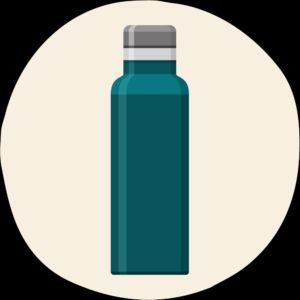
✅ More sanitary than plastic bottles but needs regular cleaning.
Porosity: Stainless steel is nonporous, making it one of the more hygienic materials for water storage.
Durability: Resistant to corrosion and cracking, reducing spaces where bacteria can hide.
Cleaning: The 2018 study indicates rinsing may perform similarly to soap and water short term, but routine washing is still recommended.
P.S. Alcohol flasks are included

You might assume alcohol keeps a flask sterile. Not quite.
False. Heat, lip contact, and environmental exposure introduce bacteria. Alcohol flasks require regular cleaning just like any other container.
To put the lid on this convo
Let’s be honest: water bottles can get pretty gross. Yes👏🏾you👏🏾 really👏🏾 do👏🏾 need👏🏾 to👏🏾 clean👏🏾 them.
The reassuring part? A simple daily wash with soap and water significantly reduces bacterial growth. Periodic deep cleaning using bleach, baking soda, vinegar, or the dishwasher (if safe for your container) helps maintain a hygienic, odor-free bottle — so you can focus on hydration, whether you’re tracking ounces or figuring out how much water your bottle holds in mL.












Leave a Reply
You must be logged in to post a comment.