

Grief is a universal human experience and is often explained through the 5 stages of mental health recovery: denial, anger, bargaining, depression, and acceptance. Some experts also describe seven stages, expanding the framework to capture the deeper emotional layers of loss, including guilt and gradual rebuilding.
At some point in life, nearly everyone will encounter grief. It may stem from the death of someone close, losing a job, the end of a relationship, a serious diagnosis, or any major life transition that disrupts your sense of normalcy. These events can significantly impact emotional well-being and may require a process similar to mental health recovery.
Grieving is also intensely personal. It rarely unfolds in a tidy, predictable, or linear fashion. There’s no set schedule for emotional healing. You might cry unexpectedly, feel anger surge, withdraw socially, or experience emotional numbness. All of these reactions are common and valid.
Although each person’s journey through grief differs, many individuals notice patterns that align with the recognized stages of emotional healing and recovery.
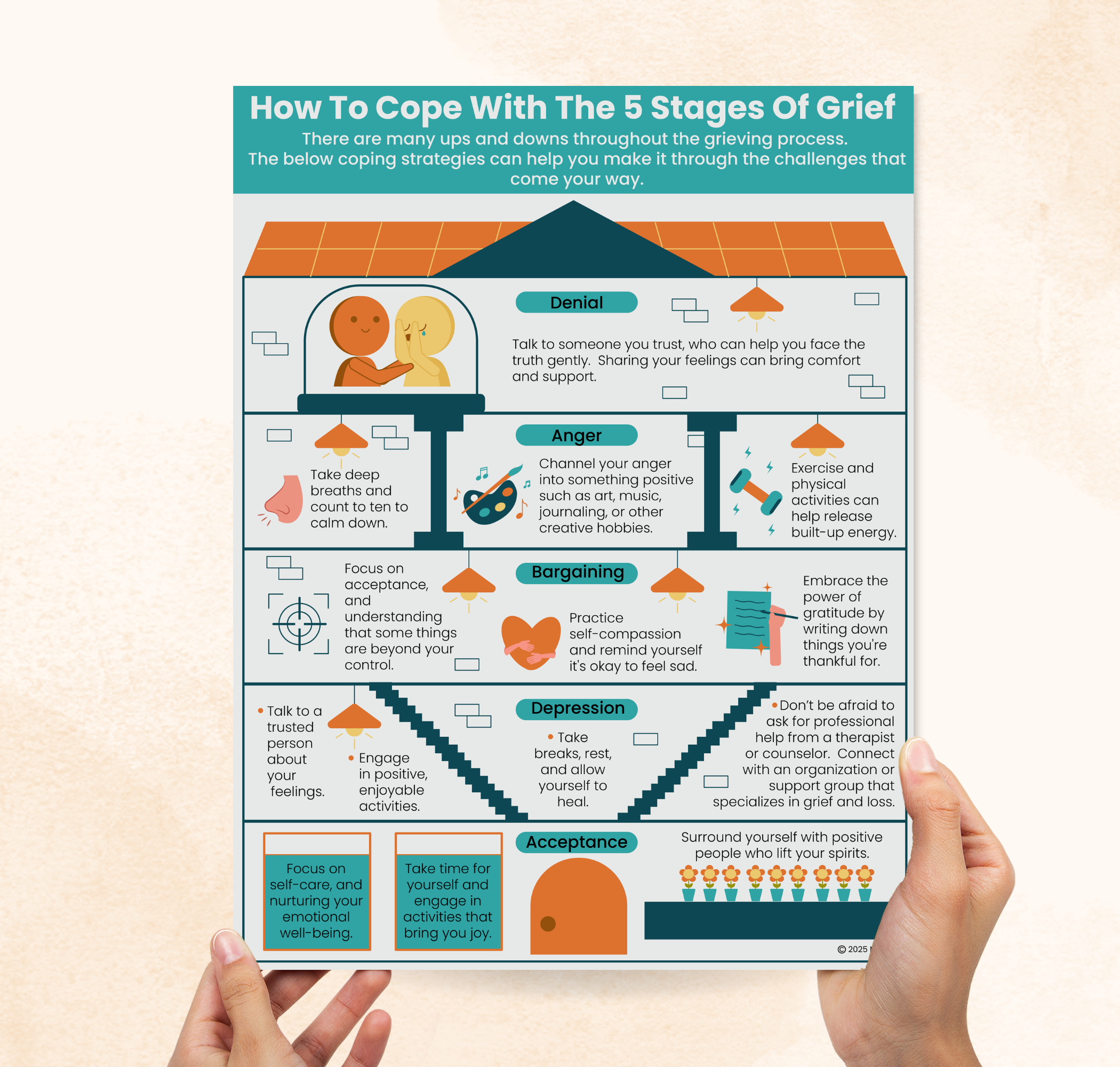
Are there 5 or 7 stages of grief?
In 1969, Swiss-American psychiatrist Elizabeth Kübler-Ross introduced the idea that grief unfolds in five stages in her groundbreaking book “On Death and Dying.” Her insights were based on years of working with individuals facing terminal illness.
Over time, two additional stages were proposed, creating a seven-stage model intended to better represent the complexity of grief responses and psychological adjustment after loss.
It’s important to understand that neither the five-stage nor the seven-stage model perfectly defines every person’s experience. Emotions during grief tend to fluctuate. You may skip certain stages, revisit others, or experience multiple stages simultaneously. This flexibility is a normal part of the mental health recovery process.
The 5 stages of grief
Kübler-Ross originally developed her model to describe the emotional responses of people living with terminal illness, but it has since been widely applied to general grief and loss. Today, these stages are often discussed in conversations about the 5 stages of mental health recovery after significant life events.
According to the Kübler-Ross model, the five stages of grief are:
- denial
- anger
- bargaining
- depression
- acceptance
Below is a closer look at what each stage may involve.
Stage 1: Denial
Grief can feel overpowering. It’s common to initially respond to sudden or painful news by refusing to believe it’s real. Denial acts as a psychological buffer, giving your mind time to gradually process the reality of the loss.
This defense mechanism can temporarily reduce emotional intensity. However, as denial fades, the emotions you held back—sadness, fear, confusion—often surface more strongly. Facing these feelings is a necessary, though challenging, step in the healing journey.
Examples of the denial stage
- Breakup or divorce: “They’re just upset. This will be over tomorrow.”
- Job loss: “They were mistaken. They’ll call tomorrow to say they need me.”
- Death of a loved one: “She’s not gone. She’ll come around the corner any second.”
- Terminal illness diagnosis: “This isn’t happening to me. The results are wrong.”
Stage 2: Anger
While denial can soften the initial shock, anger often emerges as reality sets in. Anger may serve as a protective layer, covering deeper pain and vulnerability.
This emotion might be directed toward other people, yourself, a higher power, or even unrelated objects. Even when you logically understand that no one is to blame, your feelings may feel too intense to manage calmly in the moment.
Anger doesn’t always appear as explosive rage. It can show up as irritability, resentment, or bitterness. For some individuals, this stage passes quickly. For others, it may last longer before gradually easing into reflection and deeper emotional processing.
Examples of the anger stage
- Breakup or divorce: “I hate him! He’ll regret leaving me!”
- Job loss: “They’re terrible bosses. I hope they fail.”
- Death of a loved one: “If she cared for herself more, this wouldn’t have happened.”
- Terminal illness diagnosis: “Where is God in this? How dare God let this happen!”
Stage 3: Bargaining
During bargaining, you may find yourself dwelling on “what if” or “if only” thoughts. This stage often reflects a desire to regain control in a situation that feels overwhelming and unpredictable.
It’s common to mentally replay events, imagining how different choices might have changed the outcome. Some individuals may also attempt to make promises to God or a higher power in exchange for relief or healing.
Bargaining is part of the broader emotional adjustment process and can overlap with questions like Can a mentally ill person become normal? when grief intersects with ongoing mental health struggles. These thoughts reflect a natural desire for restoration and hope.
Examples of the bargaining stage
- Breakup or divorce: “If only I had spent more time with her, she would have stayed.”
- Job loss: “If only I worked more weekends, they would have seen how valuable I am.”
- Death of a loved one: “If only I had called her that night, she wouldn’t be gone.”
- Terminal illness diagnosis: “If only we had gone to the doctor sooner, we could have stopped this.”
Stage 4: Depression
Unlike anger or bargaining, which can feel active and outwardly expressed, depression during grief often feels heavy and inward. By this stage, the full weight of the loss may become clearer.
You might withdraw socially, feel persistent sadness, experience low energy, or question your sense of purpose. This stage can resemble clinical depression, though it is often a natural response to loss.
If feelings of hopelessness persist or interfere significantly with daily functioning, consulting a mental health professional can be beneficial. Many people also explore whether Can you recover from mental illness without medication as part of their broader mental health recovery journey. Professional guidance can help determine the most appropriate support.
Examples of the depression stage
- Breakup or divorce: “Why go on at all?”
- Job loss: “I don’t know how to go forward from here.”
- Death of a loved one: “What am I without her?”
- Terminal illness diagnosis: “My whole life comes to this terrible end.”
Stage 5: Acceptance
Acceptance does not mean happiness or the absence of pain. Rather, it reflects acknowledgment of reality and an ability to move forward despite the loss.
In this phase, you begin adjusting to a new normal. While difficult days may still occur, they are often balanced by moments of stability or even hope. Acceptance is frequently viewed as the final step in the 5 stages of mental health recovery, representing emotional integration rather than forgetting.
You may start setting new goals, rebuilding routines, and redefining your identity in light of what has changed.
Examples of the acceptance stage
- Breakup or divorce: “Ultimately, this was a healthy choice for me.”
- Job loss: “I’ll be able to find a way forward from here and can start a new path.”
- Death of a loved one: “I am so fortunate to have had so many wonderful years with him, and he will always be in my memories.”
- Terminal illness diagnosis: “I have the opportunity to tie things up and make sure I get to do what I want in these final weeks and months.”
The 7 stages of grief
The seven-stage model builds upon the original framework and offers a more detailed look at emotional transitions after loss. The stages include:
- Shock and denial: A state of disbelief and emotional numbness.
- Pain and guilt: Intense emotional distress, sometimes accompanied by self-blame.
- Anger and bargaining: Frustration combined with attempts to negotiate or regain control.
- Depression: Withdrawal, reflection, and deep sadness.
- The upward turn: A gradual easing of intense emotions and increased calm.
- Reconstruction and working through: Actively rebuilding life and developing coping strategies.
- Acceptance and hope: Embracing the new reality while recognizing future possibilities.
This expanded model aligns closely with long-term emotional resilience and mental health recovery, particularly when coping with complex or prolonged grief.
For example, in the case of a breakup or divorce:
- Shock and denial: “She absolutely wouldn’t do this to me. She’ll realize she’s wrong and be back here tomorrow.”
- Pain and guilt: “How could she do this to me? How selfish is she? How did I mess this up?”
- Anger and bargaining: “If she’ll give me another chance, I’ll be a better boyfriend. I’ll dote on her and give her everything she asks.”
- Depression: “I’ll never have another relationship. I’m doomed to fail everyone.”
- The upward turn: “The end was hard, but there could be a place in the future where I could see myself in another relationship.”
- Reconstruction and working through: “I need to evaluate that relationship and learn from my mistakes.”
- Acceptance and hope: “I have a lot to offer another person. I just have to meet them.”

Why understanding the stages of grief matters
Grief is a natural psychological and emotional response to loss. Recognizing the 5 stages of mental health recovery can help normalize your reactions and reduce feelings of isolation.
Understanding these stages allows you to anticipate emotional shifts, identify your needs, and practice healthy coping strategies. It can also encourage you to seek professional help when needed, especially if symptoms become overwhelming or prolonged.
Ultimately, knowledge of the grieving process supports self-compassion and fosters gradual healing.
The takeaway
No two people experience grief in exactly the same way. The timeline, intensity, and order of emotions can vary widely. For some, the grieving process lasts weeks; for others, it may extend over years. Both experiences are valid.
If you feel stuck, overwhelmed, or unsure how to move forward, reaching out to a mental health professional can provide valuable support. Therapy, counseling, and community resources can play an important role in emotional healing and long-term recovery.























Leave a Reply
You must be logged in to post a comment.