

Stage 4 kidney cancer represents the most progressed form of kidney malignancy, where the disease has originated in the kidneys and then extended to other organs in the body. The treatment approach and prognosis vary based on multiple individual factors.
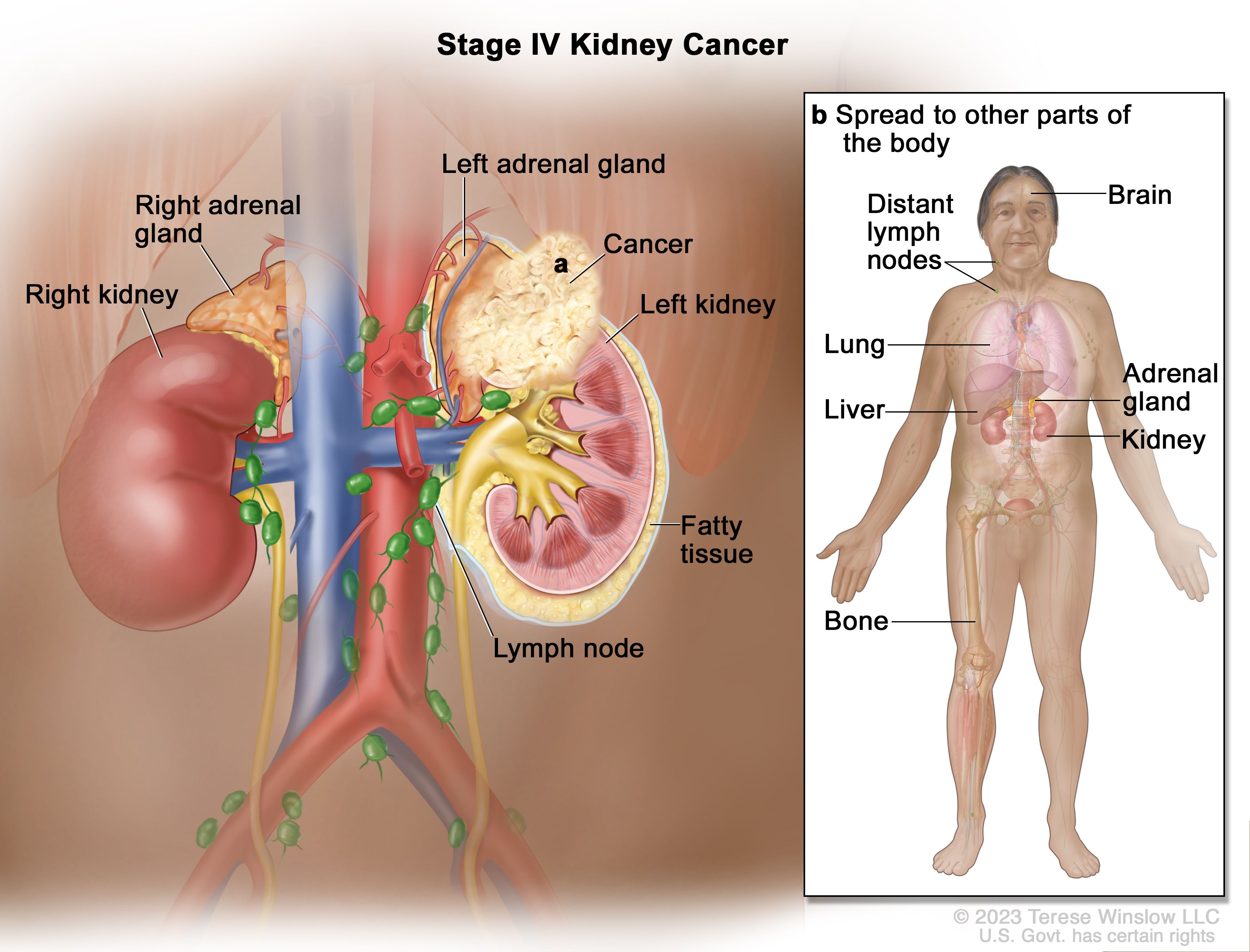
The kidneys are a pair of fist-sized organs located on either side of the spine beneath the ribcage. Their main job is to filter waste and excess fluid from the bloodstream, which the body then removes as urine.
The American Cancer Society (ACS) projects that almost 82,000 individuals in the United States will be diagnosed with kidney cancer in 2024.
Renal cell carcinoma (RCC) accounts for about 90% of kidney cancers, per the ACS. Also called renal cell cancer or renal cell adenocarcinoma, RCC typically appears as a single tumor in one kidney.
Occasionally, multiple tumors can develop in one kidney or both kidneys.
In some patients, RCC spreads beyond the kidney to distant parts of the body. That spread defines stage 4 kidney cancer, the final and most severe stage.
How does kidney cancer spread?
RCC starts as a tumor in one or both kidneys.
From there, the tumor can invade nearby tissues or travel to distant sites in the body.
There are two main routes by which RCC can spread:
- Local: The tumor extends into adjacent veins and tissues, including lymph nodes and blood vessels. This is sometimes called locally advanced RCC.
- Metastatic: The cancer moves beyond the kidney to remote organs such as the lungs, bones, or brain.
The pattern of spread helps determine your cancer stage and guides treatment decisions.
What are the stages of kidney cancer?
Staging describes how far kidney cancer has progressed and helps inform prognosis and therapy options.
The American Joint Committee on Cancer uses a TNM system to classify kidney tumors:
- T (tumor): The size and extent of the primary kidney tumor.
- N (node): Whether nearby lymph nodes contain cancer.
- M (metastasis): Whether the cancer has appeared in distant parts of the body.
Based on the TNM findings, doctors assign a numbered stage for RCC. These stages reflect tumor size and spread.
There are four main stages:
- Stage 1: Tumor is under 7 centimeters and confined to the kidney.
- Stage 2: Tumor is larger than 7 centimeters but still limited to the kidney.
- Stage 3: Tumor has invaded a major vein, nearby tissue, or regional lymph nodes.
- Stage 4: Cancer has reached the adrenal gland or has spread to distant lymph nodes or other organs. This is the most advanced stage of RCC.
What’s the outlook?
Prognosis for stage 4 RCC varies greatly between individuals.
The ACS provides estimated 5-year survival rates for people after an initial RCC diagnosis, based on Surveillance, Epidemiology, and End Results (SEER) data from the National Cancer Institute.
The ACS groups survival statistics into three categories:
| Stage | Definition | 5-year survival % |
|---|---|---|
| localized | cancer has not spread beyond the kidney | 93% |
| regional | cancer has spread nearby, such as to lymph nodes or adjacent structures | 74% |
| distant | cancer has spread to remote parts of the body, such as the brain or bones | 17% |
Stage 4 RCC corresponds to the distant category.
Keep in mind these numbers are averages and estimates.
Newer patients may experience better outcomes because treatments are continually improving.
Your clinician will give a prognosis and treatment plan tailored to additional details, such as tumor biology and your overall health.
What are the treatment options?
Treatment for stage 4 RCC depends on where the cancer has spread and your general health status.
Options may include surgery, systemic drug therapies, or investigational treatments in clinical trials.
Surgery
Surgery is commonly used for stages 1–3 when tumors are more confined and easier to remove. For stage 4 disease, surgery is often not the best option.
When cancer has metastasized, surgically removing tumors frequently does not provide a meaningful benefit. Removing the primary tumor alone has not shown clear advantages in many cases.
However, if surgery is appropriate, a cytoreductive nephrectomy may be performed to reduce symptoms or possibly extend survival. This operation removes most or all of the affected kidney.
Systemic therapies
If surgery isn’t feasible for stage 4 RCC, doctors often use combinations of medications.
A biopsy of the tumor is typically done first to establish whether the cancer is clear cell or non–clear cell RCC, which helps guide treatment choices.
Targeted therapies may include drugs such as:
- tyrosine kinase inhibitors
- angiogenesis inhibitors
- mTOR (mammalian target of rapamycin) inhibitors
Immunotherapy options may include:
- checkpoint inhibitors like pembrolizumab (Keytruda) and nivolumab (OPDIVO)
- cytokine-based treatments
Clinical trials
Experimental therapies may be accessible through clinical trials. Talk with your doctor about the possibility of joining a clinical trial.
In addition, healthcare teams often provide supportive care to manage symptoms and treatment side effects.
Frequently asked questions
How long can you live with stage 4 renal cell carcinoma?
Predicting survival for stage 4 cancer is difficult because it depends on many variables.
The ACS reports a 5-year survival rate of about 17% for people diagnosed with stage 4 kidney cancer. This figure reflects the percentage of people alive five years after their stage 4 RCC diagnosis.
What is the best treatment for renal cell carcinoma stage 4?
There’s no single best treatment for stage 4 RCC. According to the National Cancer Institute, first-line therapy depends on the specific extent and characteristics of the tumor. It often involves combinations of medications, which may include:
- nivolumab (OPDIVO)
- ipilimumab (Yervoy)
- cabozantinib (Cometriq, Cabometyx)
- pembrolizumab (Keytruda)
- axitinib (Inlyta)
- lenvatinib (Lenvima)
- avelumab (Bavencio)
- sunitinib (Sutent)
- pazopanib (Votrient)
- sorafenib (Nexavar)
- temsirolimus (Torisel)
- bevacizumab (Avastin)
- interferon-alpha formulations
- interleukin-2 (IL-2, Aldesleukin)
In selected patients, nephrectomy or palliative external-beam radiation therapy (EBRT) may also be considered.
Can stage 4 kidney cancer go into remission?
Complete remission is possible but uncommon, and current data do not suggest it occurs frequently.
Treatment choices depend on tumor burden and the organs involved. Management typically includes surgery (when appropriate), systemic therapies, and potentially clinical trial options.
Is stage 4 cancer terminal?
Stage 4 indicates the most advanced disease and requires aggressive management, but it is not always terminal.
For instance, about 17% of people with stage 4 kidney cancer live at least five years after diagnosis.
Takeaway
Stage 4 kidney cancer means tumor(s) in the kidney have spread to other areas of the body, such as the lungs, brain, or bones.
If you’ve been diagnosed with stage 4 RCC, remember that published survival statistics are general estimates.
Your personal outlook is influenced by factors like the specific cancer type, extent of spread, response to therapy, and your overall health.
It’s important to follow your treatment team’s guidance, attend appointments, and take prescribed medications. Adhering to recommended therapies and lifestyle measures to manage side effects can help support your health during treatment.























Leave a Reply
You must be logged in to post a comment.