

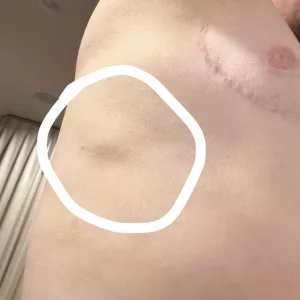
A shoulder lump is a bump, mass, or growth located in the shoulder region. You may notice it rubbing against clothing or the strap of a bag.
Not all lumps are the same. Some are painful, while others are painless or only mildly bothersome. The lump’s color may be pink, white, or match your skin tone. These features depend on the underlying cause.
There are many possible explanations for a shoulder lump, and most are benign. Still, you should see a healthcare provider if the lump is new, enlarging, or painful. If you recently sustained an injury, seek urgent care.
Below, we review common reasons for shoulder lumps, their signs, and treatment options.
Causes of shoulder lumps
Shoulder lumps arise from a variety of conditions that range in seriousness. Noting other symptoms and the lump’s behavior can help narrow the cause.
Lipoma
A lipoma is a collection of fatty tissue beneath the skin. It’s a benign (noncancerous) soft-tissue growth. The exact cause of lipomas is unknown.
Lipomas are fairly common. Approximately 1 in every 1,000 people has one. They frequently appear on the shoulders, trunk, neck, and armpits.
Typical features include:
- soft, rubbery, and doughy feel
- movable under the skin
- usually under 2 inches, though they can grow larger
- sometimes tender
Most lipomas are not painful, but they can hurt if they press on nerves or contain blood vessels.
Cyst
A cyst is a closed sac of tissue that can form a lump. Depending on the type, it may contain fluid, pus, or air. Most cysts are benign.
Several cyst types can occur on the shoulder, including:
- Epidermoid cyst. Also called a sebaceous cyst, this is a flesh-colored sac under the skin filled with keratin, a thick, yellowish material that may drain.
- Paralabral cyst. Filled with joint fluid, a paralabral cyst forms near the shoulder joint. It’s often painless but can hurt if it compresses nerves or is associated with cartilage tears.
- Ganglion cyst. While usually seen on the hands or wrists, ganglion cysts can rarely develop near other joints like the shoulder. They’re generally round or oval and painless.
- Bone cyst. A bone cyst is a fluid-filled cavity within bone. It may be painless but can expand and increase the risk of fracture.
Abscess
An abscess is a pus-filled collection beneath the skin caused by bacterial infection.
An abscess may resemble a large pimple. Other signs include:
- round appearance
- firm but squishy texture
- pain
- redness
- pus draining from the center
- warmth to the touch
Because an abscess is infectious, you may also experience fever and chills.
Trauma or injury
Shoulder lumps can develop after an injury. Possible traumatic causes include:
- Fracture. A broken shoulder bone can produce pain, swelling, and a noticeable bump at the fracture site.
- Separation. In a separated shoulder, ligaments connecting the collarbone and shoulder blade tear, sometimes causing the shoulder blade to sit lower and form a bump on the top of the shoulder.
- Muscle contusion. A contusion to muscle causes swelling and bruising. If blood pools in the tissue, a hematoma may form and feel like a lump.
Muscle knot
A muscle knot is a cluster of tense muscle fibers that remain contracted even at rest.
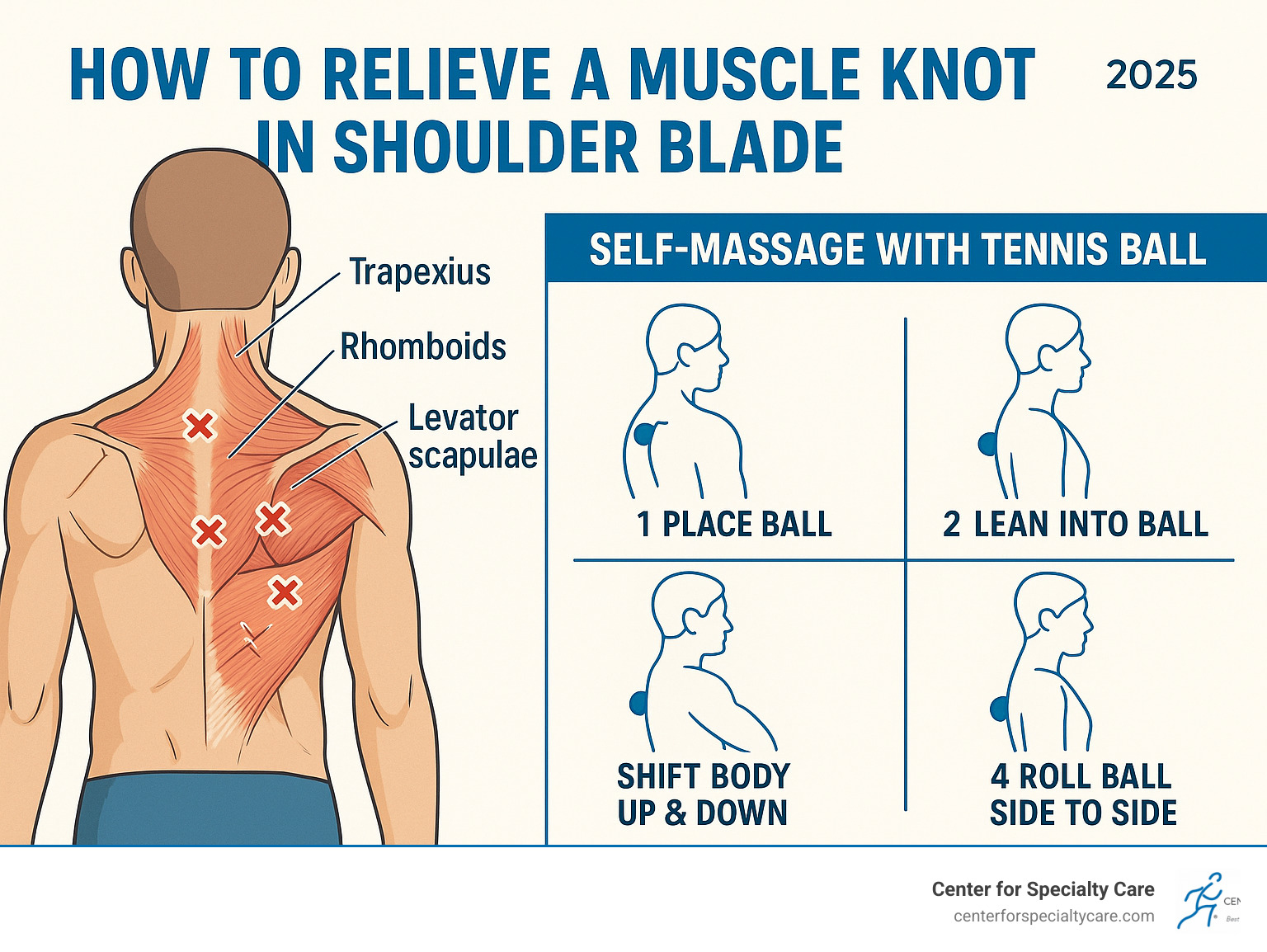
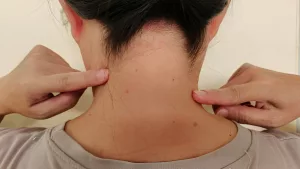
Also called myofascial trigger points, these knots can appear anywhere, commonly on the neck and shoulders.
Symptoms often include:
- dull ache or pain
- tenderness when pressed
- firmness
- localized swelling
Muscle knots often result from inactivity or repetitive overuse. Regular movement and massage therapy can help relieve them.
Large pimple or wart
The lump could be a large acne lesion or a wart. These skin conditions are usually benign but may be uncomfortable.
Pimples develop when pores become clogged with oil and dead skin cells and commonly occur on the shoulders, face, upper back, and chest.
Larger lesions are typically:
- Cystic acne. Painful, pus-filled bumps that form beneath the skin.
- Nodular acne. Harder, painful lumps that also develop below the skin’s surface.
Warts are caused by human papillomavirus (HPV). While commonly found on the hands, warts can appear anywhere, including the shoulders.
Warts may be:
- small or large
- rough or smooth
- white, brown, pink, or flesh-colored
- itchy
Arthritis
Arthritis, which involves joint inflammation, can produce lumps around the shoulder. The lump’s characteristics vary by arthritis type.
Rheumatoid arthritis (RA), an autoimmune form, can cause rheumatoid nodules beneath the skin over bony areas such as the shoulders.
A rheumatoid nodule can grow as large as a lemon and is often:
- skin-colored
- firm or doughy
- either movable or adhered to deeper tissue
Osteoarthritis (OA), the degenerative variety, may produce bone spurs (osteophytes) that form around affected joints.
Osteophytes commonly occur on the shoulders, neck, knees, fingers, and feet. They may be asymptomatic but can cause pain or restricted motion if they press on nerves or soft tissues.
Cancer
A shoulder lump can, in rare cases, be a soft tissue sarcoma — a malignant tumor in connective tissues like muscle, tendons, and nerves.
These tumors are often painless early on and most frequently affect the:
- shoulders
- thighs
- pelvis
- abdomen
- chest
As the tumor enlarges, it may cause pain and limit movement.
Squamous cell carcinoma, a form of skin cancer, can also produce rough, scaly lumps that may resemble warts.
Possible causes by location
The lump’s specific location on or around the shoulder often gives clues about its origin.
Lump on the shoulder blade
A lump over the shoulder blade may point to a fracture or a separated shoulder.
Lump on the shoulder bone
The shoulder complex includes several bones. Bumps in this region can be due to:
- separated shoulder
- fracture
- rheumatoid nodule
- osteophyte
- bone cyst
Shoulder lump under the skin
Lumps beneath the skin’s surface are commonly:
- lipoma
- cyst
- cystic or nodular acne lesion
- abscess
Shoulder lump on the skin
Lumps on the skin’s surface may be:
- noncystic pimple
- wart
- squamous cell carcinoma lesion
Lump on shoulder muscle
Possible muscle-related lumps include:
- muscle contusion
- muscle knot
- soft tissue sarcoma
Painful versus painless lumps
Many shoulder lumps are uncomfortable, but some are typically painless. Causes that are often painless include:
- lipoma
- cyst
- rheumatoid nodule
- osteophyte
- warts
- malignant tumors
Generally, these lumps cause pain only when they compress nearby nerves or soft tissue.
When to see a doctor
Most lumps are not dangerous. However, if a shoulder lump does not resolve within 2 weeks, schedule an appointment with a physician.
Seek medical attention sooner if the lump:
- enlarges
- becomes painful
- is fixed and doesn’t move
- recurs after removal
If you recently injured your shoulder, get immediate medical evaluation because the injury could be significant, such as a fracture.
How a shoulder lump is diagnosed
To identify the cause of a shoulder lump, a clinician may use several approaches:
- Physical exam. The doctor will feel the lump and check for redness, warmth, and swelling.
- MRI scan. MRI provides detailed images of soft tissues.
- X-ray. If a bony lesion is suspected, an X-ray can help.
- CT scan. CT imaging takes X-rays from multiple angles for a clearer view of bone and soft tissue.
- Biopsy. If a lipoma or tumor is suspected, a tissue sample may be taken for laboratory analysis.
Treatment options for shoulder lumps
Treatment depends on the underlying cause of the lump. Possible strategies include:
- Surgical removal. Excision is often used for lipomas, cysts, warts, and rheumatoid nodules.
- Drainage. Draining is useful for abscesses, cysts, and hematomas.
- Prescription medications. For cystic acne, topical or oral medications may be prescribed. Medications can also be used to reduce rheumatoid nodules.
Minor causes often need no specific therapy and may resolve on their own.
Takeaway
Shoulder lumps vary in size and texture — they can be hard, doughy, smooth, or rough, and may or may not be painful.
Most shoulder lumps are benign and resolve without intervention. Still, if a lump continues to grow, remains after 2 weeks, or becomes painful, see a doctor for evaluation. Prompt care is especially important after recent trauma.
Related reading: If you’re experiencing discomfort affecting the upper body, consider resources on shoulder pain pregnancy, breasts and upper back pain, and helpful rotator cuff injury stretches.


















Leave a Reply
You must be logged in to post a comment.