

Many people will encounter turbinate issues at some point. These problems, and the associated breathing troubles, often resolve on their own or with medical help.
What are turbinates?
Did you realize your nose contains natural air conditioners? Inside the nasal cavity are three pairs of fleshy ridges that filter, warm, and humidify the air you inhale. These are known as turbinates.

When turbinates are healthy, they do a good job regulating temperature and moisture inside the nose. However, if they swell, enlarge, or shift out of position, they can create a nasal blockage that interferes with airflow.
The inferior turbinates are the ones closest to the nostrils that you can see when looking into your nose. These are typically the focus of a turbinate reduction.
Why is turbinate reduction performed?
Some common and reversible reasons for turbinate enlargement include:
- allergies
- infections
- weather variations
- stress
- certain medications
- hormonal fluctuations
But there are causes of turbinate enlargement or displacement that are harder to reverse and may require surgical reduction. These include:
- chronic infections
- severe allergic disease
- structural abnormalities of the nose
Turbinate reduction is also often advised for patients having a septoplasty, which corrects a deviated septum.
A deviated septum is a displacement of the bone and cartilage dividing the two nostrils. This can press on the turbinates and lead to breathing difficulty.
Reducing the turbinates can further widen the nasal passages in someone undergoing septoplasty.
What occurs during the procedure?
There are multiple methods to decrease turbinate size. Some are minimally invasive while others are more involved.
Cautery, coblation, and radiofrequency reduction
In certain situations, surgeons recommend techniques that shrink turbinates without excising bone or large amounts of tissue.
These approaches use a needle-like instrument that delivers heat or energy to the turbinate tissue, causing scar formation that reduces the turbinates’ bulk.
These procedures are categorized as cauterization, coblation, or radiofrequency reduction.
They typically take about 10 minutes and can often be done in a clinician’s office under local anesthesia, which is injected into the nasal tissues.
No special preparation is usually required. These less invasive options are commonly chosen for milder turbinate enlargement.
Surgical removal
In other instances, the surgeon may remove portions of the turbinates. These operations are generally performed in an operating room under general anesthesia administered by inhalation or intravenously.
You’ll usually be instructed not to eat or drink starting the night before surgery. You should also avoid aspirin- or ibuprofen-containing medications for two weeks before the operation to reduce bleeding risk.
During this type of turbinate reduction, the surgeon makes incisions to remove some of the bone beneath the turbinates to shrink their size.
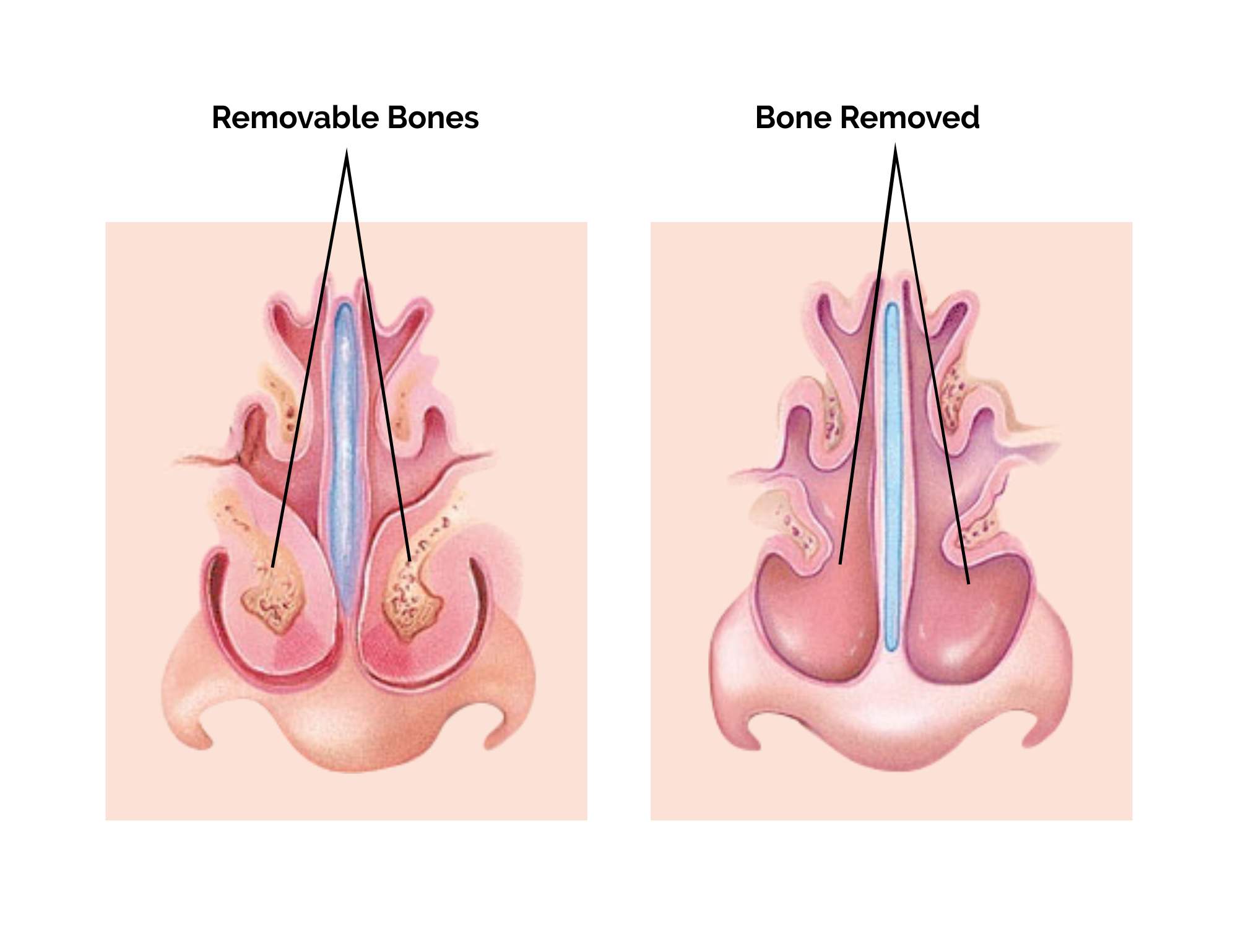
They might also employ a small handheld instrument to shave away some of the soft tissue, further enlarging the nasal airway.
Removing underlying bone or surrounding tissue is typically reserved for more severe cases and is often combined with a septoplasty.
A septoplasty involves cutting the lining that covers the septum. A technique called outfracturing may be used to fracture the bony turbinates so they can be repositioned more favorably.
What is recovery like?
Recovery depends on the method used. For minimally invasive reductions, healing is usually quick and not very painful. The newly formed scar tissue in the nose generally fully heals within about three weeks.
For more extensive turbinate surgery, recovery can take three to six months. Absorbable packing may be placed during the procedure but is not always necessary. Gradually, the nasal tissues will settle into place.
To lower the chance of bleeding and swelling, avoid vigorous activity and refrain from blowing your nose for several weeks after surgery.
Your surgeon may also advise elevating your head when sleeping to reduce nasal irritation.
Are there side effects?
Side effects are less common and milder with minimally invasive turbinate reductions. You may experience crusting or dryness in the nose for about three weeks.
Using saline nasal rinses and antibiotic ointment can help manage these symptoms.
With more invasive procedures that remove bone or tissue, side effects are more likely and can be more significant. Potential complications include:
- pain
- bleeding
- swelling
- irritation
- nasal dryness
- infection
There’s also a chance turbinate tissue could regrow after surgery, possibly necessitating additional reduction procedures.
How much does it cost?
Minimally invasive turbinate reductions can cost up to roughly $2,000 without health insurance. With coverage, the out-of-pocket expense may be half that or less, and in some plans could be free.
More invasive turbinate procedures that include bone or tissue removal, often performed with septoplasty, can range from $800 to $10,000 without insurance.
The price depends largely on the technique used and the procedure’s duration. With insurance, the cost might be only a few hundred dollars or even covered entirely, depending on your plan.
What’s the prognosis?
The aim of turbinate reduction is to decrease turbinate size while preserving enough tissue to prevent excessive nasal dryness and crusting.
If too much turbinate tissue is removed, the nasal cavity can become very dry and crusty. Occasionally, reduced turbinate tissue may regrow, requiring repeat treatment.
Overall, turbinate reductions are successful at widening airways and improving breathing for most patients. Adhering to your surgeon’s preoperative and postoperative instructions can help speed recovery and optimize outcomes.






















Leave a Reply
You must be logged in to post a comment.