
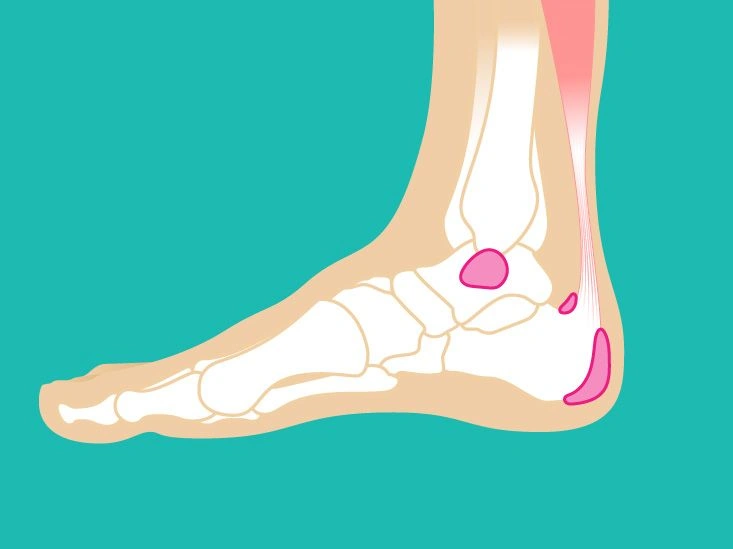
Ankle bursitis occurs when a bursa — a tiny fluid-filled sac in the ankle — becomes irritated. This can lead to swelling, discomfort, and limping. Initial care often includes ice, rest, and pain medications.
Your ankle is built from the junction of four bones. The ankle bone itself is known as the talus.
Picture a sneaker: the talus would sit near the upper part of the tongue area.
The talus nests with three other bones: the tibia, fibula, and calcaneus. The two lower-leg bones (tibia and fibula) form sockets that cradle the top of the talus. The lower portion of the talus rests on the heel bone (calcaneus).
Ankle bursa
A bursa is a small sac filled with fluid that cushions and reduces friction between moving bones and soft tissues.
One bursa lies at the back of the foot, between the heel bone (calcaneus) and the Achilles tendon. This bursa helps cushion and lubricate the ankle area and is called the retrocalcaneal bursa.
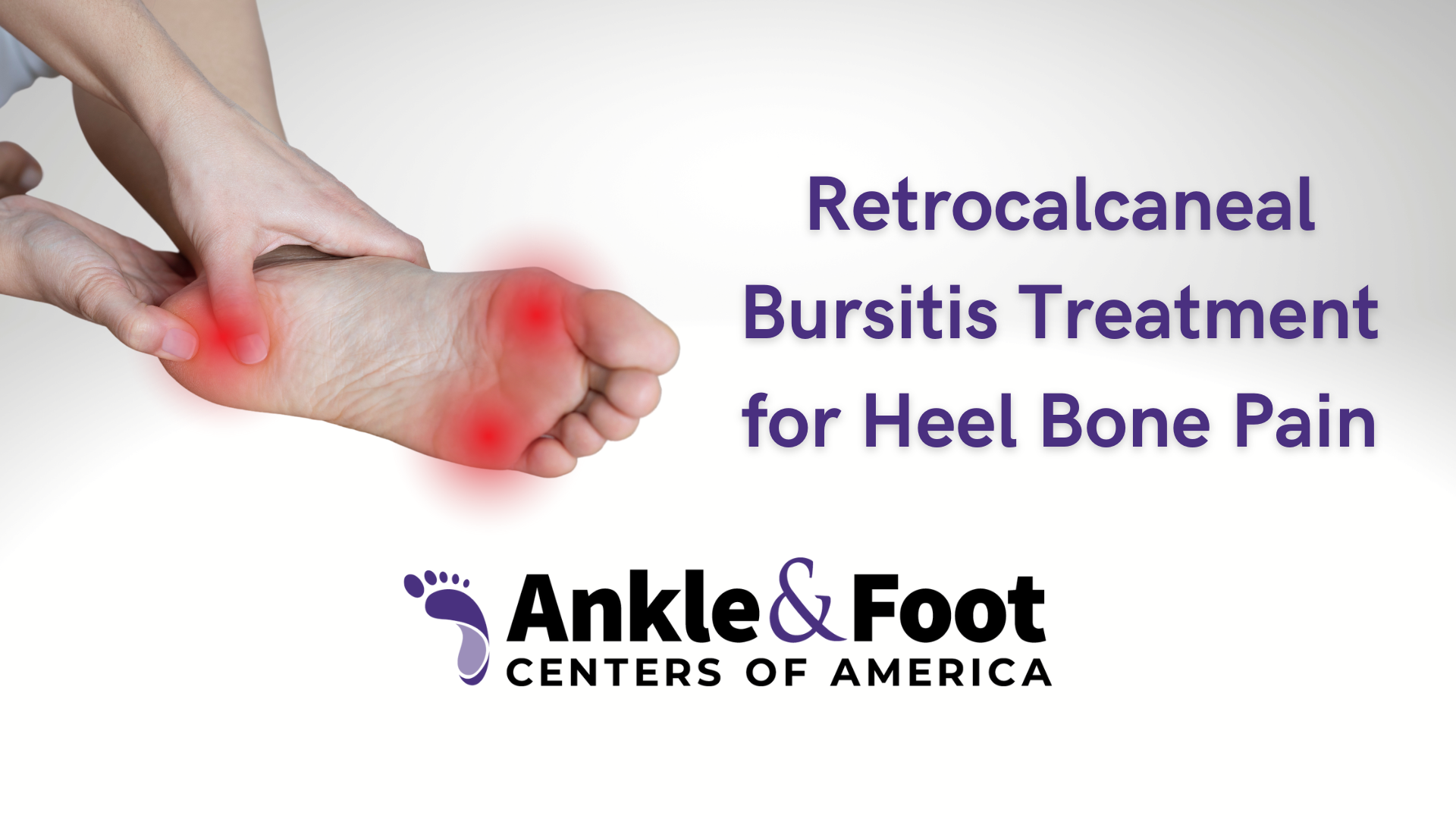
When the retrocalcaneal bursa is inflamed, the condition is referred to as retrocalcaneal bursitis or anterior Achilles tendon bursitis.
Causes of bursitis in the ankle
Ankle bursitis develops when bursae become inflamed. This inflammation can result from repetitive movement stresses, a traumatic impact, or pressure from poorly fitting footwear.
Common triggers for inflamed bursae include:
- overuse or strain on the ankle from repetitive activities like walking, jumping, or running
- running uphill without adequate stretching or preparation
- ill-fitting shoes
- previous trauma to the area
- ankle arthritis
- gout
- infection (septic bursitis)
- rheumatoid arthritis
- enlargement of the heel bone, known as Haglund’s deformity
- a direct blow to the region
Other bursae
Stress around the ankle can sometimes lead to development of additional bursae beneath the skin near other parts of the ankle joint. These new bursae can also become inflamed, producing ankle bursitis.
Names and typical sites for these other bursae include:
- Subcutaneous calcaneal bursa. This bursa forms at the back of the heel, beneath the retrocalcaneal bursa. Inflammation here is common in young women who wear high heels. It’s also known as posterior Achilles tendon bursitis.
- Subcutaneous bursa of the medial malleolus. This bursa develops at the bump on the inner ankle where the shinbone (tibia) ends.
Symptoms of ankle bursitis
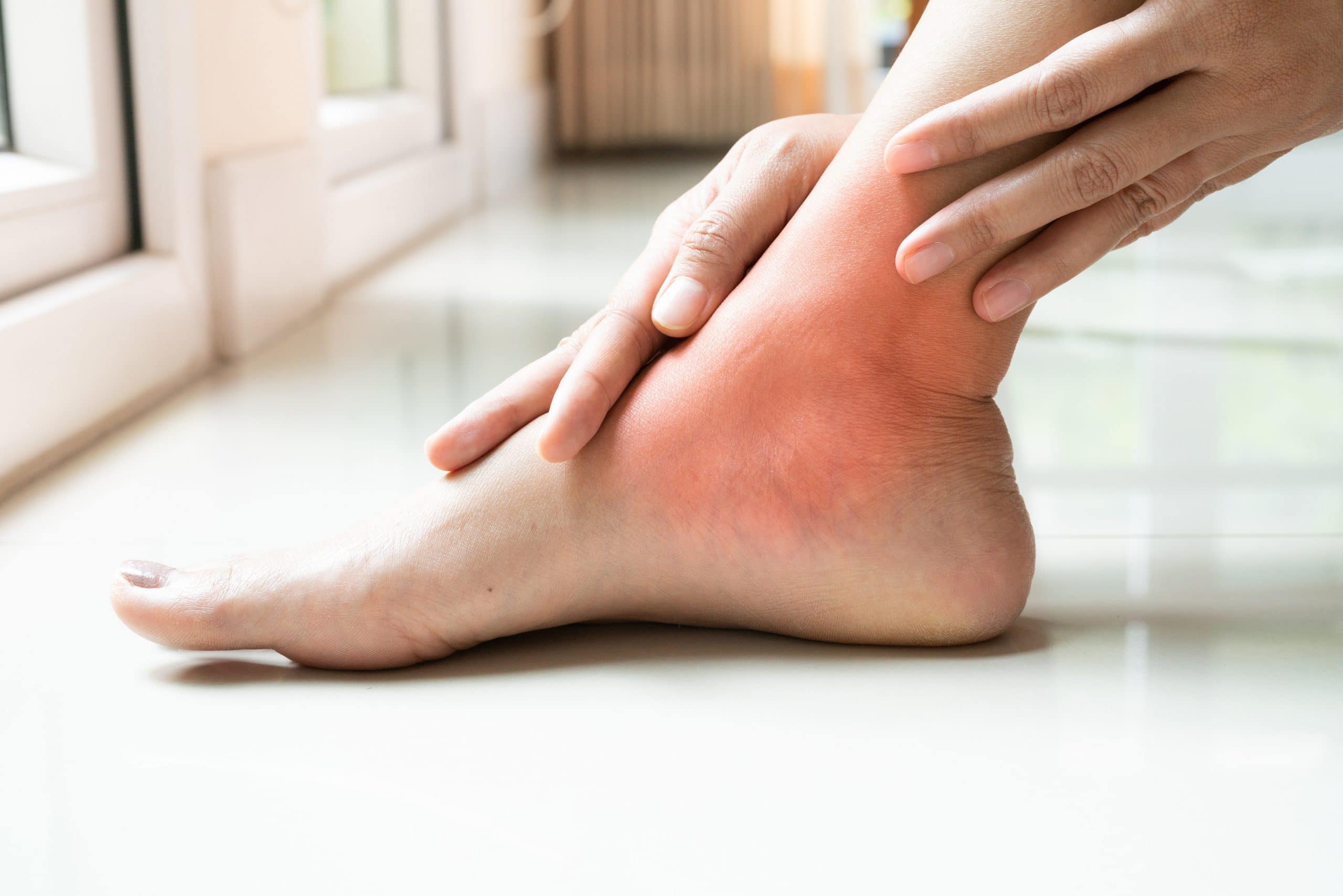
Signs may appear gradually. Pain around the heel is typical. Other symptoms to watch for include:
- soft-tissue swelling at the top of the heel bone
- tenderness when pressure is applied to the back of the heel or when flexing the foot
- pain when standing on tiptoes or when leaning back on the heels
- limping to avoid placing full weight on the affected ankle
- redness (with posterior Achilles tendon bursitis)
- fever or chills, which could indicate an infection
How is ankle bursitis diagnosed?
Diagnosis is usually based on a physical exam. Your clinician will inspect the ankle for visible swelling and assess sensitivity with movement.
An X-ray may be ordered to rule out a fracture or dislocation; bursae themselves do not appear on X-rays.
An MRI can be used to visualize bursal swelling.
If infection is suspected, a clinician may aspirate fluid from the bursa using a syringe. This is done under local anesthetic and may be guided by CT, X-ray, or ultrasound imaging.
Ankle bursitis and Achilles tendinopathy can present similarly and can coexist. Seeing a healthcare provider helps determine the precise cause of your symptoms.
Treating ankle bursitis
Treatment typically starts with conservative approaches:
- Apply ice and rest the ankle for the first several days after symptoms begin to lower inflammation.
- Use NSAIDs such as ibuprofen (Advil, Motrin) or naproxen (Aleve, Naprosyn), or take prescribed pain medications.
- Wear roomy, comfortable shoes.
- Consider orthotic inserts to reduce friction at irritated sites.
Read about making and using a cold compress.
Your provider may recommend physical therapy to relieve pain initially and to support recovery later.
If symptoms don’t improve, your doctor might suggest an injection of corticosteroid into the bursa to reduce inflammation. This is usually performed with a local anesthetic.
Some clinicians improve injection precision by using ultrasound to guide needle placement.
If tests confirm an infection (septic bursitis), antibiotics will be prescribed.
Preventing ankle bursitis
Key measures to prevent ankle bursitis include:
- Always warm up and stretch before exercise, sports, or strenuous activity.
- Wear appropriate footwear that provides support and isn’t overly tight or loose.
- Avoid sudden, jerky movements and abrupt increases in weight or intensity during workouts.
These precautions are especially important when increasing activity or time spent on your feet, and if you participate in high-impact sports like basketball, soccer, tennis, or running. They also apply to leg strength training.
The takeaway
If you develop ankle bursitis, address it promptly. Don’t ignore the pain — it’s a signal something is wrong. Early treatment will get you back on your feet and returning to activities sooner. Conservative care such as rest and anti-inflammatory measures is most effective when started early.












Leave a Reply
You must be logged in to post a comment.