
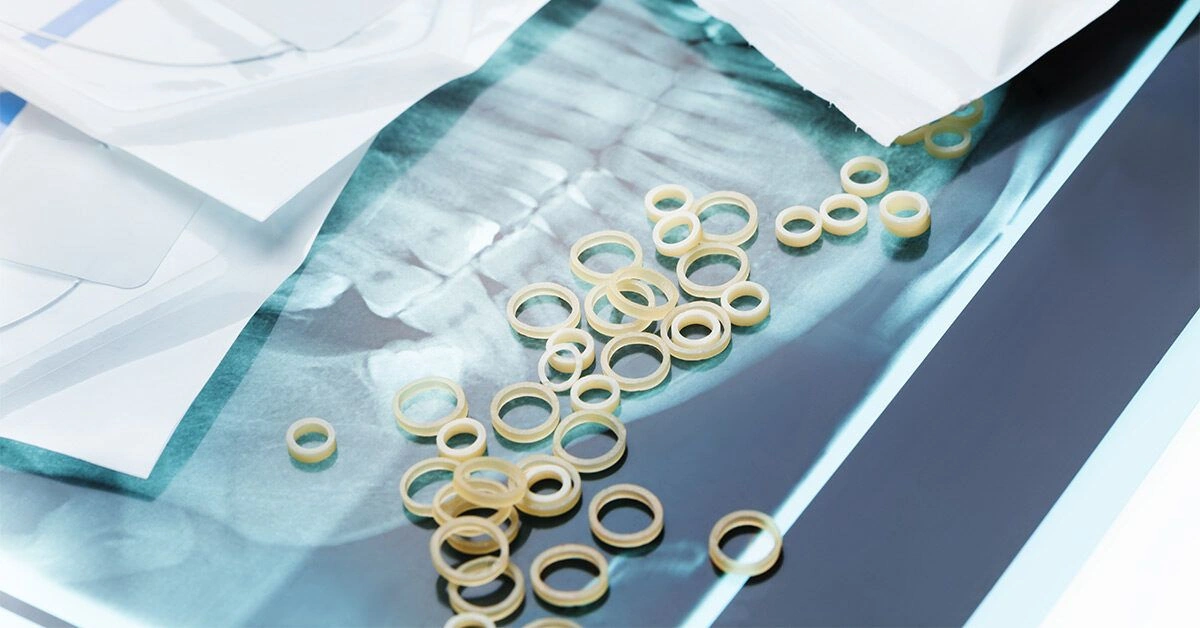
Traditional metal braces move and align your teeth using brackets and a metal archwire. Often, rubber bands are hooked to certain brackets to provide extra force on targeted areas of your mouth.
Invisalign offers a subtler option compared with conventional braces. It relies on clear plastic aligner trays that fit snugly over your teeth to gradually reshape your bite. You’ll typically swap each aligner for a new one about every week or every other week.
In some situations, an orthodontist may advise wearing rubber bands in conjunction with Invisalign. These elastics function similarly to those used with metal braces, adding directed force to particular regions of your mouth.
Continue reading to learn when your orthodontist might recommend wearing elastics with Invisalign and which bite issues they can help correct.
Purpose of Invisalign elastics
The following appliances shift your teeth but don’t change how your upper and lower jaws meet:
- Invisalign
- other clear aligners
- traditional braces
Conversely, rubber band elastics exert force in specific directions to correct bite problems such as overbite or underbite. The elastics are arranged in distinct patterns tailored to the particular bite issue being addressed.
Invisalign rubber bands for overbite
One of the most frequently treated bite problems with Invisalign is “class II malocclusion,” commonly called an overbite or overjet.
An overbite exists when the last molars of the lower jaw sit farther back than the last molars of the upper jaw, causing the upper jaw to appear more forward.
A 2017 study reported that Invisalign effectively improved overbites in a sample of 120 adults with an average age of 33.
To address an overbite, Invisalign elastics are often attached from the upper canines down to the lower molars. Canines are the pointed teeth located to the left and right of the front teeth.

Invisalign rubber bands for underbite
An underbite occurs when the first lower molar is positioned forward relative to the first upper molar.
A 2016 case report demonstrated successful treatment of a mild overbite with Invisalign.
To correct an underbite, elastics can be placed from the upper back molar to the lower canines.
Invisalign rubber bands for anterior open bites
An anterior open bite is when the front upper and lower teeth tilt outward and do not meet when the mouth is closed. Treating this with Invisalign may involve elastics that connect the upper and lower front teeth.
A small 2017 review suggested Invisalign might be effective for managing mild open bites in adults.
Invisalign rubber bands for preserving bite
After achieving an optimal bite, vertical elastics may be used to help maintain tooth positions. These rubber bands attach to corresponding teeth in the upper and lower arches to stabilize the result.
Does everyone with Invisalign need elastic bands?
Not all Invisalign patients require elastics. If you’re treating a relatively minor issue, such as slight crowding or small gaps, elastics may be unnecessary.
Elastics are more commonly recommended when there are discrepancies between the alignment of your upper and lower teeth, like overbites or underbites.
How visible are the bands and buttons?
Many people choose Invisalign because it’s less conspicuous than conventional braces. Adding elastics and attachment “buttons” can make the system more noticeable, though visibility varies depending on where they’re placed.
Buttons are small bonding pads attached to teeth to anchor elastic bands, according to “PORTH Personalized Orthodontics.” They’re generally tooth-colored and not highly conspicuous, especially if located toward the back of the mouth.
Elastic bands tend to be more visible than buttons. If elastics are required near the front teeth, they’ll be easier to see than elastics placed toward the rear. Clear elastics are less noticeable than colored ones.
If you’re worried about how visible your Invisalign will be, discuss your concerns with your orthodontist before treatment to set expectations.
How to put on your Invisalign rubber bands
Putting on elastics correctly can be awkward at first, but it becomes simpler with practice.
Your orthodontist will give you precise directions, but here are two common methods for applying rubber bands.
Method 1
- Remove your Invisalign trays and align the top and bottom trays in your hand.
- Locate the hooks on each aligner where the elastics belong and attach the elastics to those hooks.
- Hold the aligners together like a sandwich and insert them into your mouth while keeping tension on the elastics.
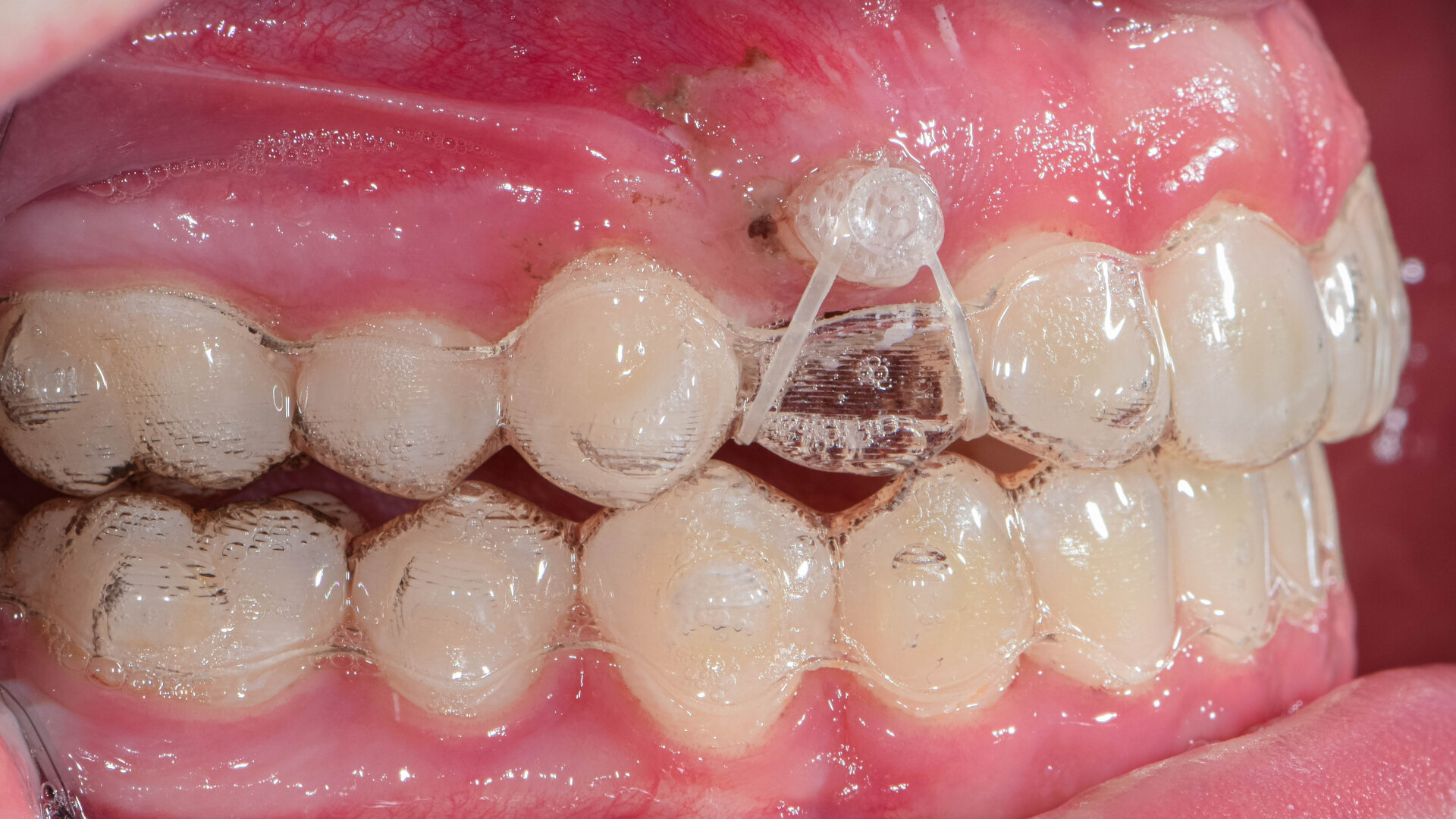
Method 2
If you’re using bonded attachment buttons to secure your elastics, you may prefer this technique.
- Take the bottom aligner out of your mouth.
- Hook the elastics onto the designated hooks. Use your fingers to maintain tension while you reseat the aligner.
- Grab an elastic and stretch it toward the button on the upper tooth. Snap it into position, then repeat on the other side.
What to do if a hook or button falls off
Hooks or buttons may detach while eating or brushing, or if the bonding material is compromised.
If a button comes off, don’t attempt to reattach it yourself. Keep the button in a safe place and contact your orthodontist promptly. The sooner you see them, the less likely treatment progress will be delayed.
How to care for your mouth while wearing aligners with hooks and rubber bands
Elastics lose their stretch over time, so replacing them regularly is important. Your orthodontist may advise changing them two to four times daily.
If you’re away from home and don’t have fresh elastics, it’s better to reuse your current ones than to go without.
Although you’ll switch Invisalign trays periodically, it’s still essential to keep them clean. Below are recommended care tips for your aligners and oral health.
- Rinse your aligners with water each night.
- Use a soft toothbrush and mild liquid soap to remove trapped food particles from your trays.
- Keep aligners in their protective case when not in use.
- Avoid harsh cleaning agents on your trays, such as denture cleaners, mouthwash, scented soaps, or toothpaste.
- Remove aligners and elastics while eating.
- Limit beverages to water when trays are worn.
- Never clean your trays with hot water.
- Maintain regular brushing and flossing, taking care around any bonded attachments. A soft toothbrush can help prevent accidental damage.
Takeaway
Your orthodontist may prescribe rubber bands to use alongside Invisalign. Similar to conventional braces, these elastics help coordinate the upper and lower teeth and can treat bite problems such as overbite or underbite.
Adhering to your orthodontist’s instructions for wearing elastics is crucial. Failing to follow their guidance could reduce the effectiveness of treatment or prolong the time needed to reach your desired outcome.



















Leave a Reply
You must be logged in to post a comment.