
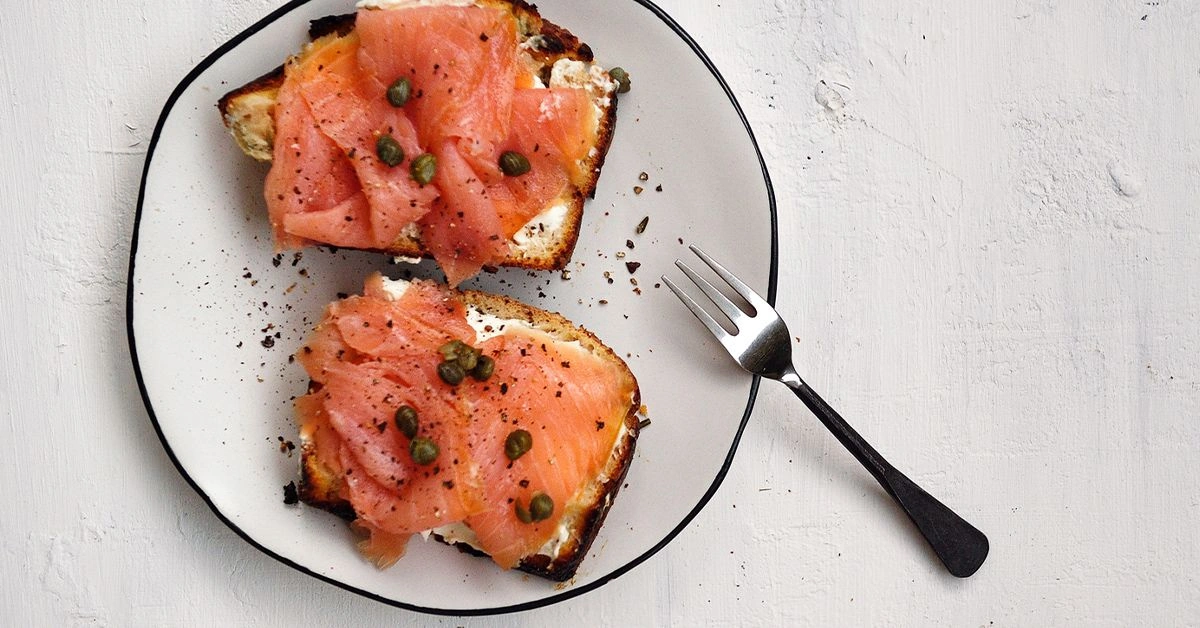
Smoked salmon, admired for its briny, wood-fired taste, is often seen as a gourmet item due to its relatively high price.
Many people confuse it with lox, which is also cured but not exposed to smoke.
Like lox, smoked salmon is frequently served on a bagel or crackers with toppings such as cream cheese, cucumber, or tomato.
This piece covers everything you should know about smoked salmon, including its nutrient profile, curing and smoking techniques, and associated health advantages and concerns.
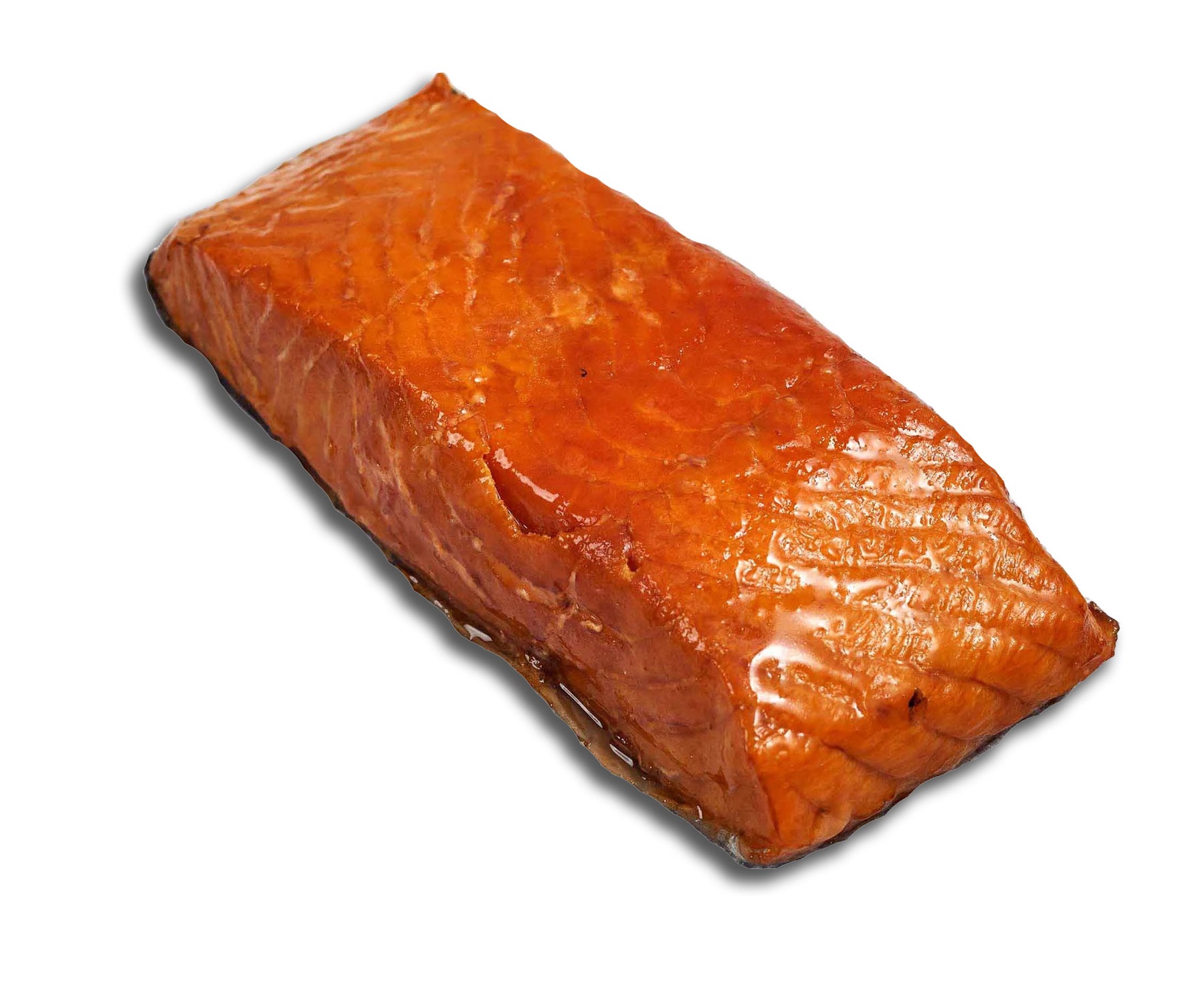
Nutrition facts
Smoked salmon is fairly low in calories while providing excellent-quality protein, essential fats, and a variety of vitamins and minerals.
A 3.5-ounce (100-gram) portion of smoked salmon contains (1):
- Calories: 117
- Protein: 18 grams
- Fat: 4 grams
- Sodium: 600–1,200 mg
- Phosphorus: 13% of the Daily Value (DV)
- Copper: 26% of the DV
- Selenium: 59% of the DV
- Riboflavin: 9% of the DV
- Niacin: 30% of the DV
- Vitamin B6: 16% of the DV
- Vitamin B12: 136% of the DV
- VitaminE: 9% of the DV
- VitaminD: 86% of the DV
- Choline: 16% of the DV
Additionally, smoked salmon is an abundant supply of omega-3 fatty acids, providing about 0.5 grams of combined eicosapentaenoic acid (EPA) and docosahexaenoic acid (DHA) per 3.5-ounce (100-gram) serving (1).
These fats are essential because the body cannot synthesize them, so they must be obtained through diet.
EPA and DHA support brain performance, cardiovascular health, and healthy aging (2, 3, 4, 5).
Salt content
Because of how it’s processed, smoked salmon contains a high amount of sodium, typically 600–1,200 mg per 3.5-ounce (100-gram) portion (1, 6).
By contrast, the same portion of fresh salmon supplies about 75 mg of sodium (7).
The Institute of Medicine (IOM) and U.S. Department of Agriculture (USDA) advise capping sodium intake at 2,300 mg per day to lower the risk of heart disease and stroke (8, 9).
The World Health Organization (WHO) and American Heart Association (AHA) recommend even lower amounts — 2,000 and 1,500 mg per day, respectively (10, 11).
Therefore, you may want to track your smoked salmon intake, particularly if you’re salt-sensitive.
Summary: Smoked salmon supplies high-quality protein, many vitamins, and omega-3 fats. However, it contains substantially more sodium than fresh salmon.
How smoked salmon is made
Smoking is a technique used to flavor, cook, or preserve food by exposing it to smoke. It’s commonly applied to meats, poultry, and fish.
The smoking process
To prepare smoked salmon, thawed, boneless fillets are coated with salt — and sometimes sugar — and left for 12–24 hours to draw out moisture in a process called curing.
The longer the curing period, the saltier the final product.
By removing moisture, the salt boosts flavor and serves as a preservative to inhibit bacterial growth that could lead to foodborne illness.
The fillets are then rinsed to remove extra salt and moved to a smoking chamber to dry. Drying helps form a pellicle, a protein layer that enables smoke to cling to the fish’s surface.
The smoker attached to the chamber burns wood chips or sawdust — often from oak, maple, or hickory — to create the smoke.
Cold- vs. hot-smoked salmon
Salmon may be cold- or hot-smoked. The primary distinction is the temperature inside the smoking chamber.
For cold-smoked salmon, temperatures range from 50–90°F (10–32°C) for 20–24 hours. This range doesn’t cook the fish, so careful curing and handling are required to minimize the risk of foodborne pathogens (12).
By contrast, hot smoking requires the chamber to be warm enough to reach an internal fish temperature of at least 145°F (63°C) for a minimum of 30 minutes to ensure the salmon is fully cooked (12).
Most commercial smoked salmon is cold-smoked. Hot-smoked products are usually labelled as fully cooked on packaging (13, 14).
Cold-smoked salmon typically has a smoother, milder texture, while hot-smoked salmon is flakier with a more pronounced smoky flavor.
Food safety experts generally discourage cold-smoking at home because of the hazards involved. Hot smoking, however, can be safely done at home with appropriate equipment and methods (15).
Selection and storage
Some smoked salmon varieties require refrigeration, while others remain shelf-stable until opened. Check the label for storage instructions.
After opening, smoked salmon can be kept in the fridge for up to 2 weeks or frozen for about 3 months (16).
Avoid packages with many dark spots. These pieces tend to have an off taste and ideally should have been trimmed off, though sometimes they’re left on to increase package weight and cost.
Summary: Smoked salmon is produced by curing fillets with salt and then exposing them to smoke in a kiln. Most commercially available smoked salmon is cold-smoked, meaning it’s smoked at temperatures that don’t reliably kill all harmful bacteria.
Health benefits and risks
Smoked salmon offers several health advantages, but there are also important cautions to consider.
Benefits of smoked salmon
The omega-3 fats EPA and DHA found in fatty fish like salmon are associated with lowered risk of heart disease, some cancers, and age-related cognitive decline (17, 18, 19, 20).
These fatty acids may exert benefits by lowering triglycerides, reducing inflammation, and helping preserve brain structure and function.
However, other nutrients in fatty fish may also contribute, since several trials of isolated omega-3 supplements haven’t consistently replicated the same benefits (21, 22, 23).
The USDA recommends adults consume at least 8 ounces (227 grams) of seafood weekly to obtain roughly 250 mg of combined EPA and DHA (8).
Smoked salmon is also rich in multiple vitamins and minerals important for health. A 3.5-ounce (100-gram) portion supplies an impressive 136% of your daily vitamin B12 needs and 86% of the DV for vitamin D (1).
That same portion provides over half of your daily selenium requirement, a mineral with antioxidant properties that may help protect against certain conditions (1).
Risks of smoked salmon
A single 3.5-ounce (100-gram) serving of smoked salmon can account for more than half the USDA’s recommended daily limit for sodium (9).
If you’re monitoring salt intake, you may prefer to limit smoked salmon or choose fresh salmon instead.
Observational research links smoked and processed meats to a higher likelihood of some cancers, particularly colorectal cancer (24).
Cold-smoked salmon can also increase the risk of listeriosis, an infection caused by the bacterium Listeria monocytogenes (25, 26, 27).
Listeria is easily eliminated by adequate heat but can proliferate at temperatures between 34–113°F (1–45°C), the same range used for cold-smoking.
Those at greater risk — including older adults, people with compromised immune systems, and pregnant women and newborns — should avoid cold-smoked salmon, although canned and shelf-stable options are generally safe (28, 29).
Summary: Smoked salmon supplies heart-supporting omega-3s and many nutrients, but it’s notably high in sodium. Cold-smoked versions can raise the risk of listeriosis.
Ways to eat smoked salmon
Here are several delicious ways to serve smoked salmon:
- on a bagel with cream cheese
- topped on a fresh salad
- on toast alongside scrambled eggs
- added to a baked gratin
- in a potato-leek soup
- tossed into a pasta
- folded into a dip for crackers
- arranged on a platter with raw vegetables
Additionally, you can prepare hot-smoked salmon at home if you have a smoker.
Begin by curing fillets in salt for at least 4 hours. Pat them dry, then smoke at 225°F (107°C) until the internal temperature reaches 145°F (63°C). Use a meat thermometer to confirm doneness.
For those curious about related options and calorie counts, you might also check out sushi calories to compare.
Summary: Smoked salmon is versatile — commonly enjoyed in dips, bagels, salads, and pasta dishes.
The bottom line
Smoked salmon is a savory, cured fish known for its rich texture and distinctive smoky flavor. It’s loaded with high-quality protein, essential omega-3 fats, and multiple vitamins and minerals.
Nevertheless, it carries a substantial sodium load, and cold-smoked forms may pose a listeria risk.
When consumed in moderation and with awareness of these concerns, smoked salmon can be a nutritious addition to your diet.






















Leave a Reply
You must be logged in to post a comment.